Aug 13, 2026
Grok Bot first impressions
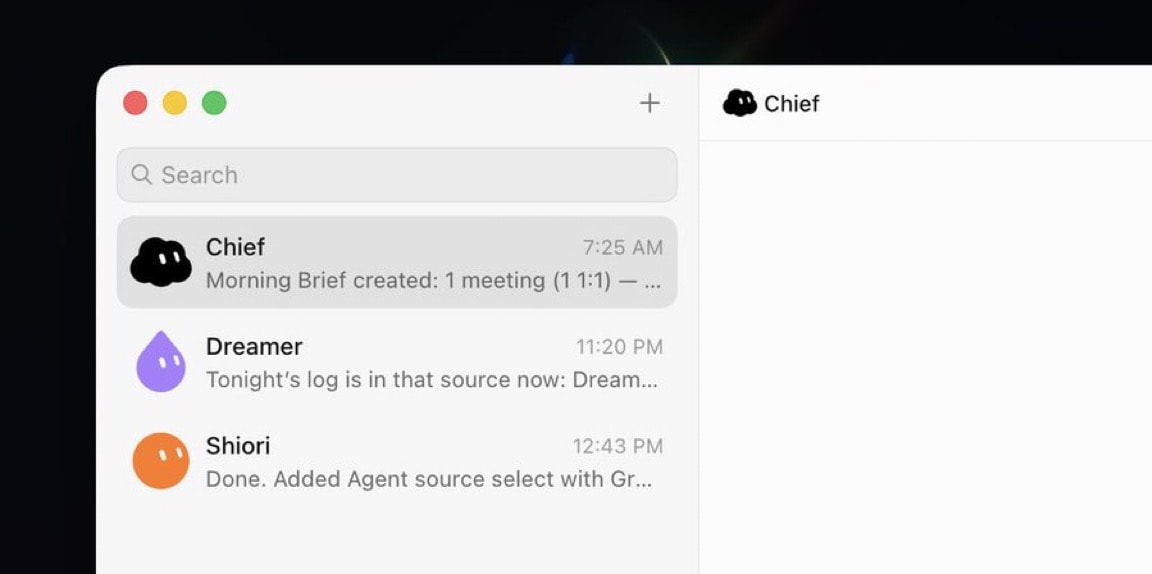
- With Grok Bot you don't juggle threads, you juggle named/personified agents. This seems like a ~fine mental model: hire a team of specialists that can talk among themselves to get work done.
- But this creates some problems when you want to multitask within a single agent. If you give an agent a chunky task that takes a long time, you don't really want to interrupt it or distract it mid-task. I haven't found a way to queue messages. In a thread-first world, you'd just spin up another thread.
- (Technically there's a "create thread" button on each message bubble, but it feels intentionally buried and not recommended.)
- I'm biased towards using threads to create "context bubbles" for discrete tasks and prevent context contamination. But every Grok Bot agent uses a single long-running thread, and it's not obvious where discrete tasks get chunked or compacted. If I'm working with sensitive data, this forces me to create copies of the same agent so I can force context bubbles around sensitive tasks.
- I'm not sure if most people will prefer a single omni-agent that juggles threads and projects (Jarvis-style), or if people actually want to build and manage multiple discrete agents that coordinate with each other. Tradeoffs in both directions, and maybe you end up needing both models for different audiences.
- The agents themselves are capable and surprisingly dynamic. They are good at responding quickly, keeping you updated iMessage-style as they make progress on long tasks, and configuring themselves on the fly (or even reacting appropriately if you adjust their configuration manually).
- One of the surprising details that Grok Bot hides is all the thinking steps/tool calls. Almost every other AI agent exposes these, including ours at Notion. When we designed Notion Agent last year, we tried to remove these steps for the sake of simplicity, but our customers demanded we add them back both because they serve as a useful loading indicator (it's entertaining to watch computers magically do work!), and because they can be used to spot the model going off track so you can jump in and pause/steer. But I suspect model progress (speed + quality) in the last year is making both of those points less relevant, so maybe it's okay to hide more of the underlying noise from the transcript. Grok Bot agents are still good about sending mid-task progress update messages (I think this is all Grok 4.6?)
- The idea of starting a new chat with multiple agents (aka a channel? project? workspace?) is pretty nice, but agents are still a bit dumb and they go in loops talking to each other before finally shutting up. Maybe there are some prompt-fu opportunities to make them chill out.
- It's been a great experience delegating agents to work simultaneously across the cloud computer, my local machine, and Cursor cloud coding sessions. The system works really well, and I've been able to throw fun tasks at the agents without any major problems.
- Consolidating skills, MCPs, connectors, and more complex tools behind a single "Plugins" concept feels right. It looks like everyone on the frontier is coming to the same conclusion.
- No model picker feels weird, but only because I'm used to fiddling with models/effort levels per task in all my other coding tools. Presumably Grok Bot agents are doing some routing under the hood? Making this + thinking tokens + tool calls opaque means you really have to have a "model take the wheel" mindset when using this app. Again, probably long-term right, but short-term feels uncomfortable (giving up control).
- The UI is nice. Mobile app is nice. Cursor mobile app is nice for code sessions. It just all feels...nice. Kudos to the design team for nailing the visual polish and small details. The motion design for the agent avatars is s-tier.
- Yet this shape of tool is becoming so common across so many companies (and open source!) that I don't really know how people are going to justify one $200/mo subscription vs. another. I suspect in the short term it'll come down to vibes/tribal affiliation/token subsidization, at least until there is some bigger differentiator at the capability level.
- As an experiment, I told my Grok Bot agents to switch to using a Notion database for the memory layer. They had no objections and I've watched them create ~20-30 pages in my Memory database. This feels really noisy, and I'm not sure what the impact on quality will be, but it's cool that the agents had no problem adapting to work the way I want. Whether they're actually using the database correctly under the hood, I can't tell...the whole system is quite opaque.
- Grok Bot is an odd name for an app that wants you to coordinate work across lots of bots.
- My hunch is most people don't actually have that much stuff they need to automate in their daily life. I'd love to see retention graphs!