Get the top HN stories in your inbox every day.
bhouston
I'm not a gold bug but Alan was a proponent of the gold standard. He wrote about how the gold standard created responsible spending and more equality in the world:
https://ritholtz.com/2008/11/gold-and-economic-freedom-by-al...
The world we are in now, especially in the US, is one where there is near unlimited government credit but it is, according to many, papering over deep structural problems. At some point, these chickens will come home to roost in some way or another. But it is hard to predict when.
So he was in favour of the gold standard because it prevented massive unconstrained expansion of credit and that seems sensible.
throw0101d
> He wrote about how the gold standard created responsible spending and more equality in the world:
The Gilded Age, which had quite high levels of inequality, occurred when the gold standard was active:
* https://en.wikipedia.org/wiki/Gilded_Age
It should also be noted that the gold standard did not bring any kind of price stability:
* https://archive.is/https://www.theatlantic.com/business/arch...
Further, sticking to the gold standard made the Great Depression worse as it reduced flexibility and options of central banks had, and made deflation worse:
* https://www.nber.org/papers/w3488
The sooner countries left the gold standard the sooner they started recovering from the Great Depression:
BigTTYGothGF
> The Gilded Age, which had quite high levels of inequality, occurred when the gold standard was active
I've got some news for you about modern levels of inequality.
throw0101d
I am aware of today's inequality (e.g., I read Piketty back when he was making a splash). But the critique is that Greenspan argued gold standard = less inequality and that fails on the historical record.
If we want to talk about the causes of the 'New Gilded Age' that's something else. As a general starting point I'd begin with:
* https://en.wikipedia.org/wiki/Friedman_doctrine
curiousllama
Yea, that's his point. The gold standard neither prevents nor encourages inequality, except inasmuch as it limits policy flexibility (which, similarly, could be used to promote or limit inequality).
jimbokun
Don’t those two data points suggest inequality is orthogonal to the gold standard?
laughing_man
A lot of monopolistic business practices that are illegal today were accepted practice in the Gilded Age, and that has to explain at least some of the inequality.
I feel like the existence of endless almost-free credit rewards gamblers, and when they win, they win big.
thegrim33
The gold standard was used from before the US existed as a country to after the entire country and all cities had been built, and it was driving buggies around on the moon. Seemed to function pretty decently.
wonnage
There is an idea floating around that trade imbalances create global inequality (Trade Wars are Class Wars by Klein & Pettis) and the original sin was adopting the dollar as the reserve currency instead of something like Bancor (https://en.wikipedia.org/wiki/Bancor)
twothreeone
Interesting, thanks for the pointer! Though, since we're dealing in hypotheticals already: wouldn't the expectation be that whoever gained the upper hand on the world stage would've aimed for de-facto control over whichever currency system was in place anyways?
paulddraper
> The Gilded Age
Which saw 40% increase in median real wages over 30 years. [1]
> It should also be noted that the gold standard did not bring any kind of price stability:
Prices are *475%* what they were 50 years ago, far exceeding price changes under the gold standard.
> Further, sticking to the gold standard made the Great Depression worse as it reduced flexibility and options of central banks had, and made deflation worse:
It did make deflation worse. Deflation = Bad is an assumed tenant of modern economics.
> The sooner countries left the gold standard the sooner they started recovering from the Great Depression:
By a certain definition. The US did not really leave the gold standard until 1971 (which coincidentally, is when inflation really started to take off).
throw0101d
> Which saw 40% increase in median real wages over 30 years. [1]
Which occurred in spite of the Gold Standard, rather than because of it:
* https://econbrowser.com/archives/2012/09/the_gold_standa_1
There were major periods of instability during that period. Growth that is unlikely to be repeated:
* https://en.wikipedia.org/wiki/The_Rise_and_Fall_of_American_...
> Prices are 475%* what they were 50 years ago, far exceeding price changes under the gold standard.*
And wages would have been worse under a Gold Standard:
* https://econbrowser.com/archives/2012/09/return_to_the_g
> It did make deflation worse. Deflation = Bad is an assumed tenant of modern economics.
It is not an assumed tenant, it is (or was for many millions) a lived experience.
Let us say a farmer had taken out a mortgage in 1928, and let us say his mortgage payment was US$20 (equivalent of 1 oz. of gold). In May 1929 he would have had to have sold 114 pounds of cotton to earn $20 (or 18 bushels of wheat, 23 of corn, 44 of oats). By May 1932 he would have had to sold 369 pounds of cotton (or 38 bushels of wheat, …):
* https://www.sciencedirect.com/science/article/abs/pii/030439...
* https://econbrowser.com/archives/2012/02/why_not_abolish
And it would have been the same for selling any good or service: to pay whatever debts you had (mortgage, car/business/student loans) you would have to work more to earn the same amount of money. Is that good?
up2isomorphism
It depends on how inequalities is defined. But from the wealth distribution point of view, today’s wealth distribution skews much more towards the top. Although the lowest living standards improve thanks to the technology advancement.
OnlyANeurosci
Ah the classic "you have a fridge, king louie didn't have a fridge therefore in the scope of ALL of human existence you are obscenely wealthy" trope.
https://www.mediamatters.org/fox-nation/fox-cites-ownership-...
Noaidi
The separation of wealth during the Gilded age was caused by the same thing it is caused by today: rapid industrialization. This rapid industrialization began when the US was off the gold standard during the civil war. The 1920's gilded age was fueled by fiat money, the greenback.
The great depression was triggered in part by imbalanced gold flows when we returned to gold back currencies.
https://explaininghistory.org/2025/06/12/golden-fetters-the-...
We are essentially replaying the greenback inflation of the 1860's and have been doing it since 1971.
rawgabbit
From your linked article.
” The Wall Street Crash of October 1929 precipitated a U.S. recession, but it was the gold standard that converted this into a worldwide depression. With currencies locked to gold, there was little scope to ease monetary conditions. When the U.S. economy slumped, its import demand plummeted and it exported deflation to the rest of the world. Gold-standard countries could not respond by cutting interest rates or letting their currencies depreciate to stimulate exports – their priority was to defend the peg. As a result, economic downturns spread rapidly.”
throw0101d
> The 1920's gilded age was fueled by fiat money, the greenback.
So-called fiat money didn't become a thing until after FDR became president, which was after 1932.
throw0101d
> The separation of wealth during the Gilded age was caused by the same thing it is caused by today: rapid industrialization.
What "rapid industrialization" is happening today?
palmotea
> The 1920's gilded age was fueled by fiat money, the greenback.
Cite? I'm pretty sure that the 1920s, $20 was literally a gold coin of a certain size.
undefined
b40d-48b2-979e
He also oversaw the economy for twenty years before one of the worst recessions in the world. He helped set the stage for multiple disasters with his policies, so I'd take his opinions with a grain of salt.
jimbokun
By the same standard shouldn’t he also get credit for those 20 years of prosperity?
OnlyANeurosci
"He burned the house down, but for a while we were VERY warm and it was good."
You don't credit an arsonist with "keeping a homeless person warm" when they set a homeless person on fire...
chollida1
Really?
I don't think anyone really holds him responsible for the dotnet crash of 2000 as that was a market issue and irrational exuberance issue and not a monetary one.
And 2008 was similar. The Fed doesn't control or have any responsibility for lower lender standards or ARM mortgages.
Congress was responsible for the GSE's that bought any mortgages and wrote insurance on those mortgages, so you can't blame the FED for that.
Wallstreet are their regulators were responsible for the securitization of mortgages that went bad in 2008, not the FED.
At worst you can say they had the wrong monetary policy but that's an opinion and not something that can be said as a fact.
Can you flesh out how you feel Greenspan is responsible for 2008?
hylaride
He actively campaigned against any regulation of derivatives. There is an infamous lunch that he had with Brooksley Born (who was head of the Commodity Futures Trading Commission) in the late 1990s where she attempted to regulate them. The details of the meeting are fuzzy and none of the participants will go on the record to what was said, but the gist is that he said he would fight her tooth and nail. After massive lobbying from Greenspan, as well as Lawrence Summers, congress passed legislation prohibiting her agency from regulating derivatives. She resigned shortly after.
HeyBigE
You don't think Greenspan had a major hand in the dot com crash? "In late 1999, the Federal Reserve under Greenspan flooded the financial system with unprecedented liquidity to ward off potential deflationary impacts and cash-hoarding caused by the Y2K bug panic. The Fed expanded the money supply at an annualized rate of 22% in the fourth quarter of 1999."
As for the Great Recession, taking the Fed Funds rate from 6.5% to 1.0% and holding it there for a year was the catalyst for driving everyone into the mortgage market looking for returns. And then did not regulate subprime lending or the shadow banking market:
"As the housing market boomed, subprime mortgage originations skyrocketed from 8.2% of all mortgages in 2003 to 23.5% in 2006. The Fed possessed the authority under the Home Ownership and Equity Protection Act (HOEPA) to crack down on predatory lending and loose underwriting standards but chose not to act aggressively."
"The Fed failed to properly monitor off-balance-sheet vehicles, investment bank leverage, and complex derivatives like mortgage-backed securities (MBS) and collateralized debt obligations (CDOs). Because these instruments developed outside traditional commercial banking oversight, a highly leveraged 'shadow banking' system grew completely unchecked under the Fed's watch."
So yeah, the Fed has its fingerprints all over the scene of the crime. Lots of blame to go around though..
sporadicism
> Can you flesh out how you feel Greenspan is responsible for 2008?
Greenspan felt Greenspan was responsible for 2008.
https://www.nytimes.com/2008/10/24/business/economy/24panel....
jcranmer
The chief criticism lies in the "Greenspan put"--the idea that the Fed would just never let asset prices fall, a policy which both bears his name and is noteworthy enough to have a detailed Wikipedia article on it.
CalRobert
There was a dot net crash too??
skywhopper
Greenspan actively advocated for more use of ARM mortgages for personal home buying, while in a position to have the best access to data and analysis on the growing risk of those mortgages. Whereas mere common sense and a knowledge of economic history would argue against widespread use of ARMs for individual home purchases. When the fed chair says “we need more ARMs” to a market using ARMs to prop up a growing bubble, that is as much or more responsibility as any other single person.
undefined
bhouston
It was generally 20 years of growth and the 2008 banking crisis actually happened after he left.
hylaride
Alan Greenspan acquired too much power and went out of his way to railroad regulators. It was a classic "absolute power corrupts absolutely" and his flooding the markets with dollar liquidity at every crisis completely destroyed any concepts of moral hazard, of which we are still living with the consequences to this day.
He set the stage for the financial crisis that started crumbling a year after he left the fed chair. It wasn't all his fault (politicians lost any spine and bankers any sense), but he was the conductor.
b40d-48b2-979e
And when production for a system I built burns down the month after I leave my job, the next guy they hire was actually the culprit! Greenspan was seen as responsible for the dot-com bust as well which was solidly in the center of his tenure.
brightball
39 trillion in debt with no Congressional stomach for...
- spending cuts
- stopping fraud
- figuring out how the net worth of people in Congress increases from hundreds of thousands of dollars to 10s or 100s of millions of dollars
- addressing wasteful and ineffective programs
Given those issues, the only solution will be inflation. The circling the drain moment will hit with the associated welfare programs get a direct staple to inflation itself, so we will spend more to combat inflation, causing more inflation faster.
It's not going to be fun.
bhouston
Also please add as an option: raise taxes on the wealthy individuals and corporations back.
https://inequality.org/article/11-charts-tax-wealthy-corpora...
This is really ambiguous:
"- stopping fraud"
And can mean many things. On the right, it often means Somali daycares, on the left it means the underfunding of the IRS so that it doesn't do audits of rich people.
I find this to be mostly a distraction:
"- figuring out how the net worth of people in Congress increases from hundreds of thousands of dollars to 10s or 100s of millions of dollars"
We should ban stock trading by members of the government, the Ro Khanna bill, but while it can be a source of corruption, it isn't a major source of inequality in the US.
This is unclear, can you be more specific as it has different answers based on one's partisan leanings:
"- addressing wasteful and ineffective programs"
I think a lot of the distortion of US policy towards the rich is a result of Citizens United and similar unrestrained lobbying funds.
roughly
“Raising taxes” is a misnomer - “restoring taxes to the level they were when we were deciding how to allocate tax revenue” is more accurate. There’s plenty of other causes of the deficit, but “Congress deciding not to take money from wealthy people and corporations to fund the services they’d promised to the rest of us” is the core. We don’t have a budget deficit, we have a tax revenue deficit.
enragedcacti
> - stopping fraud / - addressing wasteful and ineffective programs
Good to know that this will be an evergreen argument despite an extremely well-supported project to do just that taking place in the last two years with nothing to show for itself other than hundreds of thousands of deaths.
magicalist
>> stopping fraud / - addressing wasteful and ineffective programs
> Good to know that this will be an evergreen argument despite an extremely well-supported project to do just that taking place in the last two years with nothing to show for itself other than hundreds of thousands of deaths.
Not to mention the most prominent example of this this year sidestepped the Congressional stomach completely. An order of magnitude larger budget than all of the NSF grants combined spent on the war with Iran over 100 days.
Both wasteful and ineffective: it failed to achieve any of its goals and had a massive negative impact on the US economy that will continue for some time.
Does it count as fraud, though, or just gross negligence when experts had already warned that this would be the exact outcome ahead of time but were ignored?
anthonypasq
> despite an extremely well-supported project to do just that
a weird extremely small executive branch task force with pretty much zero power is not what i would call a well supported project in the context of the trying to reduce spending in the american government.
Congress controls the purse, doge had nothing to do with congress.
brightball
EDIT: I see several comments suggesting that there is nothing left to cut. I'm not sure how anyone squares that perspective with this federal budget growth chart.
The federal budget over time...
2026 - $7.5 trillion
2020 - $4.8 trillion
2015 - $3.9 trillion
2010 - $3.7 trillion
https://fred.stlouisfed.org/series/FGEXPND
We do not have a tax problem, we have a spending problem. There's no reason that the US federal government shouldn't be able to operate on a budget equivalent of about $4 trillion which was just about the average from 2010-2020. There seems to be quite a lot available to cut.
jltsiren
You should leave Social Security out of the calculations. It's supposed to be a self-funding program that has no impact on budget balance. That accounts for ~$0.5 trillion of the growth since 2020.
Another ~$0.5 trillion is from higher interest payments.
A large fraction of the budget consists of wages and actual spending. Inflation is 25–30% since 2020.
Then there is healthcare spending, which can be expected to grow faster than inflation, as the population is growing older.
The US is basically running into the same issues as European welfare states. While government spending remains qualitatively the same, demographic changes make it grow faster than tax revenue. Those who couldn't maintain a balanced budget in the past are finding the situation particularly difficult. In some sense, the situation is even worse in the US. Healthcare (old age spending) is particularly expensive, while individuals have greater responsibility for childhood expenses.
jimbokun
That’s different than saying there’s a lot of “waste” to cut as many argue.
The benefits agencies that make up the bulk of the spending have very low overhead and are run very efficiently. The vast majority of funds go directly to beneficiaries.
Balancing the budget will require massive cuts to very popular programs.
conductr
This ball is already in motion IMO. Inflation numbers aren’t even believable and It’s already not fun.
bhouston
> Inflation numbers aren’t even believable and It’s already not fun
For inflation to have an impact on the US debt, it has to be approaching the level at which the US debt is increasing. In the last year, the US debt increased by 7.6%, much higher than inflation.
rawgabbit
From what I observe from fraud and corruption witch-hunts, they are nothing more than that. The real fraud is that government that is supposed to serve the people who elected it serves everyone else first.
toomuchtodo
There is nothing left (edit: discretionary) to cut, and there is no material fraud. Taxes must go up. Only the top 40% of Americans have any income or wealth to tax (bottom 60% of Americans have no federal tax liability). Or, as you mention, we monetize the debt, print dollars, and burn up the currency value.
https://usafacts.org/government-spending/
https://usafacts.org/answers/how-much-debt-does-the-us-have/...
bhouston
> There is nothing left to cut
Hmm.... I found this, I wonder if there is any way this line item in the budget could be reduced, it looks sort of big:
https://www.usaspending.gov/agency/department-of-defense?fy=...
brightball
https://news.ycombinator.com/item?id=48633650
The average federal budget from 2010 to 2020 was $4 trillion. This year it is $7.5 trillion. There's quite a lot to cut.
derf_
> ...it prevented massive unconstrained expansion of credit and that seems sensible.
At the height of the Great Depression (1936), some economists proposed The Chicago Plan to separate the provision of credit from the money supply by eliminating fractional reserve banking, giving better control of the increases and contractions of credit, the elimination of bank runs, and a dramatic reduction in debt. There was a recent (2012) paper from the IMF [1] that seemed to find this actually is pretty sensible, although I do not claim to be smart enough to understand all of the implications.
[1] https://www.imf.org/en/publications/wp/issues/2016/12/31/the...
bko
I have come around to gold. Money shouldn't be dual purposes, we should apply single responsibility principal. Money should refer to some stable (albeit slightly growing by nature) account of measure.
Prices should get cheaper. That's a progress dividend. We get better at growing food every year, why shouldn't food get cheaper? Imagine a world in which prices regularly go down. You're a passive beneficiary of technological progress.
The argument that prices can't get cheaper or [bad thing will happen] was never very convincing to me. Prices already do get cheaper for large swaths of the economy that have technological progress grow faster than money supply. Cell phones are rapidly depreciating. You can wait 6m to a year and get a significant discount on the latest iPhone version. People don't stop buying iPhones, and Apple doesn't stop investing in iPhones. This is even more true w/ AI models. Investors/companies are burning billions to build tech that will only get cheaper and obsolete in years if not months.
So if you were to try to convince me that deflation would reduce investment or spending, tell me why this doesn't apply to tech products that get cheaper every year.
throw0101d
> Prices should get cheaper.
Does that include the price of labour? Are you okay with your salary going down? Because the historical record shows that's what happens during deflationary periods: producers of good/services see the price that they can sell things for goes down, and so they insist on their suppliers and inputs—including labour input—reduce their prices as well.
bko
Why would it go down? The person is becoming more productive? Do employees at Apple salaries go down because the iPhone they're working on is worth less every year?
Again, tie it to things that decrease in price over time.
dessimus
>Prices should get cheaper. That's a progress dividend. We get better at growing food every year, why shouldn't food get cheaper?
This can only really happen if the rate of efficiency gains consistently out pace resource and labor costs, such that the marginal cost of delivering produce to market is flat or decreases for the farmer over time.
margalabargala
> Imagine a world in which prices regularly go down
That world results in a lot of people individually deciding "why buy now, when I can buy for less later" and sitting on their money.
That in aggregate makes the economy much worse.
You're up against human nature here. Money may be an arbitrary numerical denomination of value, but people's behavior around it and how that affects the economy at large need to be accounted for. Having prices slowly creep upwards over time (low inflation) tends to result in more, better things sooner.
bko
Keep reading the comment.
Why do people buy iPhones today knowing that they can get a significant discount in 6-12m for that same iPhone
boppo1
>That in aggregate makes the economy much worse.
Does it really? A lot of our problems seem to stem from conspicuous consumption. People will still need things (food shelter clothing) and that will motivate purchasing. "Oh n0es people won't buy flavor of the month consumer garbage, what ever will we do" just doesn't track.
OnlyANeurosci
> I have come around to gold. Money shouldn't be dual purposes, we should apply single responsibility principal.
Gimme all the gold contacts in all of your electronics please, we shouldn't be using gold for those I guess....
wolpoli
Recall that real interest rate = interest rate - expected inflation. The goal of the central banker is to keep real interest rate low. If you have negative expected inflation, that sets a lower bound on the real interest rate since interest rate could only go as low as zero. This gives less flexibility for monetary policy to handle crisis and that scares the central bankers.
wwweston
Tech product price dynamics benefit from a bunch of things that food doesn’t: they’re optional purchases, they’re early stage developments which have more low hanging fruit, and purchase price can be subsidized with later plays (subscriptions, data sales, network effects, freemium to enterprise pipeline).
Also - I think if you look at the data you’ll find periods off the gold standard where food prices grew more slowly than inflation and even wages, ie food becomes cheaper. 80s and 90s for example.
triceratops
> We get better at growing food every year, why shouldn't food get cheaper?
It has gotten cheaper, as a percentage of people's income and spending.
skywhopper
If prices get cheaper all the time, there would be no way for anyone to ever borrow money. Tech products like phones used to get cheaper because 1) they start out at a wild markup; 2) they have intense competition by rivals to build the latest and greatest; 3) the ability to make things faster/smaller continued to increase. Those factors are non-existent for most industries, and they are reducing in effect for tech products over time.
stephen_g
The gold standard makes zero sense. Why should the amount of money the economy needs have any relation to the amount of gold a country holds?
What happens in practice is that you set a conversion rate to account for this, and basically immediately things start to drift further and further out of whack leading to massive distortion. There's a reason the gold standard era was a cycle of big swings of inflation and deflation, with panics, recessions, crashes pretty continually.
It's the same with fixed or pegged exchange rates - you can set it to something reasonable at the start but it will always drift, usually until things are distorted that the system fails. That's why we don't have a gold standard anymore and why fixed exchange rates have all mostly failed and gone away too.
There's just no reason to believe that pegs to commodities or other currencies would ever correspond to the amount of money that the economy needs to be in circulation, so they always fail.
aunty_helen
There’s no roosting. It’s frog boiling. Every day your money loses value.
That’s why stocks go up, spending goes up and the asset class gets richer. When you peg these to an arbitrary “value” you can see, companies aren’t getting trillions of dollars more efficient, the government isn’t delivering more services and the utility of a business or property hasn’t increased.
undefined
burnte
> So he was in favour of the gold standard because it prevented massive unconstrained expansion of credit and that seems sensible.
That's because it permanently cripples economies by creating an artificial constraint and pretending it's useful. All it does is create another speculation market in gold and cripple credit markets.
kzrdude
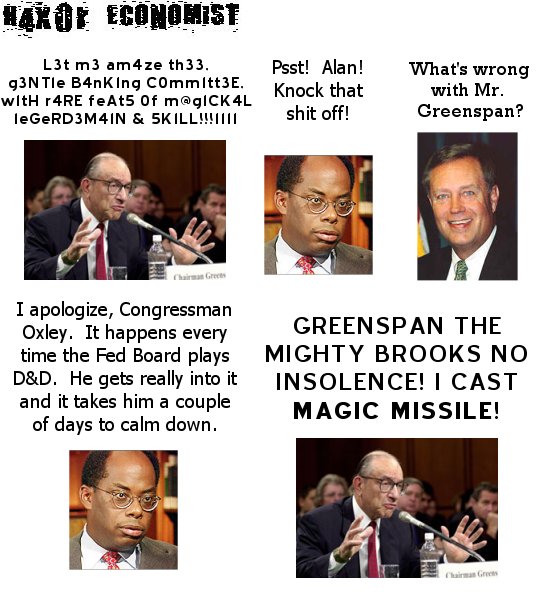
Greenspan was also the subject in the weird comics "h4x0r economist"/"haxor economist", which thankfully still live on since its early internet days https://www.rdwarf.com/users/kioh/ (NSFW language)
thakoppno
Chaos theory and all but my career in tech doesn’t happen without haxor economist. My Econ major collided with it somehow and a year later ended up with a CS degree.
AndrewSwift
This should be the top comment, at least for today.
chadgpt3
I don't get this comic at all but I really miss when random stuff like this got published online!
kzrdude
Yeah I think it's very immature and borderline, at least in rearview mirror.
After going through I came back to this tame comic which was the one I remember I actually got a kick out of as really funny back then: https://www.rdwarf.com/users/kioh/haxorec47.jpg (Theme: Greenspan n DnD)
jameszol
When I was in high school in the 90s, and just discovering the world of money and finance, I stumbled on Alan Greenspan and instantly liked some of his thinking about it. I tried my best to learn from everything he did, read every news article I could find, followed rates, the economics of money, the impact on markets, and more. I learned more about government politics and money and influence from that experience than I have since! I'll admit that my mindset about the Fed and money in general is very much due to what I learned in those impressionable years.
twoodfin
My favorite bit of Greenspan lore:
Texas Senator Phil Gramm (pretty sure it was him) was a prominent GOP member of the Senate Banking Committee. Of course, Greenspan often testified there.
Gramm would always ask Greenspan, along with his other questions, “Mr. Chairman, what’s the ideal capital gains tax rate?”
Greenspan never missed a beat: “Zero.”
Agree or disagree, you always knew where he stood!
franktankbank
HILARIOUS!
KingMob
> Agree or disagree, you always knew where he stood!
This is always such a weird phrasing to me. We collectively praise politicians for this (and admittedly, many of them will just say anything to get elected), but the phrase discourages the idea that learning and changing your mind is valuable.
(Not trying to single you out, just writing about how we collectively do this. I'm sure I've done it in the past.)
twoodfin
The phrasing was indeed trite.
The anecdote was intended to highlight the directness of his answer rather than the constancy of his position.
shrubble
IIRC it was Greenspan that didn’t mean to, but did disclose the use of gold swaps, so even if there is all the gold that is claimed to be in Fort Knox, the question of who owns the gold is unanswered.
helterskelter
Interesting bit of trivia, Greenspan was in Ayn Rand's inner circle and read her drafts of Atlas Shrugged as it was being written, and they were close friends until her death.
love0972
He shaped global monetary policy for nearly two decades. His 2008 admission that his free-market ideology had a "flaw" was one of the most honest moments in central banking history.
mediumsmart
time to watch inside job from 2010 again
fouc
Mostly I just know Alan Greenspan for being a disciple of Ayn Rand back in the 1950s/60s. Though the Objectivists didn't like his work at the federal reserve. In 2008 he admits to being shocked that banks weren't rationally selfish.
lucius_verus
Related article from around that time: https://www.motherjones.com/politics/2008/10/alan-shrugged/
roughly
The banks were not, the bankers were.
billbrown
The guy who called the Federal Reserve the "penny in the fuse box" of the economy was not an "Ayn Rand disciple" by the time he took the chairmanship. Power as chair of the Council of Economic Advisers under Ford really transformed him and I think severed the tenuous hold he had on her principles.
jandrese
The libertarian community really thought they had their fox in the hen house when he was put in charge of regulation, and he did a fair bit of deregulation, but not nearly to the extent that they wanted. In the end it was enough to trigger a major financial crisis, but not enough to completely collapse the world economy and return to the feudalism they wanted.
flumes_whims_
What regulations did he as federal reserve chair rollback and which of them caused the 2008 crash?
anothermathbozo
He killed Brooksley Born’s proposed derivatives regulations in the late 90’s.
tennfown
> but not enough to completely collapse the world economy and return to the feudalism they wanted.
Don’t worry, wealthy drug addict pedophiles in Silicon Valley are carrying that torch now.
firefax
Non paywalled obituary: https://apnews.com/article/greenspan-federal-reserve-death-2...
gosub100
Aside from your attempt to circumvent the supply and demand controls, I find the impact of his contributions highly inflated.
alberth
For many Americans, Greenspan was the only Fed Chair known widely by name by the general public.
NoboruWataya
I'm not from the US and was born after Greenspan took up the position but I thought Paul Volcker was a pretty well known name during his tenure?
unregistereddev
During his tenure, yes. Volcker remains famous among finance nerds, because it turns out he was right. He caused a recession and risked his own job, but in doing so he successfully reigned in runaway inflation.
While Volcker was controversial in his time and celebrated later, Greenspan was widely respected in his day. I remember Greenspan being sought for interviews national television to help explain finance topics to the general public.
rootusrootus
Maybe GP meant Americans alive today. Volcker is probably memorable mostly to an age bracket swiftly shrinking.
collabs
I am so confused... so he was a proponent of gold standard but also supported low interest rates and the "Greenspan PUT"?
Get the top HN stories in your inbox every day.
https://archive.ph/tSlDZ
https://www.cnbc.com/2026/06/22/alan-greenspan-former-chairm...