Get the top HN stories in your inbox every day.
tda
FrenchTouch42
May want to give Apollo a try: https://github.com/ClassicOldSong/Apollo (re Sunshine)
langarus
Any idea how this solution compares to parsec?
nickburns
Neat use case. But in fairness, you've simply 'offloaded' NAT traversal/port forwarding to automagic helper protocols over which you have no control even if you wanted it.
RulerOf
I recently tried whitelisting IPv6 prefixes at the network border and running straight IPv6 traffic from end to end.
It works really well so long as there's an encrypted transport, although I'm a little annoyed that the routes are very different and the ping times are different too. Although at the moment I can't remember if they're worse ¯\_(ツ)_/¯
jak6jak
That seems really exciting! If you wanted to share game streaming to a general public would they have to install tailscale on their device/login? How does that work? Am I right in assuming that tailscale is built mostly for sharing resources with people you trust instead of the general public?
undefined
flowstraume
I'm confused. I wanted to do this too with an OpenWRT router, but I was under the impression I still had to open a 40000 port so my NAT devices can see it. Wouldn't it still be on the exposed public Internet?
arjie
What hardware do you use on the networking side?
tda
Nothing special, an edgerouter that allows installing tailscale
arjie
Ah, perfect. The Mikrotiks weren't as straightforward earlier but maybe it's easier now. Glad to know it works on EdgeOS. Did you just use this? https://github.com/jamesog/tailscale-edgeos
aborsy
There are several ports open (you dont open them, Tailscale does), including for peer relay. Some are vpn ports, but the ports for relay servers are not for VPN so my guess is that the software that listens to those ports is a lot less secure (compared to Wireguard or OpenVPN).
tda
Yes my router has open ports, but it does not do any port forwarding. So I can 'directly' connect any device behind my router without my router needing to know any specifics of which device that is. And I don't need to do any port forwarding of anything on my network and thus expose them to the whole internet; I just expose them to the users of my tailscale network (only me)
toomuchtodo
Does your router not support UPNP for dynamic port punching?
behnamoh
How does Tailscale make money? I really like their service but I'm worried about a rug pull in the future. Has anyone tried alternative FOSS solutions?
Also, sometimes it seems like I get rate limited on Tailscale. Has anyone had that experience? This usually happens with multiple SSH connections at the same time.
dimatura
Our company pays for the premium business plan, $18/mo/user. You have to pay for at least the lower tier plan once your team grows beyond a handful of people. And there's several quite useful features (though maybe not essential) on the premium plan like serve/funnel and SSH.
On the other hand, I do wonder about zerotier. before tailscale we used zerotier for a few years, and during the first 3-4 years we paid nothing because as far as I can recall there was nothing extra that we needed that paying would've gotten us. Eventually we did upgrade to add more users, and it cost something like $5/mo (total, not per user).
tamimio
Zerotier is not the same as tailscale although both can be used to do the same, but under the hood both are fundamentally different, ZT is layer2 like switch, so it’s like an Ethernet meanwhile TS is built on top of wireguard and is layer3. ZT allows broadcast/multicast and has own protocol, TS don’t. I use both among others, and ZT since around 2019, I found it reliable in some cases in IoT world while TS had better throughput in usual applications.
dimatura
Yeah, they're not direct replacements. I think both models have have their pros and cons. In fact I tried both around when covid shutdowns started (server being in the office, me at home), and liked zerotier better; it was faster, and a more generous free tier. But now tailscale has won out for a couple of reasons; the main one, it's simply less flaky for us on macOS, especially for devs working overseas. No idea why and maybe there's simple fixes (that don't involve repeated connections/disconnections, hopefully). The other, tailscale has a few extra things that are nicer and easy to use like identity-based ACLs, funnel/serve, magicDNS, ssh management, etc.
gpm
I've used serve/funnel on the tailscale free tier... definitely agree that the team size limit seems like it would move companies to the paid plan though.
dimatura
I think how it works usually is that they let you use the features from higher tier plans than the one you're on; once you use them enough they send you an email asking to upgrade. That's what happened to us and I've seen other users mention it. Not sure how I felt about it, OTOH maybe it was less friction than explicitly subscribing for some "2 weeks free trial" or whatever but OTOH it did feel weird and unexpected. Anyway, we felt the extra features were worth it so ended up paying.
lysace
How do you handle the do-before-thinking devs? Or the kinda low-to-mid performing devs? Most companies has one or a few of those, right? They help the company machine go around by doing the somewhat boring stuff over and over again.
Tailscale in a company/developer env seems awesome when you know what you are doing and (potentially) terrifying otherwise.
Does someone set up detailed ACLs for what's allowed? How well does that work?
madeofpalk
> How do you handle the do-before-thinking devs?
Isn't that exactly what tailscale is built to accommodate - zero trust?
You set up ACLs and other permissions to not allow people to do more than the damage you can tolerate.
vizzier
> Also, sometimes it seems like I get rate limited on Tailscale.
As I understand it if everything is working properly you should end up with a peer to peer wireguard connection after initial connection using tailscales infrastructure. ie, there should be nothing to rate limit. There are exceptions depending on your network environment where you need one of the relays noted in this post.
As for opensource alternatives:
https://github.com/juanfont/headscale can replace tailscales initial coordination servers
and https://netbird.io/ seemed to be a rapidly developing full stack alternative.
arsome
Headscale also offers a relay server of its own.
kkapelon
There is also netmaker
evmar
They wrote a blog post addressing this concern: https://tailscale.com/blog/free-plan
riknos314
The Tl;Dr here is that the cost to them of operating the free tier is lower than what they estimate their Customer Acquisition Cost would be without a free tier, so the free tier generates better leads/conversions to their paid products at a lower cost than traditional sales and marketing.
As long as these economics continue to hold they'd be stupid to discontinue the free tier.
eleventyseven
But it isn't 'economics' as there is no actual data or science here, just a wild guess about what customer acquisition might currently cost. All it takes to rug pull is some exec speculating that 'the economics' have changed.
hashstring
Makes me wonder.
Say 5% of the free tier users converts to a paying customer within 5 years. And user growth is constant. Then over time, you will get a much larger free tier user base, compared to your paying customers (in absolute numbers). At some point, it must become tempting to charge all free tier users a little bit to continue, because the group got so big, so there is a lot that can be earned there.
Is this wrong, or should we expect this?
dawnerd
Makes sense. Get tech people to adopt it, then push for it at work. It's brilliant and it will work. It's working for Cloudflare too.
wat10000
All it takes is for the decision-maker who gets the credit for cutting costs by removing the free tier to be a different person from the one who gets the blame for higher customer acquisition costs. Not saying it'll happen, just that it being a bad move isn't a guarantee.
Aurornis
Tailscale is a perfect example of using a free tier to become popular with developers, who then evangelize the product to their employers. The employers pay for business scale plans.
allthetime
Facilitating peer to peer connections is cheap.
Just like cloudflare, a healthy free offering makes lots of happy/loyal developer users. Some of those users have business needs / use for the paid features and support and will convince their managers to buy in.
prodigycorp
I love tailscale but you may be right, it's entering that acquisition zone that'll inevitably bum everyone out.
Salesforce, stay away from it!
tomxor
I have the same fears. Last year they have publicly stated they are not interested in acquisition [0]
> Pennarun confirmed the company had been approached by potential acquirers, but told BetaKit that the company intends to grow as a private company and work towards an initial public offering (IPO).
> “Tailscale intends to remain independent and we are on a likely IPO track, although any IPO is several years out,” Pennarun said. “Meanwhile, we have an extremely efficient business model, rapid revenue acceleration, and a long runway that allows us to become profitable when needed, which means we can weather all kinds of economic storms.”
Nothing is set in stone, after all it's VC backed. I have a strong aversion to becoming dependent upon proprietary services, however i have chosen to integrate TS into my infrastructure, because the value and simplicity it provides is worth it. I considered the various copy cat services and pure FOSS clones, but TS are the ones who started this space and are the ones continuously innovating in it, I'm onboard with their ethos and mission and have made use of apenwarrs previous work - In other words, they are the experts, they appear to be pretty dedicated to this space, so I'm putting my trust in them... I hope I'm right!
[0] https://betakit.com/corporate-vpn-startup-tailscale-secures-...
nerdsniper
Would be curious if a partial decompilation and short static analysis would yield any reliable info about what they might be collecting.
omnimus
Just note i doubt Tailscale were first popular vpn manager as i remember many hobby users are Zerotier converts and also much older products like Hamachi.
Tailscale have build great product around wireguard (which is quite young) and they have great marketing and docs. But they are hardly first VPN service - they might not even be the most popular one.
politelemon
Dearest Salesforce, Apple, Oracle, and IBM. Please look elsewhere for acquisitions to ruin for everyone. Cheers.
nsbk
At this point Tailscale is working so well and I'm so happy with it that I'm afraid it's time to start migrating to Headscale [0] for my home network. The rag pull may just be too painful otherwise!
sureglymop
I've been smoothly running headscale on a hetzner vps for many months now. Works without issues (note that it does lack some features still).
ErneX
Same here.
allthetime
Facilitating peer to peer connections is cheap.
Just like cloudflare, a healthy free offering makes lots of happy/loyal users. Some of those users have business needs / use for the paid features and support.
timwis
I'm having a hard time understanding how this is different from a bastion server, where you're tunneling through an intermediary server that you've deployed in the target network.
I guess the difference is the fact that the intermediary server doesn't need a port open (as standard nat punching will work)? Or are there other big differences?
bingo-bongo
We've setup and used peer-relays since it was first announced and they've been great, but they do solve a somewhat specific problem.
Some of our users experienced fairly limited throughput from time to time. Under certain circumstances (eg. always ipv4 NAT/double-NAT, never for ipv6) their Tailscale client couldn't establish a direct connection to the Tailscale node in the datacenter, so data was relayed through Tailscales public relay nodes. Which at times was rate limited/bottleneck - in all fairness, that is to be expected according to their docs.
The first mitigation was to "ban" the specific public relay they were using in the policy. Which helped, but still not a great solution and we might just end up in a weird whack-a-mole-ish ban game with the public peer relays in the long run.
So we setup a peer relay, which networking-wise is in a DMZ sort of network (more open), but location wise still in the datacenter and allowed it to easily reach the internal (more restricted networking) Tailscale nodes. Which solved all throughput problems, since we no longer have users connecting through the public relays.
Also, the peer relays feels a little bit magic, once you allow the use of them in the Tailscale policy, it just works(tm) - there is basically zero fiddling with them.
EDIT: I'll happily provide more details if interested - we did a fair amount of testing and debugging along the way :)
timwis
Thanks, that's a helpful example to put it into context!
fireant
I think that biggest difference is that your client applications don't need to be explicitly configured to use the bastion server. For example ssh, web browsers, rdp, samba and so on can just pretend that you are inside the target network. Doubly useful if this is a "customer" network and you are working with multiple customers.
bityard
I wonder if someone might indulge me by answering a question or two about Tailscale. I have a self-managed wireguard network which works, but probably isn't very smart or elegant.
From what I can gather, Tailscale does a lot of "magic" things to accomplish its goals, and some of them actually have "magic" right in the name. As a system administrator by trade, I have been bitten SO MANY TIMES by things that try to automagically mess with DNS resolution, routing tables, firewall rules, etc in the name of user-friendliness. (Often, things that even ship with the OS itself.)
Are there any documentation or articles detailing exactly what it's doing under the hood? I found https://tailscale.com/docs/concepts but it doesn't really cover everything.
If I have a virtualization host with, let's call it a "very custom" networking configuration, how likely is it to interfere with things? Is it polite and smart about working around fancy networking setups, or does it really only handle the common cases (one networking interface, a default route, public nameserver) elegantly?
raggi
It's difficult for us to maintain documentation of exactly the kind you'd want there, though we do try to keep up with docs as best we can. In particular there is a fairly wide array of heuristics in the client to adapt to the environment that it's running in - and this is most true on Linux where there are far far too many different configuration patterns and duplicate subsystems (example: https://tailscale.com/blog/sisyphean-dns-client-linux).
To try and take a general poke at the question in more of the context you leave at the end:
- We use rule based routing to try to dodge arbitrary order conflicts in the routing tables.
- We install our rules with high priority because traffic intended for the tailnet hitting non-tailscale interfaces is typically undesirable (it's often plain text).
- We integrate with systemd-resolved _by preference_ on Linux if it is present, so that if you're using cgroup/namepsace features (containers, sandbox runtimes, etc etc) then this provides the expected dns/interface pairings. If we can't find systemd-resolved we fall back to modifying /etc/resolv.conf, which is unavoidably an area of conflict on such systems (on macos and windows they have more broadly standard solutions we can use instead, modulo other platform details).
- We support integration with both iptables and nftables (the latter is behind manual configuration currently due to slightly less broad standardization, but is defaulted by heuristic on some distros/in some environments (like gokrazy, some containers)). In nftables we create our own tables, and just install jumps into the xtables conventional locations so as to be compatible with ufw, firewalld and so on.
- We do our best in tailscaled's sshd to implement login in a broadly compatible way, but again this is another of those places the linux ecosystem lacks standards and there's a ton of distro variation right now (freedesktops concerns start at a higher level so they haven't driven standardization, everyone else like openssh have their own pile of best-guesses, and distros go ham with patches).
- We need a 1360 byte MTU path to peers for full support/stability. Our inner/interface MTU is 1280, the minimum MTU for IPv6, once packed in WireGuard and outer IPv6, that's 1360.
I can't answer directly based on "very custom" if there will be any challenges to deal with. We do offer support to work through these things though, and have helped some users with fairly exotic setups.
velcrovan
> It's difficult for us to maintain documentation of exactly the kind you'd want there
Suggestion: let an LLM maintain it for you.
Alternate suggestion for OP: let an LLM generate the explanations you want from the code (when available).
raggi
This problem space is not small enough to stay within current LLM attention span. A sufficiently good agent setup might be able to help maintain docs somewhat through changes, but organizing them in an approachable way covering all the heuristics spread across so many places and external systems with a huge amount of time and versioning multivariate factors is hugely troublesome for current LLM capabilities. They're better at simpler problems, like typing the code.
_se
LLM docs suck.
For technically complex things, they EXTRA suck.
This is a bad idea.
Computer0
Headscale is an open source alternative, I haven't read the code but it might be a good place to start: https://github.com/juanfont/headscale
patmorgan23
I believe the client is open source and there's a reverse engineered server (that some tail scale employees contribute to)
adithyassekhar
I wish I could read this but got this[0] guy on mobile with no close button, won't close when you click outside the modal.
0: https://i.postimg.cc/14h3Q9mD/Screenshot-20260219-001356-Chr...
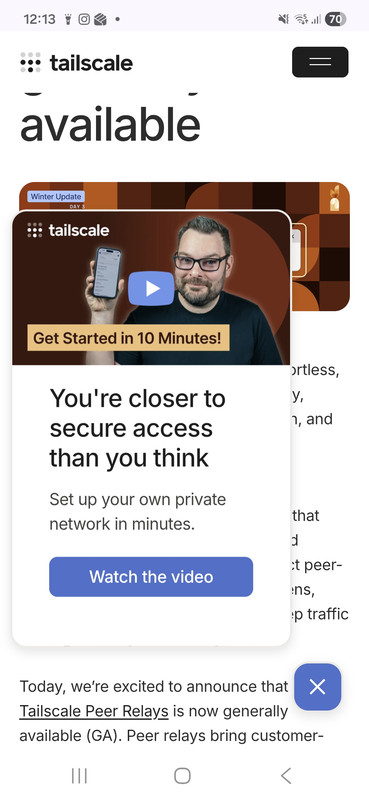
Edit: Nvm, found it. Weird place to put it.
yardstick
I see a white X in a blue box to the lower right of the modal. Is it that?
adithyassekhar
That was it, ok now I feel stupid.
drannex
Oh man, I even read all the comments and still couldn't find it when I finally clicked on the image link. Terrible UX.
cc: @apenwarr (tailscale founder), might want to have someone fix this and move the close button to the top right of the modal, not the bottom right.
a_wild_dandan
You’re not stupid. That’s terrible UX. The button is completely disconnected from its modal, and is placed in a bizarre/nonstandard location.
jrm4
I haven't really dived into Tailscale et al because I'm still using Tinc; and the bulk of this discussion continues to make me not want to.
What's the big deal here? Any good reason to switch (besides Tinc's obscurity?)
skinner927
tinc is cool. Keep using it.
marcosscriven
I really like Tailscale. Recently though I’ve been having some hard-to-diagnose slowdowns even on a direct (non DERP) connection. I’m not sure if it’s something to do with MTUs or my ISP.
ZoomZoomZoom
If you're sold on Tailscale due to them "being open" (as they semi-officially support the development of Headscale), keep in mind, that at the same time some of their clients are closed source and proprietary, and thus totally controlled by them and the official distribution channels, like Apple. Some of the arguments given for this stance are just ridiculous:
> If users are comfortable running non-open operating systems or employers are comfortable with their employees running non-open operating systems, they should likewise be comfortable with Tailscale not being open on those platforms.
https://github.com/tailscale/tailscale/issues/13717
A solution like this can't really be relied in situations of limited connectivity and availability, even if technically it beats most of the competition. Don't ever forget it's just a business. Support free alternatives if you can, even if they underperform by some measures.
pmarreck
I don't understand this attitude. Some humans have to eat and put a roof over their heads sometimes, and extracting consulting fees from open-source work (i.e. the Redhat model) is not always a paying business model. A hybrid model is often the best way to compromise.
Disclaimer: I'm pursuing a similar solution on an app I'm working on. The CLI will be free and open-source (and will have feature parity with the GUI), but charging money for the GUI will also help support that development (and put my son through school etc.)
And by "feature parity", I really mean it- The GUI will be translated into 22 languages... and so will the CLI. ;) (Claude initially argued against this feature. I made my arguments for it. It: "You make a compelling argument. Let's do it." LOL)
The lowest level of it is already available and fully open-source: https://github.com/pmarreck/validate
I'm building something on top of that which will have a nice GUI, do some other data integrity stuff, and also have a CLI. And will be for sale in the Mac and Windows app stores.
pitched
I also have to eat and put a roof over my head. Tying that to a system that can change permanently at any time to something less helpful is dangerous.
Preferring open source is a risk mitigation strategy. The closed alternative may have better features to make them worth that risk though.
philipallstar
One feature is: it's a business and won't be abandoned due to OSS but out if it has a sustainable way to continue.
api
The bigger problem is that making software easy to use is stupidly expensive and hard and is usually the kind of work devs hate. So it’s usually not possible for free software to do it, hence free software usually makes no impact outside very technical circles.
wolvoleo
Personally, I understand people need to make money but this tends to be a death spiral (enshittification). So I tend to go for solutions without those incentives at all. Or at least use the free self hosted option.
I wonder why you jumped into the mesh vpn market, it's so saturated. Theres literally hundreds of solutions out there (niche ones included for the mainstream ones it's probably 10 or so), many non profit options included. Is there really a niche you can offer that the others don't?
Edit: ah by doing the same thing you didn't necessarily mean a mesh vpn? I don't really understand what your thing does but not vpn.
I was just saying it because there's a new Show HN mesh VPN thing weekly now.
gzread
Another way to counteract enshittification is to pay for things, then stop paying when they enshittify.
omnifischer
The logic of putting roof over the head is a point that is too broadly used is not at all valid for things like tailscale as... eventually most businesses at that level (tailscale revenue in 2025 was $45.2M) are crushing the customers. Either entshittification or lock-in. There is a loss of trust. The trust on SV/software is as much as bankers (during Lehmann bros crisis). Some people in HN think oh, we are growing small farmers/engineers from grassroots etc Yes, maybe - but their thinking is to exploit customers sooner or later. These smaller ones (as compared to FAANG etc) think that common man thinks that FAANG are the exploitative ones. But no. The public is getting aware that every damn calendar app or pdf viewer or router is increasing prices or wants subscription or planned obsolescence.
A roof over the head is OK but the price increases are usually to put private Yachts. The income earned by majority of these founders is already good to have lots of roofs.
Maybe my local corner coffee shop is one fellow I would not mind having subscription with...
wanderlust123
Out of all the businesses to rant against for overcharging you are really going to focus on Tailscale?
mlrtime
So, the people building yachts also need to pay the bills. Or should the world not have yachts?
pmarreck
So the perverse "logic" here is basically that since very successful products sometimes get enshittified, there is no point to seeking ANY success?
Do you realize how out-of-touch with reality this sounds? For every $45M Tailscale there's a hundred companies you likely never heard of making respectable but not-very-excessive money in niches here and there. For example, I have a high school friend who owns one: https://speedify.com Thing is, you can't have one without the other. Hell, that's the kind of success (as in "moderate") I'm actually targeting with my work. Which is why comments like this irritate me.
Go make something that other people want and then try to live off it. Offering all of it for free won't cut it, because we don't live in a communist dictatorship (not that any of them might approve you spending your time on your pie-in-the-sky "contributory idea" in the first place).
By the way, in working on the thing I want to sell, I've made a number of offshoot projects open source as a side effect. Check my github, it's never been more active.
jhatemyjob
They don't have access to the same information as us. There's another comment that replied to you who brought up enshittification. I guarantee you he has not read the blog post by apenwarr. Or even knows who apenwarr is.
dblohm7
(Tailscalar here) To be clear: it's only the GUIs that are closed source on selected platforms.
globalnode
Thats actually a good way to split a project up into closed/open imho. Open the functional part so people can see you're not sending data to hq behind their backs and make the boring time consuming ui closed. I like it. Then make money out of a service rather than the software. As we all know, tech people will see a piece if challenging software and go out of their way to replicate it and release it for free, for whatever reasons. So open sourcing that part takes the challenge away.
ZoomZoomZoom
I stand corrected.
Although, the problem is not so single-layered. Do I understand the situation correctly, in case of iOS, to not be subject to additional limitations of the platform that restricts the distribution of your products to the extents that the laws of the countries where your business is registered require, all the user has to do is to fork the main repo (which is, thankfully, BSD), build a minimally acceptable GUI, pass Apple certification, publish the app in the app store, and Bob's your uncle?
dblohm7
Essentially, yeah, but of course you wouldn't want to use any Tailscale trademarks.
Tailscale is engineered under the assumption that any client connected to our control plane could potentially differ from our canonical OSS codebase.
dovholuknf
That's good to know. Can you point me to the peer relay code? I'd like to look at what and how it works. thanks!
DyslexicAtheist
can you say more about this. I've been considering adding tailscale to some products but if my (nerd) perspective is to survive corporate realism I need more than a 1-liner to justify. seriously curious. Also how would I pitch it to a EU based crowd that wants increasingly less to do with US based tech?
someone13
For one, Tailscale is a Canadian company :)
dblohm7
Essentially this: OSS operating systems get OSS GUIs.
1vuio0pswjnm7
"Support free alternatives if you can, even if they underperform by some measure."
I value _control_ more than I do performance
Better performance is, IMHO, not a reason to sacrifice _control_, but that's just me
If users have control, i.e., can compile from source, then in theory performance improvement is possible through DIY or work of others. However performance is not always the only important issue. Today's commercial software tends to be rushed, lower quality, bloated. Releasing work-in-progress software that requires constant remotely-installed "updates" in place of a thoroughly-tested final product is a norm
Without control, if performance, _or anything else about the software_, is unsatisfactory, then there is nothing users can do
Forgeties79
Basically a lot of current software teams operate like many modern video game companies. Ship the broken thing, (maybe) repair/improve it as people suffer through the experience.
baq
Turns out people see value in imperfect experiences.
varenc
The CLI version of the Tailscale client on macOS can be compiled from source and installed without the app store:
go install tailscale.com/cmd/tailscale{,d}@latest
So fully available in situations with limited connectivity. The GUI version of the client is closed source though, and it's available as a package or from the app store.
zarzavat
Seems like an odd thing to be concerned about. Most of the apps on my Mac are closed source, that little Tailscale menu bar item is really insignificant. You can always control it through the command line if you're really bothered by it. I'm pretty sure tailscale is on brew.
tshaddox
That justification honestly doesn't sound that ridiculous to me, especially if the closed-source stuff is mostly just platform-specific GUI and integration code. Is there even a practical mechanism to open source an iOS app and then letting users verify that the version they're downloading from the App Store is exactly the same version that is open sourced?
uneekname
I've been relatively happy with Headscale, but now that I have MacOS/iOS users I'm in the process of testing alternatives like Netbird. I was also surprised that the Tailscale Kubernetes operator is not compatible with Headscale.
mintflow
As a developer who have been built some tailscale-based clients, I think this maybe acceptable because they running a business with money from the VCs.
And I am also very grateful that tailscale implement some workaround for systems such as apple-based OS with core APIs built into the open source code, thus if you really need you can just look the open source code and doing accordingly, though it really need some research work.
For the long term if they really do not want to open source the core client code (which I do not believe at the moment), I think support a fully open source coordinator and open source client based on the fork will still be doable.
icfly2
I was going to use wireguard, but the setup is always such a pain. Then I realised that Tailscale was Canadian, so I’m happy to use it
jak6jak
I looked into tailscale in the past as a way to host a game server such as minecraft on my local machine publicly without port forwarding . It seems that tailscale is mostly configured only to work with people you know and trust. I was hoping that Peer Relays would help alleviate some restrictions with tailwind funnel. Does anyone know any alternatives?
Computer0
if you have a cheap vps you can use it to forward the traffic to for some benefit, that is what i have been doing when i need compute accessible online and don't want to pay for cloud.
itissid
I have my homenas set up with Node Proxy Manager container forwarding requests to different docker machines:ports e.g. I have some TTS/STT/LLM services locally hosted. To increase bandwidth to internet facing nodes, would you use this or some other simpler solution?
tecleandor
Is it a typo and it's the Nginx Proxy Manager?
mikepurvis
I assume so; I use the same thing with my Unraid box and then create the DNS entries in the unifi panel so I get jellyfin.lan, minecraft.lan, etc inside the house.
itissid
Oh yeah Nginx* not Node.
shj2105
I’m so confused. What is the difference between a peer relay and a DERP server that is self hosted?
apenwarr
(Tailscale founder here) Two main differences: first, every DERP server used by your tailnet must be accessible by every node on your tailnet at all times, otherwise you get hard-to-debug netsplits. That's a very high bar to maintain so we've historically recommended you don't try. In contrast, peer relays are "if a given pair of nodes can connect through any of the relays, go for it" so deploying one is always a performance and reliability improvement.
Secondly, peer relays support UDP while DERP is TCP-only. That would be fixable by simply improving the DERP protocol, but as we explored that option, we decided to implement the Peer Relay layer instead as a more complete solution.
shj2105
Hmm got it not sure I entirely understand. The issue I have is I’m trying to connect two devices where one is behind a hard CGNAT that always causes the connection to be relayed even though the other one is not behind a cgnat with proper port forwarding. Would a peer relay solve this but is it like a DERP where I have to host it on a VPS separate from my existing two networks or is this something different where I can host the peer relay on the same network not behind a CGNAT and somehow it will link the two networks through it?
kwakubiney
> every DERP server used by your tailnet must be accessible by every node on your tailnet at all times, otherwise you get hard-to-debug netsplits.
What would allow a given pair of nodes access a peer relay? Isn’t the peer relay by default also accessible by every node on the tailnet since it’s in the tailnet as well?
xeonmc
What happens if your peer relay device is behind CGNAT/SymNat?
Also, offtopic question: is Tailscale named after the idea of UDP packets “tailgating” a connection?
undefined
allthetime
Talking out my ass, but as with all things Tailscale, not much, aside from easier to use / less manual setup.
Nothing they do was impossible before, but their big win is making world wide private networking easy and accessible.
I’ve been on-boarding my friends who have their own local media servers setup so we can all share/stream content from each other.
Get the top HN stories in your inbox every day.
I just set this up the other day, and I got my ping to drop from 16 to 10ms, and my bandwidth tripled, when connecting from a remote natted site to a matter desktop my house. Together with Moonlight/Sunshine I can now play Windows games on my Linux desktop from my MacBook, with 50mbps/10ms streaming. So far so good!
Not a single port forwarded, I just set my router up as peer node.