Get the top HN stories in your inbox every day.
donatj
itissid
Oh! So IIRC it used to be that the modem could only get a rough estimate of your location and typically Apple/Google's location infra(which combined wifi/blue and lately satellite position based shadow mapping) to determine a precise location. And law enforcement got precise info from _that_ infra(E911 requirements for every device).
Clearly they don't need that now because 5g cell towers have gotten precise enough? Also, if that's true then 5g being that precise might still not apply to urban dense areas, where more postprocessing is required to get better location accuracy...
naikrovek
5G isn’t inherently any more precise, but because of the higher frequency used in 5G, the radio signals are blocked by obstructions much more easily, so there must be many more 5G radios per unit area to provide coverage. And one feature of having many more base stations around is that triangulation of specific phone is much more accurate and precise because of how close the 5G base stations are to all 5G phones.
5G infrastructure isn’t limited to tall easily visible radio towers like 4G and before; 5G transmitters are small and relatively inexpensive, making them very common. My employer has a private 5G infrastructure, and we are not related to telecommunications in any way.
joecool1029
> but because of the higher frequency used in 5G
For the most part they use the same or lower frequencies. N71 (600mhz) is lower than any of the 2G/3G bands and requires less cell density than 3G (UMTS/WCDMA) did.
> 5G infrastructure isn’t limited to tall easily visible radio towers like 4G and before;
Nor were earlier technologies. DAS systems get used in large buildings/cities and were done with 4G as well. Small cells and femtocells have been a thing since at least 3G era.
> 5G transmitters are small and relatively inexpensive, making them very common.
Transmitter cost wasn't the primary limitation before, the options for unlicensed/lightly-licensed spectrum were low before and the standards weren't really designed to use them as primary carrier until NR. Also you had to run way more components to run earlier technologies, the stack is just smaller for a NR deploy.
sorenjan
This is not true, 5G has multiple positioning improvements that are not related to higher frequencies. 5G has something called LMF (Location Management Function) that handles positioning of user clients through multiple means, like round trip time, angle of arrival, and dedicated 5G positioning reference signals.
You can read more about 5G positioning here:
https://www.ericsson.com/en/blog/2020/12/5g-positioning--wha...
https://www.ericsson.com/en/blog/2024/11/5g-advanced-positio...
https://arxiv.org/abs/2102.03361
https://research.chalmers.se/publication/542739/file/542739_...
f1shy
In 2009 I worked with a triangulation system in a dense populated area. The precision of location was comparable in average to GPS (meaning sometimes better) when indoors, it was orders of magnitude better as GPS. That was 3G, some yeras ago… I assume today is much better, as the density of cells increased
DeepSeaTortoise
I'd be very interested in more info, but am going to doubt this for now. Usually just the intra-day deformations of the terrain between the towers through hydrological activity should far exceed what GNSS can achieve.
It is just VERY VERY hard to beat the predictability of orbits.
kgwxd
Does his sister know where you live? General area+basic knowledge = most likely address.
stanmancan
Did the sisters know where you lived? Curious if the police provided them with an area and the sisters were able to give a proper address?
xandrius
Why is it so hard to believe that the police can use our devices to backtrack us, as both carriers and police officers have said numerous times?
stanmancan
Occams razor
rr808
Did he connect to your wifi? That would give the exact property to go to instead of via gps.
nashashmi
But the pinging of the phone would not share ip address
atherton33
E911 would get bssid of the access point.
NedF
[dead]
churchill
[dead]
Lapsa
[flagged]
jmward01
"and notify the user when such attempts are made to their device."
We aren't going to remove the security state. We should make all attempts to, but it won't happen. What needs to happen is accountability. I should be able to turn off sharing personal information and if someone tries I should be notified and have recourse. This should also be retroactive. If I have turned off sharing and someone finds a technical loophole and uses it, there should be consequences. The only way to stop the rampant abuse is to treat data like fire. If you have it and it gets out of control you get burned, badly.
lrvick
I turned off all cell carrier tracking 5 years ago. 100% of it.
By canceling my cell phone subscription.
I know I know, I must be amish, I have heard it all. But I run two tech companies, travel, have a family, and do most of the things most around here probably do other than doom scrolling.
So much more time in my own head to think.
nullbyte808
I have a hybrid approach with GrapheneOS. 99% of the time I only use WiFi on my phone via a Tor router. I have an anonymous KeepGo ESIM with global data that does not expire and use it when I have to when Im away from home.
lrvick
I started that way, though with AOSP I compiled myself. It was a nice nicotine patch but after a while my phone was so quiet and boring without proprietary social apps demanding my attention, I often found myself leaving it at home. Eventually I abandoned it entirely.
cryptoegorophy
Cancel phone subscription and have family. I don’t understand how you still have family? You don’t have any emergencies?
balamatom
"Somehow" society has converged on a norm where a chance at reproduction is only afforded to smartphone users.
A rather elegant solution to the problem how not every person likes smartphones, no?
anarticle
Before the era of cell phone and always on comms, leaving the house was a way to NOT be found on purpose. If you weren't home, people just had to wait!
undefined
adaml_623
Did people "have emergencies" before the invention of mobile phones?
Your question is silly
trympet
How do you work on the go? I use personal hotspot quite often. Not only when on the go, but if there is unstable WiFi. It’s saved me on multiple occasions - both for live-site incidents and for random meetings.
orphea
It really depends on who you work as and what your working conditions are. For example, if I had some non-management position at a company that insists on working from the office, I would make sure that I'm NOT available outside my designated work place.
lrvick
I basically never work away from my home desk unless I am staying multiple days away from home. In that case I bring a tiny QubesOS laptop that I attach to my leg with a leg bag (I hate carrying a backpack) and work anywhere with wifi, which is never hard to find.
hpdigidrifter
Pardon my skepticism but I find it hard to believe you can actually participate in western society without choosing to have a government mandated tracking device?
Maybe you live somewhere this is possible but it's definitely not in the developed world
taurath
Runs 2 tech companies - the basic promise of the US is when you're rich you can do whatever the hell you want because you can pay people to handle stuff for you.
But also, one doesn't always need a phone - phones can die, signal is not gauranteed. What are your "must have" things that require one to have a smart phone to participate? Assume the poster has a home phone, laptop, and credit card.
wongarsu
Phones are required, insering a SIM isn't. Your work and home probably have wifi, and services meant to be used on the go are commonly built with offline use in mind. Especially those you actually need in society
A burner phone left at home just for the ability to receive SMS would be helpful for account registrations though
DeathArrow
>Maybe you live somewhere this is possible but it's definitely not in the developed world
Since the whole world is covered by satellites, living in the undeveloped doesn't guarantee privacy.
lrvick
I am a security engineer and I live and work in Silicon Valley with an active social life. None of these things require a phone.
lazide
I’m guessing you have a bunch of other people with their own cell phones doing things?
That’s the reason most other people are (fundamentally) going to struggle.
lrvick
Traveling internationally or domestically, booking flights, hotels, going to concerts, theme parks, the movies, organizing hangouts with friends, exploring new locations... all of these things I do just fine by using a web browser on a desktop computer before I leave home, and sometimes printing a couple things. I live a typical middle class lifestyle just without the doom scrolling.
All the ways of living an active life engaged in the modern world that worked before the 2009 smartphone explosion still work just fine today. Just without tiktok and instagram. I think I am okay without those.
bloomingeek
You could also turn your cell off/on as needed. Sure you can be "seen" when it's on, but when off, it's my understanding you can't.
alt227
You cant turn modern smartphones off. You may think you can, but you cant.
What you could do is put them in a faraday cage if you wanted.
interestpiqued
You can also just use google family link, make someone else your parent, and lock down the phone. I have a "dumb phone" that is just a refurbished Samsung s22 I bought. Only supports phone calls, messaging, and some credit cards basically.
xandrius
How is being able to make phone calls prevent you from being tracked? You're still going to be constantly pinging those cell towers with a unique identifier.
CalRobert
Do you hit issues around things like 2fa, online banking?
lrvick
All 2FA options that require a phone like TOTP can be done just as easily on a laptop with a yubikey or nitrokey.
I have several business and personal bank accounts with two major banks. No Android or iOS needed.
Sure they push you hard to use them, but just say it is against your unspecified religion. They cannot make you use Android or iOS.
taurath
Most 2FA can be done without a phone, and you can also use offline 2FA keys, not necessarily a text message.
You can also set up a phone number to accept texts from a laptop.
I can do whatever on my bank by just calling. It would be a bit weird to never be able to pitch in on meals with a $ transfer app, but I suppose when you run 2 tech companies you're probably paying most of the time, or you just take a note and transfer it later.
themafia
> We aren't going to remove the security state
What security state? They aren't doing this for anyone's safety. This is the surveillance and parallel construction state.
> What needs to happen is accountability.
No agency can have this power and remain accountable. Warrants are not an effective tool for managing this. Courts cannot effectively perform oversight after the fact.
> The only way to stop the rampant abuse is to treat data like fire.
You've missed the obvious. You should really go the other direction. Our devices should generate _noise_. Huge crazy amounts of noise. Extraneous data to a level that pollutes the system beyond any utility. They accept all this data without filtering. They should suffer for that choice.
ruszki
> They aren't doing this for anyone's safety.
Strictly speaking, this is not completely true. When you call an emergency number, it’s very good that they can see exactly where you are. That was how this was sold 15+ years ago. But of course, that’s basically the only use case when this should be available.
krick
Yet when I call emergency I must provide my location verbally, and then am usually contacted for a follow-up, because the guys cannot find the place. Don't get me wrong, I'm sure that this location technology works perfectly well: just not for the "only use case when this should be available".
VerifiedReports
Except apparently they can't. I'm in L.A., a city where resources presumably represent what's available in modern cities, and the first thing I've been asked in any 911 call is "what's your location?"
This is particularly offensive considering that everyone was forced to replace his phone in the early 2000s to comply with "E-911." Verizon refused to let me activate a StarTAC I bought to replace my original, months before this mandate actually took effect.
Looking back on it, it was a perfect scam: Congress got paid off to throw a huge bone to everyone except the consumers. We were all forced to buy new phones, and for millions of people that meant renewing service contracts. Telcos win. Phone manufacturers win. Consumers lose.
cpncrunch
Should it not be available with a valid court order as well?
fooqux
> Our devices should generate _noise_. Huge crazy amounts of noise. Extraneous data to a level that pollutes the system beyond any utility. They accept all this data without filtering. They should suffer for that choice.
I like the idea on principle, but I'll like it far less when I'm getting charged with computer fraud or some other over-reaching bullshit law.
heraldgeezer
You people are so cynical.
Its simply made for 911 calls.
In the 2G era there was no compute space to just put in extra evil shit for fun
https://en.wikipedia.org/wiki/Radio_resource_location_servic...
jmward01
This line of argument is common. We use the term 'wiretap' because that is what it was, a physical tap on a physical wire and it took a real person there to do it. Even then it took a warrant to approve it. Wiretap laws were written when the technology made abuse extremely hard and were likely appropriate for the time. Now we live in an age where abuse of millions can be done in a single key-stroke and often doesn't require a warrant or oversight of any kind because the technology has changed and evolved to provide loopholes around the laws. The intent was emergency services but the mass use has been anything but. That is the key point and those that have abused this, weather on behalf of the government or for corporate profit, should be held responsible. We should have laws that criminalize breaking the intent of use in ways that harm individuals. You found a technical system rife for abuse and you use it that way? Go to jail. Pay a fine. It is that simple.
SturgeonsLaw
Made for, and used for, are two different things. The article gives an example of Israel slurping down that data constantly to track everyone, and you can bet they aren't the only ones doing that.
themafia
> In the 2G era [...]
...you could just listen to calls in the clear. Pager traffic was completely unencrypted as well.
SilverElfin
For consequences, we need to do away with the notion of qualified immunity. Why should police officers, politicians, agents of the government have any immunity for their actions? They should carry personal liability for breaking the law and violating others’ rights. Otherwise, there is no reason they’ll change. Right now, at best you’ll sue the government and get some money, but all you’re doing is punishing other tax payers.
hedora
Committing a crime and also abusing your authority to aid in the crime should be greater than the penalty for just committing that crime.
Qualified immunity is the only legal doctrine I can think of where piling on extra crimes reduces your liability.
themaninthedark
In the United States, qualified immunity is a legal principle of federal law that grants government officials performing discretionary (optional) functions immunity from lawsuits for damages unless the plaintiff shows that the official violated "clearly established statutory or constitutional rights of which a reasonable person would have known".
Under 42 USC § 1983, a plaintiff can sue for damages when state officials violate their constitutional rights or other federal rights.
https://en.wikipedia.org/wiki/Qualified_immunity
Qualified Immunity only sets the bar or threshold that you have to meet in order to sue.
myko
Nearly impossibly hard to receive justice against government officials due to this standard
undefined
SilverElfin
But for federal officials, individuals don’t have standing right?
sam345
This reflects an anarchist viewpoint or a trial lawyer's dream. Good luck having a government where everyone participating can be sued individually.
bdauvergne
It's the norm in most western countries. Prosecution of administration official is still rare, but nothing like the obvious free permit to misbehave we see in the US.
dumdedumdumdum
Get rid of qualified immunity and enjoy no more fruit of the poisonous tree. I assume you are not familiar with the laws of evidence by your emotional position. One of the biggest problems the country faces is citizen literacy in all domains. If you improve citizen literacy across all domains you will solve all problems, until they take away our ability to vote. The "system" exploits those who cannot defend themselves.
_heimdall
> We aren't going to remove the security state
We definitely won't get rid of it if we accept failure. I get that it seems extremely unlikely, but there's no use in trying to just mitigate the risk short term. One way or another that power will be abused eventually (if it isn't already).
voidfunc
Idealist views like this get us nowhere either tho.
The reality is somewhat more murky. On a long enough time horizon your point makes sense, we might be able to get rid of the security state by slowly chipping away at ig over hundreds or thousands of years.
Most of us are going to be dead in about 40 years tho. Security state isn't going anywhere in that timeframe.
_heimdall
Why not? Change like that happens slowly, then all at once. I can't say I'm optimistic that it will be gotten rid of, but if its worth fighting for then it doesn't matter if it seems likely.
Roark66
>Most of us are going to be dead in about 40 years tho. Security state isn't going anywhere in that timeframe.
How would you know? Think about the collapse of the Soviet Union, or communism in other countries. 2-3 years before it was unthinkable.
Zetaphor
I'm curious to hear someone explain why you're being downvoted
DeathArrow
>We aren't going to remove the security state.
We should make it impossible for the data to be obtained without express user agreement.
fsflover
This is exactly what GDPR does.
jmward01
Does it apply to the government like it applies to people? Is it enforced against governments like it is enforced against people and corporations? A core issue here is that laws, and the application and enforcement of laws, generally do not. Having said that I applaud the attempt and encourage pushing forward on the anti-surveillance aspects of GDPR while recognizing all laws are flawed.
cromulent
The telco would be the one collecting it first, I assume. It would be interesting for someone in the EU to request their data from their telco, and if it contains these precise locations, question the usage.
ozim
Yeah it applies to government like local municipalities have to adhere to GDPR, they cannot just have your name on the register, they have to have a legal reason.
Way you could argue it doesn’t apply to government is that the government makes the law so they can make the law that makes data processing and having your name on some kind of registry required.
But still they have to show you the reason and you can escalate to EU bodies to fine your own country if they don’t follow the rules.
kingkawn
State actors are inherently only subject to their own oversight
molszanski
I guess. In Poland when I go to gov offices I need to sign 25 GDPR clauses
jart
Don't cheer that any policy be applied to technology you wouldn't want applied to your own brain.
Imagine you get Neuralink and your best friend files for the right to be forgotten. Then poof. All your memories together gone.
subscribed
This right is applied per entity.
If I send it to the company A, company B doesn't execute it unless they're a subsidiary of A (or A is their data controller) and my request was carefully crafted.
In the scenario you painted, that would mean that my _former_ friend has issued their request to me.
In that case? Fair. Poof if that's their wish.
Otherwise? How do you imagine it work?
jart
I think I should have the right to remember the things I see.
dd8601fn
Why? My memory is not a marketing database at Facebook, and I don't see any obligation to pretend it is.
gregoryw3
I’m not super sure about the specifics but having taken a 5G class, the professor made it quite clear that due to the latency and bandwidth requirements of 5G, precise tracking is required to allow towers to correctly do beam forming.
If anyone wants to look at the future of 5G (well ORAN) here it is: https://gitlab.eurecom.fr/oai/openairinterface5g
When talking about the 5G system, cell towers can request a users estimated velocity which when combined with the towers own location combined with the physical radio (that is communicating with the phone (UE)) you can get a pretty good position estimation.
What is new is that network providers are trying to sell this tower/5G data to other companies.
I could be wrong but from my understanding 5G has always required precise tracking of every device connected.
wisplike
My knowledge on this is the tower should be able to optimise beams without location information. Channel information can be relayed back to the tower for beam optimisation. The tower needs to know the signal path characteristics but not explicitly the location.
Not disputing that location data is used for beam optimisation just that I dont believe it is required.
gregoryw3
Exactly, the channel information is all that’s required but you can quite easily get the location information from that, which makes it easier to add additional features from a system point of view.
If I recall correctly, the tower will report channel information to the higher up controller system which will then decide which next tower should be notified of a phone that’s entering its range.
So while explicit positioning isn’t required when dealing with one tower, the system overall does need to determine a users position and velocity to handle tower to tower transfers.
In other words my opinion is that the difference between a towers channel information and a users position is almost one and the same. It’s a handful of math equations away.
codedokode
This would not be a problem if you phone did not have IMEI and IMSI, and if the telco only provided an anonymous Internet channel. The problem is that you must have a phone number, often linked to your ID and pay with a bank card, linked to your ID, instead of cryptocurrency. Towers and beamforming are not a problem at all.
Ajedi32
Yeah, whether or not precise location info is required, even coarse 24/7 location tracking is a huge privacy issue. Privacy was simply never a part of the core design of our phone system in the first place. That needs to change. Device anonymization would be a great first step.
pclmulqdq
Information about received power and SNR is relayed over the 5G data link to and from the tower, and beamforming happens that way. As a result, the tower doesn't need to know where you are at all. In fact, with higher frequencies, you often get weird bouncy paths for 5G radio signals so the "beam" that gets formed can be a rather odd shape while being optimal.
GorbachevyChase
So when 5G was being deployed to the city I was working for and I could see permits, it struck me as really peculiar just in terms of economics because the density of towers needed is extremely high compared to the previous generation. As a user, I really can’t tell a difference in quality of service. So it seemed like an extremely large capital investment for no gain, which makes me think that the purpose of 5G is some dual use that is not public knowledge. That the intent was to create a high accuracy tracking system for us seems plausible to me given how much money is funded into other surveillance activity.
m463
also search for 5g miot and redcap - I think more iot/consumer electronics devices will erode privacy all over via 5g.
undefined
AnotherGoodName
This community should be talking about meshcore more imho.
It's a peer to peer network based on Lora. It really only allows text messaging but with up to 20km hops between peers coverage is surprisingly huge. Incredibly useful if you go hiking with friends (if you get split up you can still stay in touch).
See https://eastmesh.au/ and scroll down to the map for the Victoria and now more widely Australia network that's sprung up.
konsumer
Reticulum gets around a lot of these problems, as the (better) encryption is app-level (or even more fine-grained.) Its also not tied to lora, so you can interop easily with other transports. I made a websocket transport for it, and there is already TCP and UDP, and a couple non-lora radio transports. I also made a (works on web) js and Arduino client lib, and it has a few native client libs, so it can sort of be used on anything, even over traditional networks, or web clients. Meshcore and meshtastic are way more popular, but reticulum seems so much better, to me, for most things. It can still have overload problems, like any radio network, but no client is required to forward, so you can build a different kind of network ("only forward messages that are for my peeps" and marked correctly.) It also has "it costs compute PoW to send to me" which can greatly cut down on spam.
gaudystead
I only recently discovered Reticulum, only to then learn that the developer has retired from working on it. Do you know if there's still any community members carrying the torch?
konsumer
The discord is still very active, and there are still commits from original developer, so I am not sure. Its a simple enough protocol, though, and it's been reimplemented a few times. I made my own no-class python version, js, C, etc. Someone made a rust version.
Ey7NFZ3P0nzAe
He has not retired from working on it. He just got fed up with the community and is now pushing changes without allowing github issues and discussions.
grepfru_it
Great for small networks. Once bad actors find it, it will be attacked. See gnutella as the case study on unsupervised peer to peer networks
elnerd
I just read gnutella page on Wikipedia, no mention of bad actors
hamdingers
I take it you never got a mislabeled mp3 of Bill Clinton advertising online poker.
huflungdung
[dead]
karlgkk
[flagged]
sneak
The crypto is bad and the networks are extremely low bandwidth and quite unreliable and are vulnerable to jamming or spam/overload.
I’ve deployed lots of nodes, and the technology reminds me of ipfs: people who don’t use it much vastly oversell its capabilities.
bronco21016
I really want to get into these Lora based mesh tools but the range in my experience is terrible. Maybe I'm doing something wrong, maybe it's a lack of nodes in my area.
I just tested the other day. I'm in the midwest US so it's winter, no leaves. I managed to get about a quarter mile before my two portable nodes couldn't talk to each other. T-Echo with muziworks whip antenna.
Without a bunch of solidly placed, high elevation, high gain antenna nodes, this just isn't really that usable.
Plus, all the other issues others have highlighted.
subscribed
Height is might.
I couldn't get ANYTHING on my first/test ESP32 (Heltec v2).
Anything. I didn't see any packets. Then I finally heard one station later when I held it high on the upper floor.
The I hanged it at the top of my roof and I currently have almost 130 repeaters and room servers.
In your scenario a couple of 5W handhelds woukd work better.
But I agree the usabity is very limited. This is why I think of hanging a couple of guerilla solar repeaters in my neighborhood :)
bronco21016
> In your scenario a couple of 5W handhelds woukd work better.
Exactly, in nearly every “off-grid”/no cell service scenario where I’ve needed comms, the GMRS radios > Lora.
Its an interesting idea but I can’t go site prep 100s of miles of snowmobile trail before I go just to be able to send a text to someone a mile away.
NoiseBert69
Meshcore and -tastic have the huge problem that the encryption keys are bound to the device and not the app.
timschmidt
I've been using the T-Deck Pro and T-Lora Pager, so the device is the app.
jonmon6691
I agree, there's way too much going on in the firmware, just make a dumb Lora-bluetooth bridge. Hell, just integrate a Lora radio in a phone.
undefined
undefined
subscribed
The base software is open, you could potentially do it!
:)
cyberax
> This community should be talking about meshcore more imho.
The fundamental problem of distributed networks is that you can either have centralized control of the endpoints, or your network becomes vulnerable to denial-of-service attacks. So meshcore/meshtastic are great because they are used only by well-meaning people. If they become more popular, we'll start getting tons of spam :(
bastawhiz
This isn't great advice if it's supposed to be an alternative to text messaging with a carrier (especially if you're using encrypted RCS).
For one, meshcore doesn't do a fantastic job of protecting metadata. Advertisements include your public key, and if I'm reading this[0] right, your GPS coordinates.
Second, the default public channel uses effectively no encryption at all.
Moreover, the network doesn't exhaustively prevent someone who intercepts a packet from identifying who sent it. It's no Signal.
[0] https://deepwiki.com/meshcore-dev/MeshCore/7.1-packet-struct...
subscribed
All telemetry is off by default, you have to explicitly tune it on and then optionally permit specific contacts to poll it.
The PKI is basic because these networks are tiny and merging. And running on tiny computers ($5 boards with no display)
Public channel is public and it uses the default encryption key because it's a default channel, so by definition everyone is invited to participate. Not sure what your critique is.
And no, it's not trying to be signal. It's also currently less reliable.
But it's still safer than Sms, by a country mile.
bastawhiz
It's bad advice because:
1. Telling someone to use one of these devices because their phone carrier might look up their location is silly in the first place, because meshcore doesn't even eliminate the possibility of being tracked geographically.
2. It protects your messages better than SMS but if you care about the privacy of your messages, it's infinitely worse advice than suggesting someone use Signal or another app that actually replaces SMS securely.
jeromegv
You aren’t reading this right. Gps sharing is off by default on meshcore.
bastawhiz
Still falls flat when it comes to metadata privacy. Just having multiple nodes distributed geographically that listen for packets would give you the ability to narrow down the location of a specific identity dramatically, even if you're not in range of their device.
driverdan
What does this have to do with mobile carriers tracking GPS data? If you're implying we should use it instead of mobile phones that's not practical at all.
AlexanderYamanu
euhm, well. 112 programmer here. There are multiple levels. Cell tower triangulation come in automatically from providers. But they are only in tower numbers. They might be wrongly entered by engineers, hence the confirming question about where you are. Second is subscription information, as in registered address. Chances are if called from nearby your address, you are at your address. Next is a text to your phone number, which is intercepted by firmware and sends gps coords back. This can be turned off, since implementation.
jeroenhd
American carriers have a different protocol than the EU. The EU (and probably EU derived networks) uses a """secret""" SMS format that's opt-in, but the 911 system works differently.
The 911 feature can be activated fully remotely, the 112 feature is supposed to only activate when dialing an emergency number.
yencabulator
The US one is called E911: https://en.wikipedia.org/wiki/Enhanced_911
gruez
>The 911 feature can be activated fully remotely
Source? Even if the phone isn't actively doing a 911 call?
Havoc
GP likely means any 911 call automatically has geo tracing.
>The dispatcher's computer receives information from the telephone company about the physical address (for landlines) or geographic coordinates (for wireless) of the caller.
jeroenhd
Wikipedia links https://propertyofthepeople.org/document-detail/?doc-id=2108... as proof that the E911 feature is used by the FBI to track phones.
Unfortunately, definitive capabilities and constraints of this kind of cellular technology is hard to come by.
stavros
Wait wait, so if I know the "secret" SMS format I can text someone's phone and get their coordinates back?
defer
No, the SMS is initiated by the device upon calling emergency, not requested by the emergency service. The standard is called AML.
The format is not secret either, it's just binary encoded.
jeroenhd
I say """secret""" because the spec says that the format should not be published so people can't try to mess with the format, but the first link on Google shows the exact format.
The spec says:
> The AML SMS should not be seen by the caller and therefore should not appear in the SMS "sentbox" of the smartphone. This is to avoid any customer confusion and to avoid making the format of the message widely known. In addition, there is also a potential privacy concern in storing the location of an emergency call from the handset, which could be seen by others.
The AML SMS gets triggered by software on your smartphone when you dial an emergency number. You cannot use it to obtain someone else's location.
IshKebab
> This can be turned off, since implementation.
Not by users. The new thing is that Apple allows users to disable this feature. Hopefully they still detect emergency calls on the phone and enable it unconditionally for those.
jeroenhd
I believe they're talking about this feature (https://support.google.com/android/answer/9319337?sjid=18079...).
This is a system you can disable as a user, but it's not the on-modem feature discussed in the article.
jojobas
How would the modem know your coordinates if the OS doesn't provide them?
KellyCriterion
Note sure: In my country exactly this feature is used by police & state enforcement to find locatin, because this "ping" message is not forwarded from the modem to the OS, so the OS is not aware of any of these messages
AlexanderYamanu
yeah, there always was. It's a service code, like getting your imei. But it was a weird long one, and manufacturer dependent. Now UI switches are created for it apparantly. Can't find it anywhere on the internet though. I don't work there anymore, so can't look it up.
ErroneousBosh
Do you use triangulation or GPS? EISEC in the UK only uses GPS, never triangulation.
dfc
Did you read the article or are you merely responding to the title? The article begins by acknowledging triangulation and then moving on to the point of the article. The article is about commands built into the UMTS and LTE specs for requesting GPS from the device. Your comment seems to be about everything but the main point of the article.
jb1991
The hacker news guidelines forbid you from suggesting someone has not read the article. Please do not participate in this forum with such conduct.
M95D
Did you read the complete comment?
> Next is a text to your phone number, which is intercepted by firmware and sends gps coords back.
dfc
Yes I saw that and also took it to mean the person didn't read the article. A text to your phone number? The article never mentions SMS. Heck I think the 2g/3g "feature" does not even require the phone to even have a SIM installed. This next sentence also seems to have been written without reading the article: "This can be turned off, since implementation."
instagib
What you need iPhone Air, iPhone 16e, or iPad Pro (M5) Wi-Fi + Cellular iOS 26.3 or later
A supported carrier: Germany: Telekom United Kingdom: EE, BT United States: Boost Mobile Thailand: AIS, True
Turn limit precise location on or off
Open Settings, then tap Cellular.
Tap Cellular Data Options.
If you have more than one phone number under SIMs, tap one of your lines.
Scroll down to Limit Precise Location.
Turn the setting on or off. You might be prompted to restart your device.
js2
Apple doc: https://support.apple.com/en-us/126101
Only Boost Mobile in the U.S. Weird. About 7.5M subscribers. Maybe it requires 5G? Wonder if it works when roaming?
https://en.wikipedia.org/wiki/Boost_Mobile
https://en.wikipedia.org/wiki/List_of_mobile_network_operato...
SoftTalker
AFAIK, other than maybe some 5G, Boost Mobile just resells service from AT&T.
lukec11
Boost Mobile (under Dish Network), until a few months ago, ran their own custom-built 5G network that covered about 30% of the US population. They built it after the acquisition of Sprint by T-Mobile, in an effort to maintain a fourth nationwide wireless carrier.
Unfortunately Boost/Dish struggled significantly with finances and customer attraction post COVID, largely due to two problems (seamless roaming between their own network and partners’, and more importantly, getting manufacturers like Apple to build compatible phones). When the current president came into the picture, the FCC essentially forced the sale of Dish’s primary spectrum licenses to administration-friendly SpaceX, for future Starlink use.
As of now, they are in the process of moving their customers to AT&T (and possibly a secondary agreement with T-Mobile), but they seem to be maintaining their own network core - that’s likely why they’re able to implement support for this, while AT&T does not.
OGEnthusiast
Kinda funny that the most secure phone setup in the US is an iPhone Air on Boost Mobile. Who could have predicted that!
TheNewsIsHere
It isn’t restricted to Boost Mobile. It is only available on devices with the C1 or C1X modem, though. I assume this is because of specifics with the third party modems that most models in the wild have vs what Apple is doing in-house with their C1(X). If you call emergency services it will still provide precise location.
gruez
>It isn’t restricted to Boost Mobile.
Why does it list specific carriers, then?
radicaldreamer
It is restricted to Boost Mobile in addition to using the C1(X), at least for the purposes of this beta version.
crazygringo
Serious question: will this limit the ability of 911 emergency services to help you?
I can imagine a scenario where emergency servies are authorized to send the ping to get your precise location and if you disable this, you may regret it. And a major feature of some phones/watches is the ability to automatically call 911 under certain fall/crash movement detection, where you might not have the ability to re-enable your GPS location.
radicaldreamer
The feature says it doesn't restrict the ability of 911 to locate you...
pstuart
But they still can track the cellular connection and do triangulation from that, no?
Basically, if you have any cell phone the government can track you. Buying a burner phone with cash (via strawman proxy) seems like the only way to temporarily obscure your location.
I imagine with the ubiquity of cameras in the commons and facial recognition and gait analysis they can knit that up even more.
Ms-J
More abuse done to us. We never agreed for our GPS coordinates to tag along with calls for some assholes to see exactly where we are.
It is tiring. I am doing something about it by making technical contributions. If you are able to do the same, please do.
Spivak
I mean we kinda did when we decided that emergency services calls would be special and give first responders the ability to find you. Wireless carriers are required to provide GPS quality (actually better than GPS) location data to EMS and this is how they built it.
The only way to actually do this was develop a way to ask the phone because the tower isn't accurate enough. In the US it could have been more privacy preserving by being push but I imagine carriers don't want to maintain and update a list of current emergency numbers. "Sorry person in a car crash, we can't find you because cellular modem firmware is out of date and your emergency number isn't on list" is a PR disaster waiting to happen. Easier to coordinate with police and fire and let them do the asking.
butvacuum
911 is the only actual emergency number with regulations around it in the US. police and fire have _non_ emergency numbers that differ, my local hospitals will tell you to call 911; and gas, water, power, and other immediate risks to life safety are all 911 anyway (at least as the first call).
Sometimes it seems dumb, but as long as its an honest report I've never heard of anything more than an annoyed patrol officer. Felt stupid calling in an interstate sized sign hanging by a literal bolt-thread but the patrol shut down that lane.
ErroneousBosh
In general the emergency services would rather come out for something that sounds on the face of it stupid ("This sign is hanging down above the road and flapping in the breeze, can you come out to it?") and deal with it with plenty of time.
Far better than getting the call "This sign has come down and chopped a bus in half, and then four cars have run into the back of the wreckage".
Build the fence at the top of the cliff, not the hospital at the bottom.
advisedwang
It's perfectly reasonable to have the expectation that the cell phone network can provide location to emergency services but not the the telecom provider's marketing team or whoever they sell the data to.
In fact the apple feature the article talks about says [1]
> The limit precise location setting doesn't impact the precision of the location data that is shared with emergency responders during an emergency call.
So it actually now implements what it should have been all along. (except that it should be the default)
thisislife2
From the comments, it appears many are not aware that even the US government buys location data of users from data brokers - How the Federal Government Buys Our Cell Phone Location Data - https://www.eff.org/deeplinks/2022/06/how-federal-government... ... Apparently, US cell phone companies are one of the providers of this data - US cell carriers are selling access to your real-time phone location data - https://news.ycombinator.com/item?id=17081684 ...
Frost1x
We really have a societal problem in that we allow private entities to do things we don’t allow government to do. Furthermore, the issue is exacerbated by then allowing governments to bypass these issues by then just paying private entities to do the things it can’t do as a proxy for the same functional outcomes.
But we want to support privatization at all cost, even when privatization these days has significant influence on our daily lives, akin to the concerns we had when we placed restrictions on government. Seems like we need to start regulating private actions a bit more, especially when private entities accumulate enough wealth they can act like multi state governments in levels of influence. That’s my opinion, at least.
xboxnolifes
> We really have a societal problem in that we allow private entities to do things we don’t allow government to do.
Thats basically the foundational idealogy of the united states. Thats not the issue.
The real issue is your next sentence. The government can just loophole around their intentional limitations by paying private companies to work on their behalf.
runjake
It's a loophole, but it's willful by design on the government's part. The book "Means of Control" by Byron Tau covers this in great depth.
It's so much worse than even those of us who are moderately interested in mass surveillance know.
themafia
The only private companies with this power are monopolies. Effective competition would destroy this behavior. So the real problem is the government _intentionally_ and _illegally_ allows monopolies to form so they can get access to this workaround.
KellyCriterion
> allow private entities to do things we don’t allow government to do. Furthermore, the issue is exacerbated by then allowing governments to bypass these issues by then just paying private entities to do the things it can’t do as a proxy for the same functional outcomes. <
Somehow this reminds me about Blackwater / Xe Technologies? :-/
(Im betting 100 USD that soon we will find out that ICE also deployed "private financed forces" to "support state actions"?)
gruez
>> allow private entities to do things we don’t allow government to do.
>Somehow this reminds me about Blackwater / Xe Technologies? :-/
Is there some context I'm missing? Skimming https://en.wikipedia.org/wiki/Blackwater_(company) it shows they might have perpetrated some war crimes, but that alone doesn't really make them worse than the US military. For instance, consider https://en.wikipedia.org/wiki/July_12,_2007,_Baghdad_airstri....
gruez
>We really have a societal problem in that we allow private entities to do things we don’t allow government to do.
It really isn't, given that the government literally has a monopoly on violence, and therefore it makes sense to have more guardrails for it. That's not to say private entities should have free reign to do whatever it wants, but the argument of "private entities can do [thing] that governments can't, so we should ban private entities too!" is at best incomplete.
>Furthermore, the issue is exacerbated by then allowing governments to bypass these issues by then just paying private entities to do the things it can’t do as a proxy for the same functional outcomes.
Again, this is at best an incomplete argument. The government can't extract a confession out of you (5th amendment). It can however, interview your drinking buddies that you blabbed your latest criminal escapades to. Is that the government "bypassing" the 5th amendment? Arguably. Is that something bad and we should ban? Hardly.
salawat
Your cell phone provider does not constitute "drinking buddy". The fact that, in essence, everyone is being surveilled location wise all the time by these providers is reason enough to restrict the activity.
tastyfreeze
This is why I advocate for making selling location/identifying data illegal. If nobody is allowed to sell it then the government cannot legally buy it.
sib
Just because the government can't buy it, doesn't mean they can't ask for it reeeeallllllly persuasively.
jtbayly
I agree completely with your first paragraph, but I'm not sure what privatization has to do with it. Also, I agree that more regulation of private parties is needed. Or even better, break up the private companies that are like multi-state governments in terms of power.
undefined
peyton
Why not vote for some law limiting the government’s buying of this data? After all, I expect a say in how the government is run, so that seems like the appropriate path. I don’t see why I should expect a say in how AT&T is run. AT&T can’t raise an army, or enter my house, or shoot me.
kelnos
How exactly do I vote for such a law? We do not have a direct democracy, and I'm not aware of any viable political candidates that have this sort of thing as a part of their platform.
subscribed
You didn't purchase your lawmakers, the companies profiting from the bad laws did.
This is why they get their laws passed.
superkuh
They don't need to get your GPS location. With 4G and 5G the timing and clock precision at the basestations is enough to multi-laterate you down to about 50m (prior 3G/2G stuff was more like 100-200 meters). They are required by US law to store this multi-laterated position data track (updated every time your phone announces itself to basestations) for 2 years. But most telcos store it for more like 5+ years because it's valueable and they sell it.
This is all automatic and completely pervasive. Worrying about GPS and userspace computers in the smartphone is important but even if you protect that you've already lost. The baseband computer is announcing your position by the minute. Cell phones couldn't really work without the basestations deciding where you are and which will handle you.
dfc
What law requires carriers to keep Cell Site Location Information for 2 years?
superkuh
I've been repeating this ("a law") since the Snowden leaks days. I was so sure. But I tried to look up my reference for it (it was Wired) and I'm just not finding it and indeed I'm finding government memos (https://web.archive.org/web/20160112232215if_/http://www.wir...) that show it isn't true.
I'm sorry. It is not a law. I am wrong. Thank you for the correction and preventing me from continuing to repeat this embarrassing falsehood.
That said, they do still collect and use this data and turning off GPS doesn't do anything.
meindnoch
What if I told you that carriers can also activate your phone's microphone without your knowledge and listen in on your surroundings?
iamnothere
What if I told you there are phones out there with hardware kill switches to physically cut power to microphones, cameras, and GPS?
nichos
I would ask for your source
Coeur
"Mobile phone (cell phone) microphones can be activated remotely, without any need for physical access"
https://en.wikipedia.org/wiki/Covert_listening_device#Remote...
And the linked sources are:
- Kröger, Jacob Leon; Raschke, Philip (2019). "Is My Phone Listening in? On the Feasibility and Detectability of Mobile Eavesdropping". Data and Applications Security and Privacy XXXIII. Lecture Notes in Computer Science. Vol. 11559. pp. 102–120. doi:10.1007/978-3-030-22479-0_6. ISBN 978-3-030-22478-3. ISSN 0302-9743.
- Schneier, Bruce (5 December 2006). "Remotely Eavesdropping on Cell Phone Microphones". Schneier On Security. Archived from the original on 12 January 2014. Retrieved 13 December 2009.
- McCullagh, Declan; Anne Broache (1 December 2006). "FBI taps cell phone mic as eavesdropping tool". CNet News. Archived from the original on 10 November 2013. Retrieved 14 March 2009.
- Odell, Mark (1 August 2005). "Use of mobile helped police keep tabs on suspect". Financial Times. Retrieved 14 March 2009.
- "Telephones". Western Regional Security Office (NOAA official site). 2001. Archived from the original on 6 November 2013. Retrieved 22 March 2009.
- "Can You Hear Me Now?". ABC News: The Blotter. Archived from the original on 25 August 2011. Retrieved 13 December 2009.
- Lewis Page (26 June 2007). "Cell hack geek stalks pretty blonde shocker". The Register. Archived from the original on 3 November 2013. Retrieved 1 May 2010.
charcircuit
So specific models from before secure operating systems like Android and iOS. Now those operating systems even show an indicator whenever they are recording.
jajuuka
All the references are to old phones before Android and iOS came out. Or they are fake features phones sold to the target. So while this is something that was possible in the early 90's and early 2000's it's not longer a thing.
spwa4
How that works is simple: there are regulations that force that the microphone used for calling is directly connected to the "baseband", which is under control of the carrier. It has to be, because of AT&T's argument: ONE misbehaving baseband can make cell phones inoperable in an area that's up to a kilometer in diameter. So AT&T's cell towers "need" to be able to send out a signal that permanently disables a phone's transmitter.
Regulations say the baseband MUST control: all wireless signals (including wifi and GPS), all microphones and speakers, and it must be able to disable the camera electrically. It must have a tamper-resistant identifier (IMEI number ... kind of).
Oh, it must allow calling the emergency services. If in this mode, during a call to the emergency services it MUST be able to send the exact GPS position (not just once, continuously) to the emergency services at the request of the emergency services (ie. NOT the user, and carriers must facilitate this)
By the way, it's worse: as you might guess from the purpose, it doesn't matter if your phone is on the "spying" carrier or not, other carriers can send commands to other carriers' phones' basebands (because "get off this frequency" is required: spectrum is shared, even within countries. Since phones may go from one tower to another and be required to vacate frequencies, you need this command). It doesn't even matter if you have a SIM in your phone or not (ever tought that if eSIM works, it must of course be possible for any provider to contact and send instructions to the phone, so it opens up an end-to-end encrypted connection to the javacard that the actual phone cpu cannot intercept). In some phones it doesn't even matter if the phone is on or not (though of course eventually it dies). So "meshtastic" or anything else cannot make a phone safe.
And in practice it's even worse. A lot of phone manufacturers "save on memory" and use the same memory chips for the baseband processor and the central cpu. Which means that it's a little bit cheaper ... and the baseband has access to all the phone memory and all peripherals connected through the memory bus (which is all of them in any recent phone). It may even be the case that these chips are integrated in the cpu (which I believe is the case for recent Apple chips). Oh and the regulations say: if there's a conflict over control over (most) peripherals, including the microphone and speaker, the baseband processor MUST be guaranteed to win that fight.
Oh and because governments demand this, but of course neither fund nor test these devices, they are old, bug-ridden and very insecure. This also means that despite the government requiring that these features be built into phones, governments, carriers and police forces generally do not have the equipment required to actually use these features (though I'm sure the CIA has implement them all). Not even carriers' cell phone towers: they have to pay extra to allow even just frequency sharing ...
Here is an article about baseband and baseband processors.
https://www.extremetech.com/computing/170874-the-secret-seco...
iamnothere
> Regulations say the baseband MUST control: all wireless signals (including wifi and GPS), all microphones and speakers, and it must be able to disable the camera electrically. It must have a tamper-resistant identifier (IMEI number ... kind of).
This is simply not true.
Source: I own a phone where this is not the case. Many Linux phones internally attach their wireless devices via USB, so there is good separation.
Also many upscale phones have decoupled the baseband from things that were once connected to it, as an attempt to improve security. (On iOS for instance the main CPU controls wifi.)
gruez
>Regulations say the baseband MUST control: [...] all microphones and speakers
I'm going to need a specific citation for this, given that it seems trivially falsifiable by the existence of bluetooth headphones (which the baseband obviously can't control), not to mention other sorts of call forwarding features like the one iPhones have.
mlfreeman
Please provide links to the relevant regulations from an actual government website such as eCFR in the US (https://www.ecfr.gov/)
lgats
GPS isn't a wireless signal sent by the phone, it is RX only.
retsl
> A lot of phone manufacturers "save on memory" and use the same memory chips for the baseband processor and the central cpu. Which means that it's a little bit cheaper ... and the baseband has access to all the phone memory and all peripherals connected through the memory bus (which is all of them in any recent phone).
This can be mitigated e.g. via an IOMMU: https://grapheneos.org/faq#baseband-isolation
> It may even be the case that these chips are integrated in the cpu (which I believe is the case for recent Apple chips).
I don't know whether it's true or not that they use the same RAM chips. But either way it doesn't change the fact that they can still be properly segregated via the IOMMU.
CamperBob2
That's a homework assignment, not a citation.
dfc
> It must have a tamper-resistant identifier (IMEI number ... kind of).
What is the tamper resistant number that is kind of the IMEI?
undefined
apparent
One of the reasons I use iPhones is that Apple controls an integrated hardware/software experience, which makes it less likely that private information is being leaked despite the presence of privacy controls.
iJohnDoe
I wouldn’t be so confident. The article even references this. Apple has used third-party baseband devices in the iPhone since the beginning, which was from other manufacturers. All bets are off regarding security when this is the case. This does included microphone access.
The article touches on this by saying Apple is making the baseband/modem hardware now. Something they should have done since day one, and I’m not sure what took them so long. However, it was was clear they didn’t have the expertise in this area and it was easier to just uses someone else’s.
jajuuka
So what is the evidence of this being possible? Or is this just pure conjecture on your part?
wisplike
Patents is why it took them so long.
bigyabai
I empathize with the sentiment, but in reality Apple is as lazy as anyone else: https://www.technologyreview.com/2019/07/29/134008/apple-con...
bilbo0s
Apple is not as lazy as anyone else, don't believe the hype.
That assertion is a bit overblown. And people can easily find out it's overblown with a bit of research.
But at the same time, my whole philosophy is never let it touch any network connected device at all if it is critical. I don't care if it's an Apple device.
Here's reality, mobile carriers have been able to get your location from nearly the inception of mass market mobile phone use. I'm not sure anyone really believed their location was somehow secret and not discoverable. If you're using the phone or internet networks, you're not anonymous. Full stop.
Forget whatever anyone told you about your VPN, or whatever other anonymization/privacy machine that Mr McBean is selling Sneetches these days. Assume everyone is tracked, and some are even watched. Therefore everything you do or say with your devices should be considered content that is posted publicly with an uncertain release date.
llm_nerd
There is a pretty large chasm between "When you explicit (or accidentally) use the siri functionality, it can record the interaction for quality purposes and per the agreement you made share that will Apple or its agents" and "random third parties can engage hardware functionality without your knowledge and spy on you".
I am entirely, 100% certain that my telco can't just enable the microphone on my iPhone and record me, short of some 0-day exploit. I simply cannot make that bet on many other devices.
retired
My provider knows who I call, who I text, which websites I browse, my bank account number, my home address, my rough location, which countries I visited for holiday and through DTMF they can even sense which buttons I press on my handset.
undefined
KellyCriterion
Eh, no? How does your provider know all your bank accounts? If at all, then the one you are using for billing - but the 2FA apps do not expose such data to the provider? The Apps communicate via HTTPS calls in the background?
gruez
I think they're implying they can glean all that information based on the 2fa codes you receive. eg. "your security code for First Bank Of HN is: xxxxxx"
rkomorn
Maybe they meant their provider has it for payment info. That would not be unusual in Europe.
retired
I said bank account number. The one they use for billing.
IshKebab
I would not believe you until you provided actual evidence.
tigrezno
what about Graphene?
strcat
GrapheneOS only supports devices with isolated radios including but not limited to cellular. It's one of the hardware requirements:
https://grapheneos.org/faq#future-devices
The radios on the supported devices can't access the microphone, GNSS, etc.
GrapheneOS has never supported a device without an isolated cellular radio since that isolation was in place even with the initial Nexus 5 and Galaxy S4. However, some of the devices prior to Pixels did have Broadcom Wi-Fi/Bluetooth without proper isolation similar to laptops/desktops. Nexus 5X was the initial device with proper isolation for Wi-Fi/Bluetooth due to having SoC provided Wi-Fi from Qualcomm. Pixels have avoided this issue for integrating Broadcom Wi-Fi/Bluetooth. Nexus devices left this up to companies like LG, Huawei, etc. and anything not done for them by Qualcomm tended to have security neglected. Qualcomm has taken security a lot more seriously than other SoC vendors and typical Android OEMs for a long time and provides good isolation for most of the SoC components.
Don't believe everything you read about smartphone security and especially cellular radios. There are many products with far less secure cellular radios which are far less isolated but rather connected via extremely high attack surface approaches including USB which are claiming those are better. A lot of the misconceptions about cellular come from how companies market supposedly more secure products which are in reality far worse than an iPhone.
Borealid
I cannot imagine a way to connect a cellular modem that provides a smaller surface area than USB ACM. There is no direct memory access and no way for the modem to directly access other devices.
Could you perhaps elaborate on what the more-secure alternative to USB ACM would be?
codethief
> GrapheneOS only supports devices with isolated radios including but not limited to cellular.
Does that mean a Pixel with GrapheneOS won't be susceptible to the "attack" (GNSS location request via RRLP/LPP) mentioned by the OP?
lysace
At this point I would be mildly surprised.
relaxing
Why, do you think it's the sort of thing you're likely to say?
kayodelycaon
Emergency services (with the proper software) have been able to get your precise location from your phone for a while now.
This isn’t a new capability and shouldn’t be surprising.
Etheryte
None of this should be happening without the user's knowledge and consent. Swap out your phone carrier for Facebook and it should be plainly obvious why the current state of affairs is undesirable.
KellyCriterion
I think this feature is required for emergency calls if your specific carrier is not available/in reach - in emergency mode after the phone is restarted, it does connect to any carrier when calling 911, not only yours?
wolvoleo
It does indeed. When making emergency calls a phone can switch carrier though generally it will only do so when the main carrier is unavailable or overloaded.
undefined
MagicMoonlight
What is it’s a mentally ill person who is about to kill themself?
That’s the majority of uses for the system in the UK. People love to run away and waste police time.
iamnothere
That’s not a good excuse for mass privacy violation.
cosmicgadget
You know about it because your regulatory body requires the system exist.
TheNewsIsHere
And it’s typically disclosed in one way or another.
Between buying a phone and reading the OS EULA to providing an E911 address to my carrier, I can count at least three disclosures of this feature.
Nothing is secret or magic here.
undefined
nateberkopec
I spent ~5 years volunteering for a search and rescue team in New Mexico.
We definitely got the cellphone tower triangulation data. I never once saw GNSS data provided by a carrier. We used FindMeSAR https://findmesar.com/, the subject would usually text back the coordinates from the phone.
Just one data point.
The revolution that's occurred since my SAR volunteer days is the wide availability of satellite messenging on consumer phones. I'm guessing that's really changed the situation quite a bit.
flemhans
One method is a "hidden sms" which your device sends after you called the emergency number on your own merit.
The article seems to describe another system which can be involved externally.
michaelt
Surely that only happens when the phone user dials 911 ?
anonymousiam
The cell network routinely does TDoA triangulation in order to help choose which tower should serve the client mobile device. Accuracy is about 20m, and may be better at 5G frequencies. 911 gets the location from the mobile network provider, but the network provider could provide it to anyone, and they do.
Tons of "free" and crapware apps are also recording location, and sending it to data brokers.
https://www.wired.com/story/jeffrey-epstein-island-visitors-...
jeroenhd
Using LTE Timing Advance feature, especially on 5G, accuracy can be much higher.
https://5g-tools.com/5g-nr-timing-advance-ta-distance-calcul... shows an example of the parameters necessary. I don't think you can get your smartphone to dump those stats for you, but the granularity of the individual distance measurement is in the tens of centimeters.
Of course this strongly depends on cell infrastructure being placed precisely, continuously updating correction factors, and a bunch of antennae being around the target to get measurements for, but in most cities that isn't much of a challenge if the operator is working together with whoever wants to spy on citizens.
hedora
> Tons of "free" and crapware apps are also recording location, and sending it to data brokers
The last time I checked, that included Google Play Services, and some of their iOS apps.
ErroneousBosh
In the UK, it happens when you call 999 or 112. I don't think 911 is supported, although it probably should be (it'd be a mess to get everyone to agree to add it to their routing tables, but I bet there's a nonzero proportion of people who watch American TV programmes and think the emergency number is 911 - or, for that matter, American tourists).
When you dial 999 it forwards your phone's GPS location if it has a lock to the provider, who then forwards it on to one of the 999 call handling centres in the UK, who then in turn forward that on to the appropriate emergency service control room. All the various services use various different products for telephony and dispatch but they will show the incoming location, and often will prepopulate an incident with the location.
The system that does this is called "EISEC" - Enhanced Information Service for Emergency Calls - and has a lot of cool stuff defined in the spec (which is publically available! You can just go and read it! BT offer a "Supplier's Information Note" with the protocol and details of how the information is encoded) that also handles calls from landlines. These are easy - your telephone provider knows where you live. OMG! The phone company know where I live? Yes, dumbass, they pulled a wire right into your house, of course they know where it is. For VoIP the situation is a little different but you can notify your VoIP provider of the location that the number is being used at, and it'll inject that into the EISEC request.
You can do other cool stuff like if you've got fixed mobile telephone in a vehicle, you can assign the make, model, registration number, colour, and so on in the EISEC database, so given a call from a phone number they know what car they're looking for. No-one uses this.
The very great majority of calls coming in to 999 are from mobiles. It's extremely rare to get one from a landline.
None of the providers use triangulation for determining where a phone is, it's all GPS.
nateberkopec
You're thinking of Phase II E911 in the US.
That's true, but you can always be triangulated down a couple hundred meters by figuring out which towers you're connected to.
wolvoleo
Triangulation is far more accurate than that in cities. And in rural area that accuracy is already enough to identify the house you're in.
hammock
How would that work?
yetihehe
Phone detects that you call emergency service and enables gps.
Last time I called 911 (well, it's 112 in my country) my android phone asked if I want to provide gps coordinates. I did, but they still asked for address, so probably this is not integrated/used everywhere.
roywiggins
The phone could literally pop up a consent alert asking whether to respond to a GPS ping request from the carrier. Or just not honor the pings at all unless you dialed 911 within the last hour.
This is a specific service inside the phone that looks for messages from the carrier requesting a GPS position, it could just refuse, or lie. It's not the same as cell tower triangulation.
kortilla
A phone knows if it’s dialing 911. It can activate features on this criteria
cenamus
Send the GPS location only when dialling a 3-digit number? Phones probably know which numbers are emergency numbers
kotaKat
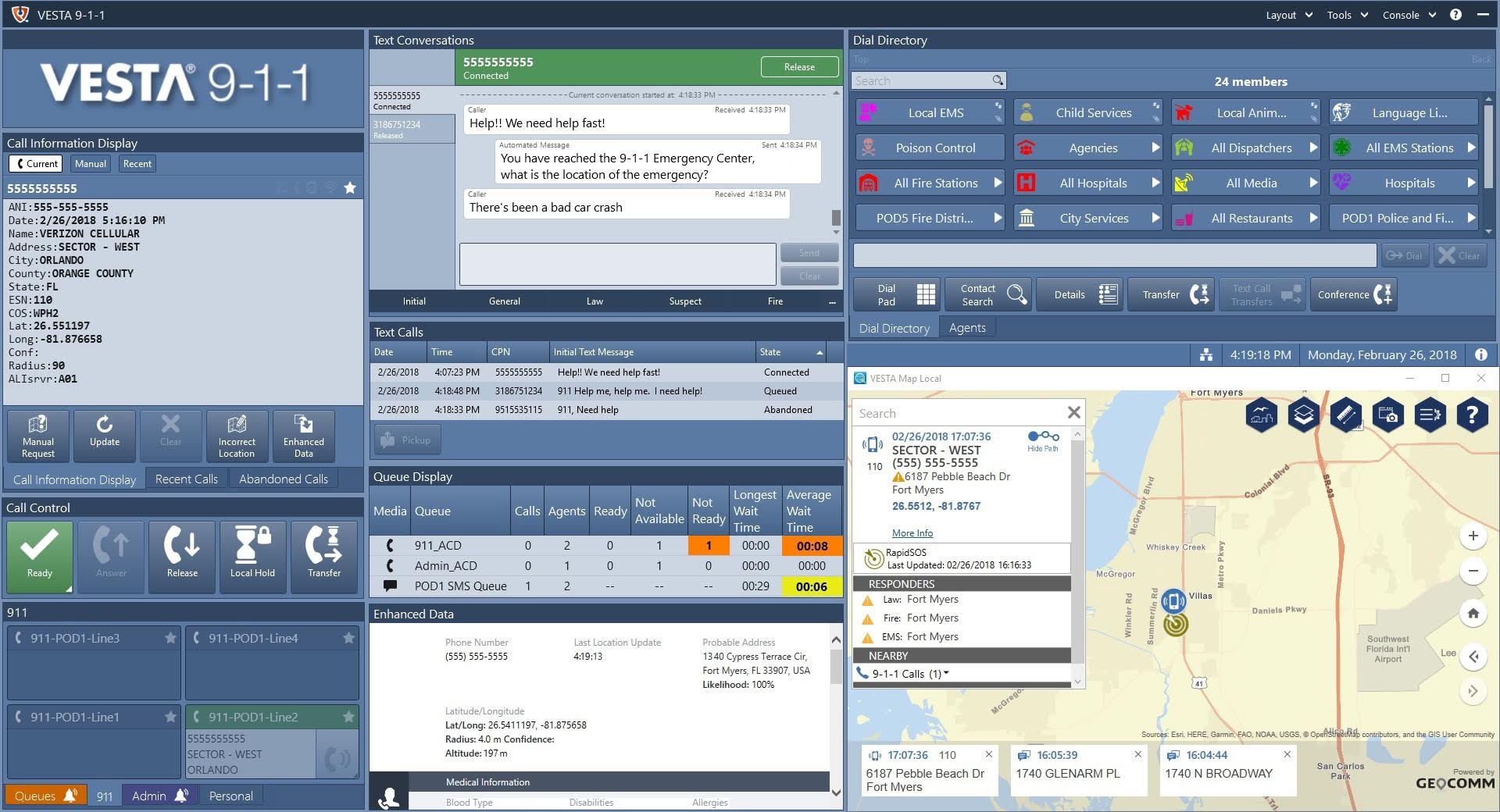
Carrier* Android and iOS both integrate with RapidSOS UNITE. RapidSOS then processes the rich emergency information from the user's device (enhanced location, videos and photos, etc), and is available to the 911 dispatcher in their dispatch software. 99.99% of Americans are covered by RapidSOS integrations in their municipalities.
https://rapidsos.com/public-safety/unite/
When the call comes in they can click a button and query RapidSOS for current 911 calls for that number and pull the information inwards.
https://www.baycominc.com/hubfs/2025%20Website%20Update/Prod...
cosmicgadget
It already exists. Emergency call is spec-defined.
joecool1029
I'll ask people, because I'm in the right circles. I want to know where it works. I've been VERY clear in my messaging to HN (on the RCS issue and having ear blown out by iPhone last week) that I am not going to glaze Apple even if the new modems they built interest me. They are usually sort of a neutral to me that has me more pissed off in the recent months than usual. Maybe send me one of your new devices if you don't want me pissed off anymore.
As for this location stuff, I'm curious though into how this works and how Apple (and BOOST/DISH) somehow prevent it happening when the big 3 in the US don't. We all know Apple would have complete control over the modem they designed, that's not a surprise. T-Mobile at least it's possible to stay NR-SA connected, it's apparently not a feature limited to SA like resistance to IMSI catchers are. Is this an OpenRAN feature, which Boost uses?
At least in the past, towers had a piece of equipment called a LMU that is sometimes installed separately from the radio equipment and it's used for measuring the timing advance to triangulate where a device may be for 911. Here's a reddit thread I started years ago for a KML of all the T-Mobile LMU installs in the NYC market: https://www.reddit.com/r/cellmapper/comments/hq2h7u/kml_of_a... (I just found it leaked, it's not online anymore probably). An FCC doc on LMU's: https://transition.fcc.gov/pshs/services/911-services/enhanc... (this is all old tech now, we're doing LTE/NR now in 99.9% of circumstances in the US)
heavyset_go
> triangulate
Trilaterate :)
joecool1029
You're not wrong, but it's annoying even the FCC uses triangulate in their documents for it.
Get the top HN stories in your inbox every day.
My friend was going through a pretty massive depression after his mom passed. He'd been with my wife and I at our house for a number of hours talking through it, and apparently not texting his sisters back. They called in a welfare check.
We live in a reasonably dense suburb. Police showed up at our front door and asked to speak with him. They just wanted to make sure he was doing OK. He asked them "how did you find me?" and their response was just "we pinged your phone".
Watching my security camera, they did not stop at any of my neighbors houses first. It was very direct to my front door. This leads me to believe whatever sort of coordinates they had were pretty spot on. His car was parked well down the block and not in front of our house so that was no give away.
This was five years ago and always struck me as a "Huh"