Get the top HN stories in your inbox every day.
impish9208
“There was this inescapable sameness, in a way. No matter what I did, I was in the same place doing mostly the same things,” she said. “I was very isolated, and nothing I could do could really change that. I’d wake up on certain days and realize, I’m just older.”
_benj
Maybe hot take…
I can see the point of sameness in homeschooling, but compared to traditional education? I’m not sure how much flexibility one would have to teach oneself calculus by 11 or the equivalent of an undergrad in math by 14!
That flexibility must be found in something non-traditional!
I’m no prodigy at all whatsoever but school was mostly dull and filled with teenager drama! Nobody knew what Linux was, cared about music production or anything interesting! The talk was which boy/girl whatever
cultofmetatron
its so much better nowadays. I"m 40 now and I'm low key jelous of kids today. Today if you want to learn to code, you have freecode camp and chatgpt to ask questions. Math? there's mathacademy and khanacademy. There are so many options now for learning stuff that we didn't have
pmdr
Learning opportunities are indeed better. But time sinks such as TikTok and YouTube have gotten exponentially better (read: addictive). I think there's a higher overall likelihood that a kid gets trapped in doomscrolling than in Khan Academy.
shivasaxena
I'm 36, but to be fair even in late 90s when we were kids we had
1) Forums like askanexper(can't remember the exact name) 2) great books like sams teach yourself in 24 hours and a habit to spend time in library 3) most importantly not as much competition as we have today. There were like a 2-3 kids in my schools of 2k who were into programming. Today that would be approaching half.
kiba
Very difficult to take advantage of if you don't have good control over your brain.
I am learning bit and pieces on how to do this but it's a long and uncertain process. Conflict monitoring is willpower is a new concept to me but it gave me a framework on how to improve my discipline over time.
SJC_Hacker
So many options but also a corresponding amount of competition and pressure
And with social media, you aren't just comparing yourself to your classmates, but with basically the entire world
ronjakoi
For those who speak strong English, yes
AlanYx
It's wonderful that Khan Academy played a role in enriching her early education. It's proving to be a solid resource across the spectrum of math ability.
AtlasBarfed
”Cairo applied to 10 graduate programs. Six rejected her because she didn’t have a college degree. Two admitted her, but then higher-ups in those universities’ administrations overrode those decisions."
This is both unsurprising and shocking to me at the same time.
For institutions of allegedly pure higher learning in a field where it's known that youth is where the advancement happens, the fact 80% axle wrap over a piece of paper that, let's face it, in modern times of grade inflation is pretty much worthless of anything beyond money and sitting in a seat for four years.
kurthr
A lot of programs don't want to have to babysit a teenager no matter how talented they are. Some of the more prestigious programs both have some experience with it and extra staff to (give profs warm fuzzies) handle any issues that come up. I'd expect it depends a lot on her interests and the particular professors that study that at any particular institution.
Even as a student, I'd be more interested in which professors at Johns Hopkins were accepting students, than which school.
xandrius
As if that was the reason.
Also, I've seen a great deal of adult babies in academia, so let's not be ageist here.
kelp_herder
I suspect the reason is not about babying her as much as it is a concern for her development, about whether she would be "missing out" on the opportunities for social and intellectual growth in college. This kind of thing is usually why well intentioned higher ed people put roadblocks in front of precocious young people.
currymj
i can understand a university administrator not feeling they can give a good educational experience to a 14 year old.
but she'd be the same age as all the first years on campus, any university must be institutionally equipped to deal with a 17/18 year old. seems like an odd choice to personally intervene to cancel an admission.
like presumably if she enrolled in a bachelor's program, and then signed up for grad math classes while doing independent research, this would be fine. but if she takes the same classes and does the same research for PhD credits instead, no good?
neilv
> Two admitted her, but then higher-ups in those universities’ administrations overrode those decisions.
I've personally seen universities go both ways, and it comes down both to individuals, and to the culture of the department/university faculty and administration.
(Not to the culture of the student body, which is influenced by the administration culture, but has very little institutional memory, and almost zero power. If you draw an analogy to nations, there might be one with the most awful 'leaders' seizing and abusing power, but that's "way above the pay grade" of the many nice citizens you will meet -- who didn't know what they were being born into, and will do their best to be decent to each other, despite whatever bits they're unfortunate to learn about the upper powers.)
graycat
Cairo may have a way out: Commonly the main criteria for a Ph.D. is: (1) Pass qualifying exams in several important topics in the field. (2) Do some research that is an "original contribution to knowledge worthy of publication" where the main criteria for publication is "new, correct, and significant".
No professor or university Dean can keep her from doing well on both (1) and (2). It looks like (1) would be easy enough for her. The work she has already done may satisfy (2). Once she has done well on (1) and (2), tough not to award her a Ph.D.
gus_massa
In my university, when someone is accepted as a graduate student of a different topic (let's say phisics -> biology) it's usual to include a few of the last courses of the major as a mandatory part of the Ph.D.
shermantanktop
- moved between countries or first/second gen immigrant? check
- home schooled? check
This on top of her extraordinary talent and hard work. Institutional education truly is a great leveler, at both the top and bottom.
stockresearcher
> moved between countries or first/second gen immigrant?
“Cairo grew up in Nassau, the Bahamas, where her parents had moved so that her dad could take a job as a software developer”
“Travel restrictions stranded her family at her grandparents’ house in Chicago. While they were there, she joined the Math Circles of Chicago”
This doesn’t read like an immigrant. It kind of reads like her dad is a fully American finance dev.
coderatlarge
“After the spring semester ended, her family moved from Davis to Berkeley — her brother had decided to transfer there — and Cairo finally felt able to settle in.”
fascinating that the family follows the kids’ educational steps.
fmbb
Are home schooled over-represented among mathematicians that solved major math mysteries?
Wait that would not even prove anything.
Are there no mathematicians who solved major math mysteries that went to school?
shermantanktop
I don’t know about major math achievements- the n is pretty small- but homeschooled kids are overrepresented in geography bees, spelling bees, and other academic competitions at the high school level.
https://readlion.com/homeschoolers-dominate-inland-northwest...
It appears that homeschooling enables students to pursue singular passions further than students in schools. It’s not for everyone though.
My point was just to note some other interesting characteristics beyond the age and gender that show up in coverage.
gosub100
I wonder what would have happened if she said "mom, dad, I want to be a fashion designer/chef/interior decorator." Undoubtedly, they would have supported her ambition and individuality..of course.
tocs3
Earlier discussion: https://news.ycombinator.com/item?id=44481441
I wish her the best in her coming career.
dang
Thanks! Macroexpanded:
A 17-year-old teen refutes a mathematical conjecture proposed 40 years ago - https://news.ycombinator.com/item?id=44481441 - July 2025 (105 comments)
myth_drannon
I find the Soviet idea of Math Circles so interesting and important. I bought books on the subject, but it's difficult to implement for your own children only. Nothing beats it like having an actual one, run by math teachers and in your city.
jarvist
Absolutely. Key for me was to invite children's friends (and family) along, host it in our house and make it a recurring weekly thing. The books (presumably you also have these from the MSRI's 'Mathematical Circles Library') are great, but week-to-week I've found the free online NRICH resources much more directly useful: https://nrich.maths.org/about-nrich
debo_
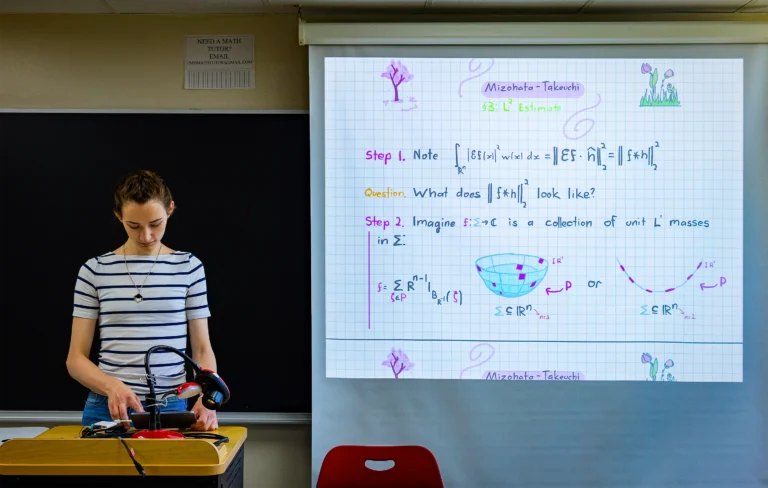
Her notes are so clear and so artfully wrought! I wonder if learning from online resources makes one naturally focus more on presentation.
From the article:
https://www.quantamagazine.org/wp-content/uploads/2025/08/Ha...
thrance
I studied math and knew a girl like that, spending an inordinate amount of times making sure to understand every single details of what we were taught, even going further when I could barely keep up. She would also make those pretty, colorful notes with visual interpretations and drawings in the margin. It takes a special form of love for the discipline. She just finished her PhD and is now starting a postdoctoral contract.
jagged-chisel
Looks like a prepared presentation rather than notes.
baq
If all presentations were prepared like this I’d probably attend them
jagged-chisel
Indeed. All presenters can take a lesson from this talented person.
yumraj
Wonder why Berkeley didn’t offer her PhD admission given that she was already working with the Prof there.
IvyMike
> When I was an undergraduate at MIT I loved it. I thought it was a great place, and I wanted to go to graduate school there too, of course. But when I went to Professor Slater and told him of my intentions, he said, "We won’t let you in here."
> I said, "What?"
> Slater said, "Why do you think you should go to graduate school at MIT?"
> "Because MIT is the best school for science in the country."
> "You think that?"
> "Yeah."
> "That's why you should go to some other school. You should find out how the rest of the world is."
-- Surely You're Joking Mr. Feynman
terminalbraid
I've been at institutions that explicitly discourage that because of that reason. They want you to get breadth of experience rather than work with the same one person for your early career.
sperginator
[dead]
MathMonkeyMan
Here's a link to the paper on the arxiv: https://arxiv.org/abs/2502.06137
larodi
Zvezdalina Stankova who comments on miss Cairo is on her own super out of the ordinary.
https://math.berkeley.edu/~stankova/
Not only she did grow in Bulgaria during the most turbolent times of regime change from communism to democracy, but later graduates with a PHD from Harvard, and later becomes Director and Founder of the Berkeley Math Circle, and is also organizer of math competitions in Bay Area, and publisher of what seems to be a complete set of Math Books, carefully crafted with her peers from BG and presented here
Curious whether miss Cairo was a student of hers or is to be.
throwaway81523
Alexander Givental is also involved with that, I think.
https://sumizdat.com/homepage/index.html scroll down.
PilotJeff
This math stuff is corrupting our youth.
Besides how can she just skip college and go right into a PhD? She hasn’t even taken intro to Sociology or poetry yet.
corimaith
>Cairo kept reading and thinking. Eventually, she found a way to construct a strange, complicated function out of waves whose frequencies all lay on a curved surface — the type of surface the conjecture required. Usually, when you add these kinds of waves together, they interfere, canceling each other out in some places and reinforcing each other elsewhere.
Rather than speaking about her age or the vague notion of talent, I'd be much more interested in why the rest of the academia was unable to replicate her methods in 40 years or so. From her own admission, it was throwing different ideas and approaches until she saw a disprecancy that ultimately disproved the theorem. There should be many people far more experienced who do have the knowledge to do this, but why did they not? This dosen't look like a intuitive jump, seems more like building a test case that fully stressed the theorem.
thrance
Heh, take a look at her paper [0]. It is much more complex that TFA makes it out to be: once you have the intuition you need to prove it actually disproves the theorem.
Also, it's probably a not very well known conjecture that people wouldn't care too much about. Also also, it was a conjecture: people were probably looking to prove it rather that disprove it, failing and then giving up.
Get the top HN stories in your inbox every day.
Related: https://news.ycombinator.com/item?id=44481441 - July 2025 (105 comments)