Get the top HN stories in your inbox every day.
fumeux_fume
saretup
You sound more prejudiced against AI than they seem to be hyping AI in that sentence.
Yes, they’re very good coders; no, they aren’t perfect. Sometimes they make trivial mistakes or hallucinate, and other times they have unique insights about difficult problems or one-shot a lot of complex tasks.
If you don’t see the value of AI even at this point, you’re either lacking imagination and/or just too stuck in your own ways.
sampullman
I appreciate the value of AI in my own work, but "they’re very good coders" and "they make trivial mistakes or hallucinate" seems incongruous.
For me, AI tools shine when I know enough about a topic to quickly error check, but not enough where I can code fluently without documentation. I'm sure it will get more useful over time, but that's where it's been for me for the last year or so.
saretup
> "they’re very good coders" and "they make trivial mistakes or hallucinate" seems incongruous.
It seems that way if you judge them the same way you would human coders, but they’re different. They might be able to do things that veteran coders can’t without spending days on it, and fail at things that beginners can do in half an hour.
A car might not be able to traverse difficult terrain as well as a horse, but it doesn’t mean the car is not a good mode of transportation.
const_cast
I don't think they're good coders at all, I think they're good at generating small snippets of codes.
If you tried to replace a programmer with whatever LLM it would completely flop. Just write a script to fetch Jira tickets and let it rip - it won't work well. Because it doesn't know that maybe the Jira ticket is stupid, or that if they implement this change it requires insight from Team X, or that this bug is really intended behavior, etc.
Being a programmer is much more than, like, making a neat regular expression or generating slightly customized boilerplate. As it stands, these are assistants in which programmers guide and handhold them the whole way. They are not coders.
vonneumannstan
So whats actually important are PMs. Got it.
otabdeveloper4
They aren't good coders. They know nothing about the problem domain requirements. (The meat of programming.)
> bu-but you can waste your day writing prompts to get around the fact that LLMs are brainless!
Yes, and?
keiferski
I don’t understand this viewpoint at all. Even if AI tools are nothing more than complex autocomplete systems - and not some kind of new consciousness - that alone is enough to dramatically shift entire industries. And it already is doing so…this isn’t theoretical anymore.
vanschelven
Not OP, but I think the viewpoint here is simply "if someone makes an evidently false claim ('great coders') right off the bat, it's enough to color the reading of the rest of the article. That's independent of what you're saying
keiferski
Fair enough, but not sure that's much better of a viewpoint. It might be a worse one. The off-hand comment was "very good coders" (not "great") and dismissing the person's entire thought process because of a nitpick is not a good way to learn anything.
skydhash
Just check any mature project's commit history. It's rarely that huge, even for things that brought in features. Here's a PR[0] that's less than the usual rambling ChatGPT produces, and add a valuable feature to the software. More often than not, you spend more time designing the feature than actually coding it. And a huge part of the design process is dealing with impact to other parts of the project.
undefined
KolibriFly
The gap between demo impressive and reliably useful in real-world scenarios is still huge in a lot of cases. That said, I think the concern isn't that AI is flawless now, but that it's improving at a pace we haven't really seen with other technologies
__loam
It's really funny to see someone say this technology, which seems to be plateauing with marginal improvements after a few years, is improving at a pace we have never seen before, in an industry that is built on the microprocessor. Astoundingly ignorant.
mallardgryph
The marketing for it all has been something else. It's a technology that demos extremely well, and is surface level very impressive, and to those who wern't paying any attention to its evolution, appeared to come out of nowhere.
But this line of "its only going to get even better" is a mantra that's endlessly expounded on, a brain worm even. It's never backed up with any observable evidence. It's marketing that they're tricking people into repeating.
otabdeveloper4
Correct. We've reached negative returns on increasing parameter counts. This is a dead end unless they figure out how to microtune models on ultra-specific niches.
bobxmax
there are hundreds of thousands of developers, lawyers, artists, musicians, etc who have transformed what they're doing with AI
KolibriFly
The progress is fast, no doubt - but the hype sometimes skips over how messy the middle still is.
otabdeveloper4
> very good legal analysts
This one in particular is a hearty kek.
bobxmax
I'm sick of this forum's lame performative cynicism masquerading as depth—it's a lazy cop-out that spares you people from the uncomfortable, demanding work of actually building something better.
Technology that any of us 5 years ago would've thought was a hundred years away and all you read is moving goalposts from ornery developers in denial.
Silicon Valley is cooked.
hbartab
> We certainly need to partner with industry. Because they are so far ahead and are making such giant investments, that is the only possible path.
And therein lies the risk: research labs may become wholly dependent on companies whose agendas are fundamentally commercial. In exchange for access to compute and frontier models, labs may cede control over data, methods, and IP—letting private firms quietly extract value from publicly funded research. What begins as partnership can end in capture.
monkeyelite
> research labs may become wholly dependent on companies
They already are. Who provides their computers and operating systems? Who provides their HR software? Who provides their expensive lab equipment?
Companies are not in some separate realm. They are how our society produces goods and services, including the most essential ones.
klabb3
Sorry for meta but.. this is one of those rare cases where both the argument and the rebuttal are worth agreeing with.
rtkwe
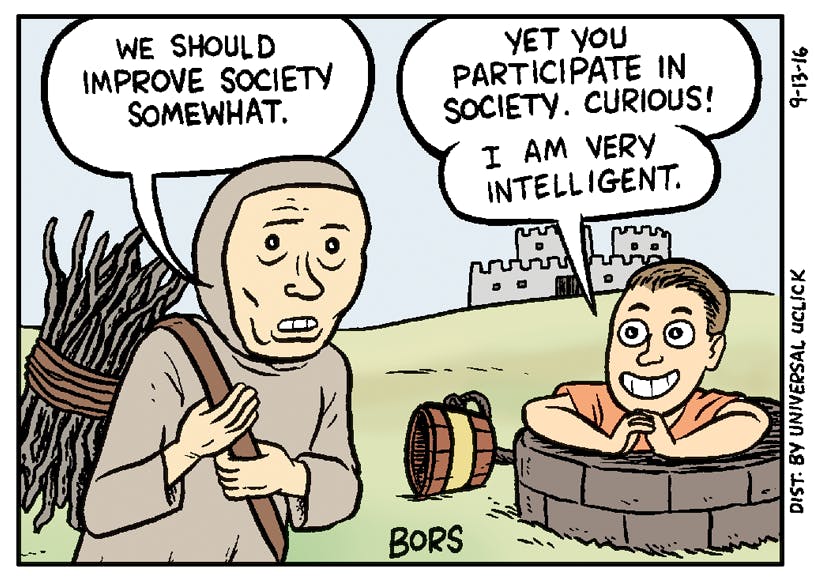
For purchases sure but their funding and therefor what they're buying with that funding is not tied to companies at all which is an incredibly important distinction. This rhymes with the old "yet you participate in society/capitalism" "gotcha" [0] and it's worth about as much.
[0] https://iea.org.uk/wp-content/uploads/2021/12/mister-gotcha-...
hdivider
I fail to understand the sentiment here.
This is the intention of tech transfer. To have private-sector entities commercialize the R&D.
What is the alternative? National labs and universities can't commercialize in the same way, including due to legal restrictions at the state and sometimes federal level.
As long as the process and tech transfer agreements are fair and transparent -- and not concentrated in say OpenAI or with underhanded kickbacks to government -- commercialization will benefit productive applications of AI. All the software we're using right now to communicate sits on top of previous, successful, federally-funded tech transfer efforts which were then commercialized. This is how the system works, how we got to this level.
delusional
> As long as the process and tech transfer agreements are fair and transparent
I think that's the crux of the guy you're responding to's point. He does not believe it will be done fairly and transparently, because these AI corporations will have broad control over the technology.
hdivider
If so, yes indeed, fair point by him/her. It's up to ordinary folks like us to push against unfair tech transfer because yes, federal labs and research institutions would otherwise provide the incumbents an extreme advantage.
Having been in this world though, I didn't see a reluctance in federal labs to work with capable entrepreneurs with companies at any level of scale. From startup to OpenAI to defense primes, they're open to all. So part of the challenge here is simply engaging capable entrepreneurs to go license tech from federal labs, and go create competitors for the greedy VC-funded or defense prime incumbents.
worldsayshi
> What is the alternative?
Reasonably there should be a two way exchange? It might be okay for companies to piggyback on research funds if that also means that more research insight enters public knowledge.
rapind
I’d be happy if they just paid their fair share of tax and stopped acting like they were self-made when they really just piggybacked on public funds and research.
There’s zero acknowledgment or appreciation of public infra and research.
dekhn
What do you mean universities can't commercialize in the same way (I may have misunderstood what you meant)? Due to Bayh-Dole, Universities can patent and license the tech they develop under contract for the government- often helping professors start up companies with funding, while simultaneously charging those companies to license the tech. This is also true for National labs run by universities (Berkeley and a few others). the other labs run under contract by external for-profit companies.
hbartab
If this were just about tech transfer, in which private firms commercialize public research, I agree. But that's not what Jason Pruet is saying. In the Q&A he notes:
> “Why don’t we just let private industry build these giant engines for progress and science, and we’ll all reap the benefits?” The problem is that if we’re not careful, it could lead us to a very different country than the one we’ve been in.
This isn't about commercialization, it's about control. When access to frontier models and SOTA compute is gated by private interests, academics (and the public) risk getting locked out. Not because of merit, but because their work doesn't align with corporate priorities.
BurningFrog
R&D results should be buried under a crystal obelisk at the bottom of the ocean, to warn to future generations.
mdhb
This is literally THE scam Elon, Thiel, Sacks and others are running as they gut the government.
Sell assets like government real estate to themselves at super cheap rates and then set up as many dependencies as they can where the government has to buy services from them because they have nowhere else to turn.
To give an example this missile dome bullshit they are talking about building which is a terrible idea for a bunch of reasons.. but there is talks at the moment of having this run by a private company who will sell it as a subscription service. So in this scenario the US military can’t actually fire the missiles without the explicit permission of a private company.
This AI thing is the same scam.
FilosofumRex
Right on target, publicly funded research always ends up in the hands of private profiteers via private university labs.
If LLM/AI is critical to national security, then it should be funded solely via the Dep of Defense budget, with no IP or copy right derivatives allowed.
mindslight
The political platform for rebuilding our country after the destructionists are deposed (which will happen sooner or later) needs to include scrutinizing every single one of these sales and/or long term contracts, and outright invalidating many of them as the fraudulent conveyances that they are. No just accepting the nonsense of "oh that's private property now, nothing can be done". If the precedent discourages "investment" (aka looting) of government institutions in the future, that's a good thing.
hahajk
In the case of huge frontier LLMs, the public labs will likely never be able to compete. In my experience, govt orgs are ardent rule-followers and wouldn't be as willing to violate copyright.
godelski
There's a risk but there's also great reward if it is done properly. The only way to maximize utility of any individual player is to play cooperatively[0]. A single actor might get a momentary advantage by defecting from cooperation, but it decreases their total eventual rewards and frankly it quickly becomes a net negative in many cases.
That said, I'm not very confident such a situation would happen in reality. I'm not confident current industry leaders can see past a quarter and nearly certain they can't see past 4. Current behavior already indicates that they are unwilling to maximize their own profits. A rising tide lifts all ships, but many will forgo the benefit this gives them to set out to explore for new and greater riches and instead are only able to envy the other ships rising with them. It can be easy to lose sight of what you have if you are too busy looking at others.
[0] Simplified example illustrated by Iterative Prisoner's Dilemma: https://www.youtube.com/watch?v=Ur3Vf_ibHD0
[0.1] Can explain more if needed but I don't think this is hard to understand.
KolibriFly
The optimist in me hopes we'll eventually reach some equilibrium where collaboration wins out
catigula
What's the "reward"?
I want to interrogate AI optimist type people because even if AI is completely safe and harmless I literally see only downsides.
Is your perception that living in theorized extreme comfort correlates to "reward"?
christophilus
You really see only downsides? I’m no AI optimist, but it is a useful tool, and it’s here to stay.
shagie
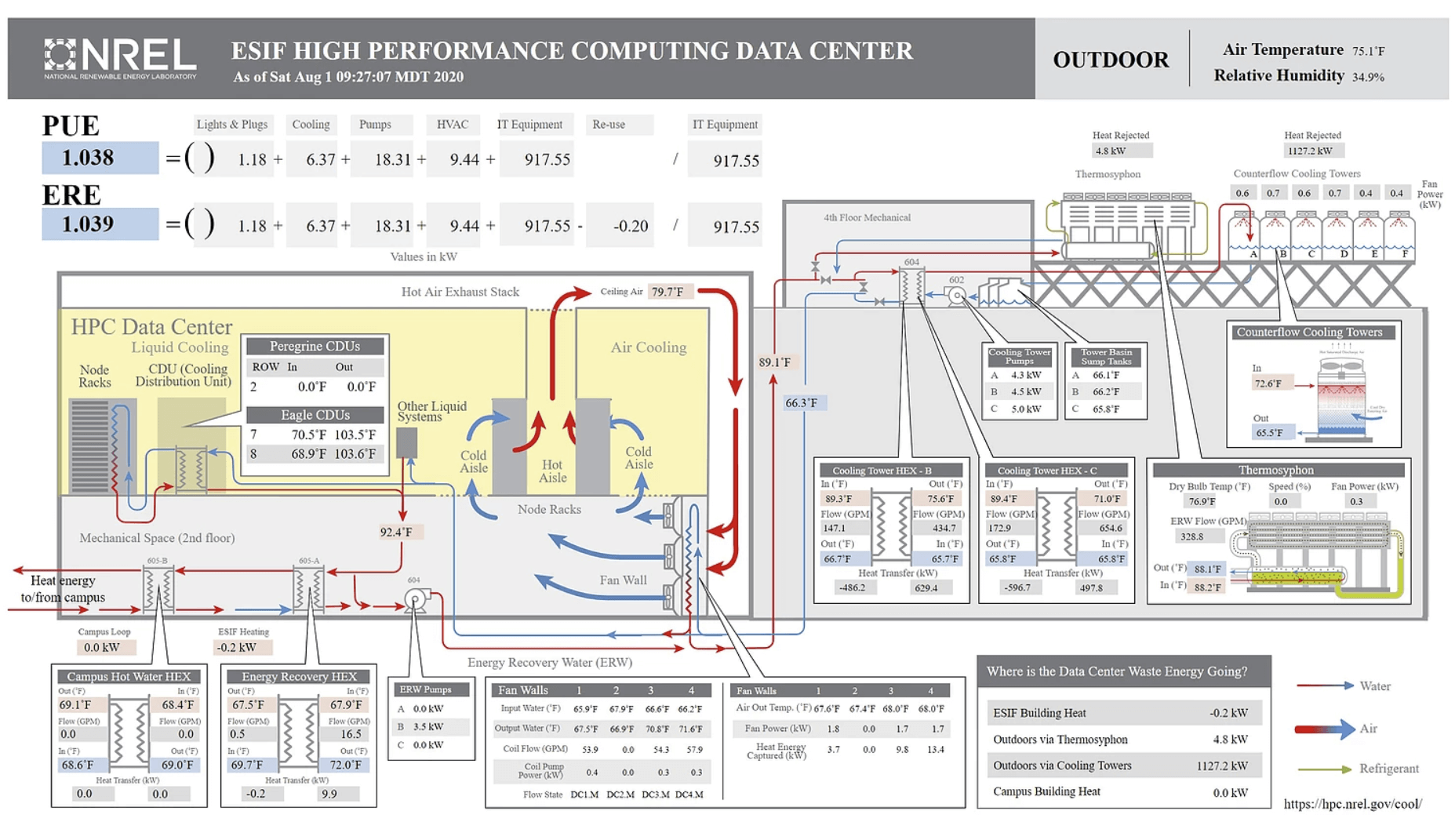
The point of https://www.nrel.gov/index is to research how to do renewable energy. Likewise, the research done by https://www.nrel.gov/hpc/about-hpc and its data center https://www.nrel.gov/computational-science/hpc-data-center is to pioneer ways to reuse its waste heat (and better cool existing data centers).
I'm kind of disappointed that their dashboard has been moved or offline or something for the past few years. https://b2510207.smushcdn.com/2510207/wp-content/uploads/202... is what it used to look like.
KolibriFly
Once public research depends on private infrastructure, the balance of power shifts fast
tantalor
I was a bit puzzled what "1663" is. Here's what I found:
> The Lab's science and technology digital magazine presents the most significant research initiatives and accomplishments from national-security-related programs as well as projects that advance the frontiers of basic science. Our name is an homage to the Lab's historic role in the nation's service: During World War II, all that the outside world knew of the top-secret laboratory was the mailing address - P.O. Box 1663, Santa Fe, New Mexico.
https://researchlibrary.lanl.gov/about-the-library/publicati...
stonogo
The actual reason is "because they're being told to." Before that, there was a massive public-cloud push DOE-wide. Nobody outside of ASCR is interested in computing, and there's a lot of money to be made if you can snag an eternal rent check for hosting federal infrastructure.
senderista
Clearly AI is worthy of public investment, but given the capture of this administration by tech interests, how can we be sure that public AI funding isn't just handouts to the president's cronies?
candiddevmike
How about we fix global warming and switch 100% to clean energy, and then invest in AI?
ben_w
To the extent that further improvements to AI remain economically useful, "let's do these other things first" means your economy trails behind those of whoever did work on the AI.
To the extent that further improvements to AI are either snake oil or just hard to monopolise on, doing everything else first is of course the best idea.
Even though I'm more on the side of finding these things impressive, it's not at all clear to me that the people funding their development will be able to monopolise the return on the investment - https://en.wikipedia.org/wiki/Egg_of_Columbus etc.
Also: the way the biggest enthusiasts are talking about the sectoral growth and corresponding electrical power requirements… well, I agree with the maths for the power if I assume the growth, but they're economically unrealistic on the timescales they talk about, and that's despite that renewables are the fastest %-per-year-growth power sector and could plausibly double global electrical production by the early 2030s.
haswell
> To the extent that further improvements to AI remain economically useful, "let's do these other things first" means your economy trails behind those of whoever did work on the AI.
The major question is: at what point will unaddressed climate change nullify these economic gains and make the fact that anyone worried about them feel silly in retrospect?
Or put another way, will we even have the chance collectively enjoy the benefits of that work?
ngangaga
Well yes, nationalism will be the dagger in the heart of humanity. But AI won't do anything to address this; in fact, leaning into the concept of competing rather than cooperating economies will accelerate pushing the dagger in.
grey-area
Is generative AI economically useful? More economically useful than switching to renewable energy?
CooCooCaCha
That’s why I wonder if a planetary government is inevitable sometime in the future. We can’t address species-wide issues if we’re constantly worried about competition, and if market forces aren’t going to work then the only other solution I can think of is a bigger, more powerful entity laying down the law.
dale_glass
Who "we"?
The people qualified to fix global warming aren't the same people qualified to work on ML.
XorNot
Don't you know? Humanity can only solve one problem at a time in order of importance.
And it's corollary: something being in the news or social media means everyone else has stopped working on other problems and is now solely working on whatever that headline's words say.
threeseed
Yes they are.
I've worked with hundreds of Data Scientists and every one had the ability to work on different problem areas. And so they were working on models to optimise truck rollouts or when to increase compute for complex jobs.
If as a society we placed an increased emphasis on efficiency and power consumption we would see a lot more models being used in those areas.
85392_school
You'd probably meet the talking point that if we don't accelerate AI development China will win.
undefined
engineer_22
Let's also cure cancer and stop all wars while we're at it.
madaxe_again
Don’t forget world hunger.
I don’t understand this line of reasoning - it’s like saying “you’re not allowed steam engines until you drain all of your mines”. It’s moralistic, rather than pragmatic.
GolfPopper
You friendly megachurch pastor, I mean TV psychic, I mean AI that will be coming real soon will do that for you! Just send money now.
threeseed
There is no one cancer but we are working to cure as many variations as we can.
undefined
bcoates
1. Build atomic power plants sufficient to supply electricity needs for projected future AI megaprojects
2. Inevitable AI winter
3. Keep running the plants, clean energy achieved, stop burning coal, global warming solved
GolfPopper
The problem is that's far from a guaranteed path. What if, instead we get:
1. Plan to build atomic power plants sufficient to supply electricity needs for projected future AI megaprojects.
2. Build the AI megaprojects first, because of fallacies related to sunk costs, urgency, and unwillingness to let the pyramid scheme collapse.
3. Never complete the nuclear plants, never get the pot of gold at the end of the AI rainbow, and pump a couple hundred million tons of CO2 into the atmosphere in the mean time.
undefined
whatever1
This is the plan. Build all the clean infrastructure with the fake promise of AI and once the bubble bursts, boom. We have spare clean capacity for everyone.
_heimdall
We can't just switch to clean energy, we would need to drastically reduce our energy use per capita.
dlivingston
Absolutely not. We would be moving backwards as a society. Increased energy usage is a bellwether of societal advancement. See the Kardashev scale and Dyson sphere for example.
threeseed
Which is actually a problem AI is perfect for.
conradev
The DOE has been building supercomputers for a while now: https://en.m.wikipedia.org/wiki/Oak_Ridge_Leadership_Computi...
godelski
Even more importantly, they are GPU based. The US has 3 exascale computers (out of 3 in the world). I should stress that these measurements are based on LINPACK, and are at fp64 precision. This is quite a different measurement than others might be thinking of with recent announcements in AI (which are fp8)
giardini
LLMs seem to be plateauing. I'd rather let the markets chase AI.
swalsh
How do you make that assessment? I'll admit, the knowledge base is not 10x every few months anymore, but the agent capabilities keep getting better. The newer models can do a lot of useful work accurately for a while. That wasn't true several months ago.
overgard
Wake me up when they solve hallucination.
voidspark
"LLM" is not mentioned anywhere in the article.
nyarlathotep_
There's a serious issue around naming here, I'll agree.
I assume "AI" in contemporary articles, especially as it pertains to investments, means "Generative AI, especially or exclusively LLMs."
voidspark
The article explains that the lab would support universities by providing infrastructure.
b59831
[dead]
woah
HN commenters in 1960:
> Clearly computer networking is worthy of public investment, but given the capture of this administration by military industrial interests, how can we be sure that public networking funding isn't just handouts to the president's cronies?
myhf
There was literally a vaporware "AI" hype cycle in 1960. Propositional logic programming was poison to investors for 50 years because of that one, just like LLMs will be poison to investors for 50 years because of this one.
dekhn
Check out the history of BBN, who was deeply involved in the creation of the modern internet. There was an open revolving door between BBN employees and granting agencies, and BBN was even charged with contract fraud by the government . It's owned by Raytheon- a classic defense company.
Our country's tight relationship between the government, military, academia, and industrial has paid off repeatedly, even if it has some graft.
newfocogi
Another recent AI article out of LANL: https://www.lanl.gov/media/publications/1663/1269-earl-lawre...
And discussed on HN: https://news.ycombinator.com/item?id=43765207
This does feel like a step change in the rate at which modern AI technologies and programs are being pushed out in their PR.
Zorass
Whether AI is a “good programmer” really depends on what you mean by programming. If it means being fluent in syntax, quickly generating prototypes, and recalling large amounts of code patterns, then yes, it's surprisingly strong. But if being a programmer includes debugging intuition, tracking context over multiple sessions, and knowing when not to write code, it's still not there yet.
zkmon
I like how he says that AI is a general-purpose technology like electricity.
KolibriFly
Whether it's hype or not, treating AI as a general-purpose tech isn't that wild when it's already touching code, writing, design, logistics, education (you name it)
andy99
The real title is "Q&A with Jason Pruet"
lp251
wonder if they still train all of their models using Mathematica because it was impossible to get pytorch on the classified systems
pphysch
AFAIK that was mostly due to a silly detail about MD5 hashing being restricted on FIPS compliant systems? Or something like that. I'm pretty sure there's an easy workaround(s).
lp251
there were a bunch of reasons. couldn’t bring compiled binaries onto the red, so you had to bring the source + all deps onto a machine with no external internet.
it was unpleasant.
LAsteNERD
PR in here for sure, but some smart context on the scientific and nat security potentional the DOE and National Labs see in AI.
zzzeek
> Over the last two years, we’ve more or less run out of benchmarks where AI isn’t better than humans.
this whole "benchmarks" thing is laughable. I've been using Gemini all week to do code assist, review patches, etc. Such impressive text, lists of bullets, suggestions, etc., but then at the same time it makes tons of mistakes, which you then call it on, and it predictably is like "oh sorry! of course!" yes of COURSE. because all it does is guess what word is most likely to come after the previous word. is there a "benchmark" for "doesn't hallucinate made up BS?" because humans can do very well on such a benchmark.
Get the top HN stories in your inbox every day.
> If you’ve played with the most recent AI tools, you know: They’re very good coders, very good legal analysts, very good first drafters of writing, very good image generators. They’re only going to get better.
Most of the bullshitters will tip their hand pretty early that they're just hype men for AI. Right off the bat, the fact that AI is disruptive and transforming society is apparently self-evident because they never cite a single premise or event to back this up. In the quote above, the phrase "if you've played" stuck out to me. Yes if you play around with them a little it's easy to believe they're really good at so many things. When you stringently evaluate them, you begin to see they make a lot of mistakes and perform inconsistently on even trivial tasks.