Get the top HN stories in your inbox every day.
jongjong
djmips
Perhaps a side note - but I know a case where someone whose code had a lot of bugs and design problems but when they were with the company they worked very hard and would address problems - often with band-aid solutions but at least they took care of their own messes so it didn't fall onto others. All of this hard work and long hours and diligence made them seem to management as if they were amazing. However after they have left, they are obviously no longer supporting their terrible code and the ones who had to take it over will certainly demonize the departed - it's a bit unfair but someone who isn't helping fix their own mess (even if they have a good reason - they moved on) is still a huge negative. You are right though, this is somewhat a biased perception and scapegoating is real.
jongjong
Great observation. I think this is often the case with overrated developers. The fact that they churn out a lot of lines of code can make them seem highly productive.
genghisjahn
These articles come out with some regularity, and yet no one ever says, "Yep! That's totally me! I'm a non contributing zero but I've made a living at making others think I add to the team!" Everyone knows people like this, but no one is one.
LazyCroHacker
Yo.
Ask me anything.
Edit : I'm actually serious. I don't do most of the things in the article, or at least definitely not with the intent and detail - but I've been moved over time from being a pretty good and certainly respected hands on techie, to a middle to upper manager with massive imposter syndrome, and certainly feel I contribute less for more credit. Client loves me. My boss loves me. My team loves me. But I myself definitely struggle to always understand my value and I definitely spend many hours each week fine tuning PowerPoint slides, reporting, over communicating, team building, teaching people to communicate differently, etc - which again, seems to make everybody happy and impressed. Maybe my hidden talent is communicating between techies and business? Possibly there's real value in my role - but DEFINITELY not according to any hacker news colleagues - nearly everything I do is venomously dismissed by th HN zeitgeist (I'm neither surprised nor resentful - I spent 20 years saying same things, until I have become them:) . So - AMA :)
mrtksn
Maybe attaching all the value to technical contributions was incorrect behaviour in first place?
I used to do that a lot until I got my first real not fully technical job and realised that all the technical stuff is actually much more learnable by many, much less impactful on the work than the dark art of working with humans. Maybe its the zeal of the convert but I think the technical contributions are not that important unless there is no margin for errors or its groundbreaking work and most of the time its not.
ilyt
That's because people working with humans tend to be TERRIBLE at keeping proper documentation about their job. If "people person" kept full psychological profile of each client and manager they work with it would be way easier to replace them so in a way it is a job-security-guaranteeing move to be obtuse.
Joking aside the way I see it is that you have to have some vision on the product, enough organization skill (which can be another person specialized in translating "visioner" ramblings into actionable stuff) to organize making it, enough marketing skill to actually sell it, and then enough tech/engineering oriented people to not fuck the product up.
Bad engineering - product that kinda works shit but depending on niche it can still be good enough to be profitable
Bad marketing/client acquisition - most cases bankruptcy, very small amount of things "sell itself", unless you get luck.
Bad vision - well, if rest is fine you either pivot to something else and deliver or bankrupt
Bad communication/managing - inefficiencies at every way that can and will hamper everyone else.
wruza
spend many hours each week fine tuning PowerPoint slides, reporting, over communicating, team building, teaching people to communicate differently
I’m in a process of leaving a company where I work at for way too many years (cause I liked the job and its tech samurai format, not even the money), because there is no person like you and the “management” actively refuses to hire one, while steadily degrading into communicating through incomplete, false and illiterate streams of consciousness and providing organizational help through lowest common denominator roles who basically return to you in a couple of days asking you to do their heavily miscommunicated job for them. Sometimes I helped people doing my own request not even realizing it, so perverted it became. Any issue harder than “we’re out of paper” isn’t worth reporting. Any new module or a process is a brainstorm between me and other roles on what “they” meant and how their words most likely correlate. The tragedy is that the team is actually good, just has no clue what we do and what the plan is.
lazyweb
Holy crap that resonates 100%. And soon I'm supposed to step into a more management style role there. Have not signed the new contract yet, though.
vegetablepotpie
I’m an aspiring overrated person, I started as a developer, then was promoted into a product owner role because of attrition. I have ended up spending most of my day in meetings and being interrupted over IM, and there is not much time for coding. Realistically, I should either do less meetings, or commit to less coding. The latter is better because I’m not as good at coding as my peers.
My barriers are that I’m not great at the people skills, and to compensate I’ve focused on the technicals of this pseudo leadership role such as making graphics for power point slides, and agile administration, like using the tools and scheduling those rituals.
How can I make the leap to doing no coding and just doing the meetings and delegation?
ary
> I definitely spend many hours each week fine tuning PowerPoint slides, reporting, over communicating, team building, teaching people to communicate differently, etc - which again, seems to make everybody happy and impressed
This is why people love you. You're massively underestimating the amount of spoon-feeding people desire. The alternative to people like you is for individuals to do the work of understanding and empathizing outside their areas of interest or domains of expertise and/or comfort.
eastbound
In my first Agile company, it felt like we developers were inventing features! In fact, a PM was spoon feeding the backlog to us, organized by theme, letting us invent the interesting parts. I only realized it 10 years later.
robotresearcher
You listed communication and communication-training things. These are very valuable and easy to under-value. The API to an organization is people. Speaking this language you are serving your team.
q-big
First: there is of course an incentive not to admit this.
Second: I do believe that many people on HN really deeply care about technology/hacking topics and have detest for office politics. On the other hand, the people that the article discuss are good at office politics/marketing themselves and often don't have such a deep knowledge about programming. Thus, I would indeed assume that the typical HN reader/writer less likely fits into the "highly overrated people" pattern of the article.
majormajor
> Second: I do believe that many people on HN really deeply care about technology/hacking topics and have detest for office politics.
I think it's more accurate to say that they have a detest for dealing with people in ways that require persuasion, or more generally situations without an "objective" right answer.
You want to do A, someone else wants to do B, you can't do both, you both think you're right, boom, "politics."
vinay_ys
A lot of the time, the person who takes this stance tend to forget that execution matters more than the idea being objectively correct. Good "politics" is about persuading the actual people who have to own and execute that idea. There are bad situations where you find yourself opposite people who add little value that is obvious and yet demand they be persuaded or else they will stand the way of your idea. When the emotional burden of fighting such battles crosses a certain threshold you feel burn-out and give up. This threshold is high for people who can do office politics well and it is low for most self-described techies. This does not mean that latter kind of people don't create the same emotional stress for others through their own political schemings (yes, even without knowing consciously, we are all political animals in our own ways – we wield what powers we have to attain our agenda, in however good or bad ways we do it).
paulcole
The average HN reader is highly overrated for other reasons.
> have detest for office politics
The problem is that many people on HN believe any interaction with someone with an MBA, marketing background, manager, etc. is “office politics.”
GoOnThenDoTell
Any interaction with another human at work is politics
q-big
> The average HN reader is highly overrated for other reasons.
Possibly ... ;-)
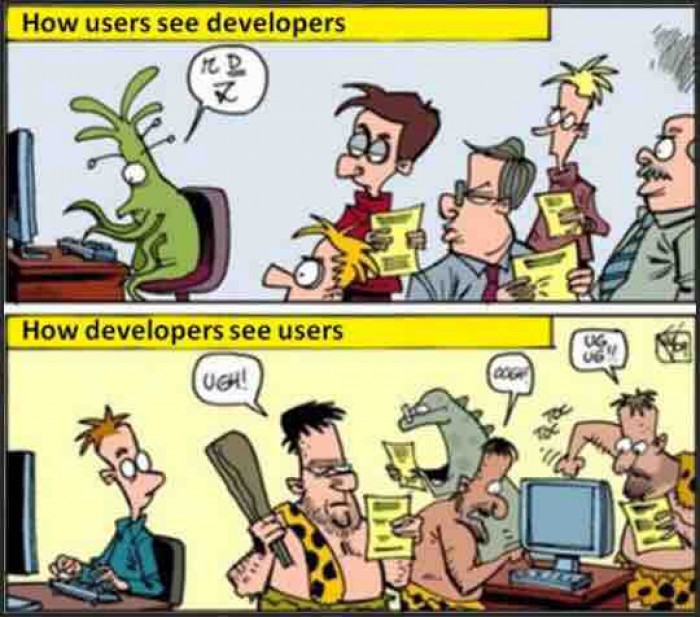
dickersnoodle
It pretty much is. See https://devhumor.com/content/uploads/images/April2016/how-de....
serverholic
Yes because if you look at it objectively those people tend to be lying, manipulative people with big fake smiles on their faces.
People are so accustomed to our messed up society that they don't even realize how amoral "normal" behavior is.
seattle_spring
That seems like kind of a strawman, doesn’t it? I’m not convinced anyone really thinks what you are claiming.
jpmoral
I think the problem is that people think that all office politics is necessarily bad.
srcreigh
Lack of interaction is a strong participation in office politics as well.
undefined
davesque
I think the reality is that anyone might engage in these behaviors from time to time. I've seen myself doing some of these things in my weaker moments and I've seen others doing them. And I've seen those same people turn around and contribute positively on other days. Of course no one is going to categorize themselves as highly overrated. Maybe that's because people often don't reliably fit into specific categories.
ilyt
Well, some of them are not exactly something you'd do on purpose, can be just from the work flow, or just how some people are
> Distract with Arguments about Minutiae
is easy for tech people as we could discuss every detail for tens of minutes ignoring the fact remaining 4 people in the meeting don't give a shit about the minutia of solution, just that it is done
> Time It So You Look Good (Or Everyone Else Looks Bad)
is easy if you (or your manager!) mismanages priorities of tasks and you don't have habit of starting with stuff that might block other people first..
Like, simeple example, ticket looks "long" from title so you don't even read it before you have longer time period. You read it, then it turns out before start you need some information first from the submitter.
You now delayed tasks by hours, maybe days, compared to if you read it first, sent the "give me stuff I need" message, then went back to doing other things before the response came
oxfordmale
There is a fine line between being highly overrated or just being successful at selling your achievements. I suspect a lot of people start out successfully selling their genuine achievements, but over time realise they can just do the selling.
rramadass
Well said!
They get caught up in the image they have created of themselves. I think there is a need for "Social Adaptation" but taken too far becomes counter-productive i.e. you lose authenticity.
toast0
You could probably say this about my last year or so at my previous job, but I didn't really use these strategies. I just had a plan to leave without leaving a gap, so I intentionally allowed my ongoijg work to be taken over, stopped picking up new things, and made sure to finish up the loose ends. I also had some time for leadership and mentoring, but I think that was more real than the type of leadership in the article; I did build a working prototype and provided real code review help and meeting support (which isn't very technical, but can be really helpful for a junior employee to keep a project moving). At the end, people expressed to me that they thought it would be hard for them after I left, but it really wasn't.
Also, I'd have to say, if you're at a small company, being the person who sets up corporate/production accounts gets you in as an important person for new employees and really helps with being overrated, because everyone has interacted with you.
mrtksn
I actually don't like that kind of articles at all precisely because I tend to find things from myself and the authors often do very bad job in analysing these behaviours because the articles are one sided "hit pieces" that essentially promote a narrative or a worldview.
All the same behaviours can be written in a self improvement post on LinkedIn or something or a successful person might try to attribute the success to these behaviours. In its core its all the same, at best people trying to explain things they don't understand using broken mental models and at worst people trying to explain their failure through their virtues(I could have been great but I'm too good of a person to act in that way).
IMHO all these behaviours have different roots and dynamics and plays little role in the actual results(being successful or overrated).
rramadass
Good nuanced view point!
nonrandomstring
The acceptance of others in our team called "society", who assume as a matter of human dignity that we each "add" something, is how we all get by and live. We're all nice people, terrified of growing old and alone, being left out out in the cold and hungry. We're all part of the same team, under the same shit system that makes us feel safer by devaluing others.
rramadass
Damn; Don't rip apart the facade like that!
ChrisMarshallNY
I have known many folks like this. I have found they don't really last long, in the evironments in which I worked.
I've definitely not been one, but I have been in ultra-high-performing environments, in a Japanese company (where they watch everything), so it became habit.
Even so, I often feel like I was the dumbest kid in the room, because I was around some damn smart people.
But I do find that making a negative posting, is a great way to get "engagement," and it's fairly common. There's lots of "Y'all are doing it wrong" posts, out there, compared to "This is why I think what I do, works well" posts.
Basically, we reward negativity.
doctor_eval
You’ve pretty much described the narcissist who headed a company I worked for a while ago.
Example real life interaction:
Me: please can we defer this non critical meeting until after product launches in a few weeks as my team is super busy and we are about to sign a customer.
Them: Non critical meeting is important for team building, which is more important than product, and must therefore go ahead.
Me: ??????
It was nice to read this article and finally have a place to put all my WTFs.
300bps
Found myself simultaneously laughing and being horrified by identifying techniques used by people I've worked with.
The advice at the end is spot on.
It also turned out that the best way to appear generous was actually to be generous since false displays of generosity were usually discovered and resulted in ostracism
I'll help anyone out at work. I'll teach anyone anything I know. I will never throw someone else under the bus. I'll take credit with "we" and blame with "I".
I've been rewarded for this behavior at the places I've worked at.
qsort
The best mix is a lot of genuine collaboration with a tiny bit of backstabbing occasionally thrown in.
Be genuinely useful, cooperative and valuable, that's a given. It speaks for itself, it's rewarding to you personally, and it's the only way to do not burn out.
But don't be afraid to play hardball. Don't cover for incompetence. Don't be taken advantage of. Don't be a sucker.
The simple wisdom of tit-for-tat is what I recommend.
neilv
Some of the symptoms the article gave are painful to read, because that can also be what it looks like when a person is blocked outside of their control (e.g., another team not delivering, or up the chain has a problem), and trying to fix it.
Before trying to assign individual blame to a part, try to debug the actual system problems in team and organization.
pdonis
> that can also be what it looks like when a person is blocked outside of their control (e.g., another team not delivering, or up the chain has a problem), and trying to fix it
Near the end of the article there is a good antidote to this:
"These things are a whole lot more transparent than the people who do them think they are"
Yes, if you just look at one incident in isolation, it might be difficult to distinguish "productive but blocked outside of their control" from "unproductive but trying to obfuscate that". But over time, the difference will be clear to everyone in the organization who actually matters.
srcreigh
That’s not a good antidote. Some systemic problems don’t get fixed and consistently cause problems. They aren’t always explicable to a wide audience either.
A good antidote is giving frank feedback and working together to come up with a solution.
pdonis
> Some systemic problems don’t get fixed and consistently cause problems.
That's true, but if you're in an organization like that, the fact that some people are unproductive but use the methods described in the article to obfuscate that fact is the least of your problems. Your real problem is that your valid warnings about systemic problems aren't being listened to. Often the only way to fix that problem for yourself is to change jobs.
> A good antidote is giving frank feedback and working together to come up with a solution.
If you're in an organization where this can work, you're in an organization where the people who matter can tell who is actually being productive and who is not, and aren't fooled by the tricks described in this article. Which means that those tricks actually aren't a problem that is worth worrying about, which is why I gave the observation I just described as an antidote.
satisfice
Most of the items here are good things that are taken too far. You can almost automate writing an article like this: take any set good things (writing code, releasing products, innovating, being kind to others, helping old ladies cross the street, etc.), take them to an unhelpful extreme, and say “don’t be like that.”
Don’t obsessively add code, or release useless products for the sake of releasing, or reinvent things that are perfectly good and not worth improving, or be creepy like Dr. Jekyll, or stalk old ladies.
I like people who keep track of status and make documentation, thank you! They are useful people!
All you need to not overrate someone is to be a critical thinker who pays attention over time to how things are done.
thewileyone
Having managed several teams in big corporate environments, I have to agree that the squeaky wheels are the ones to watch out for.
I learnt this because early on, during performance reviews, I had a sixth sense that I was shafting the quiet ones so I put together a performance metric system based on impact of work. What I found was that the quiet ones were more productive and caused the least negative impact compared to the self-aggrandizing ones. I shared this system with everyone on the team with their own data and slowly the squeaky ones started to transfer out while the team continued to improve productivity and quality because the quiet ones were happier.
brokenmachine
Bless you, good sir.
pojzon
When I spot ppl like that driving the company towards bottom I know its time to jump the ship.
Over 10 years of work, jumped few times like that.
Each and every time the company went to bin.
Following those kind of ppl does not work, having too many of the also.
But its very hard to push them out once they made “connections” and “politics” going.
mberning
Man the slackware clock thing is so common. “Is that in confluence?” burns me up regularly. Things like how to delete a file in git. Or revert a file. As the number of tools required to build software continues to grow there are more and more opportunities for people to play dumb and act dopey.
srcreigh
There’s a very fine line.
What is the standard way to set up the editor? How do people connect to databases? How do people generally reproduce an issue? What’s the attitude towards prod DBs? In fact, what is the expectations around asking questions?
Each of these questions has many different answers. Even a very experienced developer may never have seen other options and have intense expectations but not write them down because they’re “obvious”.
I wouldn’t be surprised if some company had some standard way to do certain Git operations due to some possibly misguided internal tooling effort… etc
If you really don’t want people to ask questions like that, you need to have company specific documentation which is required reading.
djmips
Sometimes it must be a personality trait. I have one dev I know that is extremely productive when he is working within his cocoon. But the minute you ask him to use a new tool or deploy to a new system - he needs major hand holding even though he's senior. I don't really understand it, but it is what it is.
renewiltord
I don't see how that can work. If someone does that even once you're going to lose respect for them. Twice and you're going to fire them for just not being smart enough.
dilyevsky
This was an extreme example, there are many more subtle variants of this usually complaining about devenv or some other tooling. Here’s one making front page recently: https://daniel.do/article/laying-myself-off-from-amazon/
And hey sometimes they have a valid point but yeah usually they will feel out management about it and if it works you’re going to hear about it non-stop
mberning
In a sufficiently large organization with legal, hr, compliance, etc. it can be brutal to get someone fired for incompetence. Often they will start looking at the manager rather than the employee. Especially if you inherit a whole team of these folks and want to purge. Sadly it is often easier to just spoon feed these types of people than get them fired.
ilyt
Unless you use MS products, then "it didn't worked yesterday!" is perfectly valid excuse...
After trying for hours to make their autogenerated libray to work (I had to patch their own wrappers to return actual error code coz they fucked up error handling) I just gave up for a day and threw some excuse
... the code worked next day. By which I mean it displayed another nonsensical error but it was progress!
remoquete
How is overcommunicating a bad thing in a remote work environment? That post was written in 2013, when most IT companies required to work on site. If you're several time zones away, you do need to overcommunicate.
How is promoting your own achievements a bad thing in the context of overcoming obstacles? Why should teams endorse a culture where achievements are not celebrated nor announced?
This comments nails it in that taking good stuff to the extreme can be bad. And that's about it. https://news.ycombinator.com/item?id=33759950
maccard
You're reading a lot into the headline and not the explanation. For overcommunicating, the real nugget IMO is:
> A lot of people mistake activity for productivity
I've worked with a few of these people, and they generally tend to be very active on slack/email, make their way into meetings and ensure they're involved in "the process", while derailing every single one of those conversations into tangents, and then slide off into the next cycle of meetings and talking.
> How is promoting your own achievements a bad thing in the context of overcoming obstacles?
I think you're taking the article to the extreme here a little bit. Again, these problematic people tend to be the ones who talk about how involved they were on system X at $PREV_JOB, and if we need to do something like it again we should talk to them about it. It's not about saying "hey I crushed it this year, here's N things i did really well", it's people who deflect their current lack of progress and work by pointing at their previous achievements.
I wish I didn't know this from past experience, but I do....
remoquete
I hear you; I also had similar experiences. At the same time, I've had bad experiences with people who never, ever, communicate, to the point that one starts wondering if they're alive. That doesn't help teamwork either.
I believe the whole post is more of a projective test than anything else: people read it how they want to read it, because it's vague and full of generalizations.
slfnflctd
This kind of behavior will likely make any normal person more stressed out and miserable than most actual work. You'll hate yourself. I agree with the author's advice at the end.
I did it to a small extent while working for a large org where I was not under much pressure to produce or build up my skills, and it was a very unhappy time. Part of it was due to unresolved mental issues, part because I noticed others doing the same things, but regardless I have no desire to repeat the experience.
RajT88
I know devs who practice bits of this to pad their credibility.
They are good developers. So it is supplemental, not their main bread and butter. For sure it is intentional.
Get the top HN stories in your inbox every day.
This article makes an interesting point but IMO it highlights 2 phenomema, not 1.
The first phenomenon is that some people seem to be more talented and useful than they are while they are present within the organization.
The second phenomenon is that when people leave an organization, their talents may be immediately discarded; they often end up being used as a scapegoats for any problem which remaining employees may notice after the person has left (possibly completely unrelated to the person).
People tend to over-rate people who are present and over-demonize people who are absent. The demonization probably falls harder on people who were overrated (since it's backed by truth) but it can also fall on people who were genuinely talented and valuable - It depends on what kind of people remain in the company and what narrative serves the interest of those who remain.