Get the top HN stories in your inbox every day.
BenoitEssiambre
doubleunplussed
Thank you so much! I've similarly been trying to wrap my head around monetary things recently, and as with learning anything in physics (my field), I believe you don't really understand a model unless you can code up a simulator.
It's been maddening not being able to find a comprehensive model of how all the bits fit together, and I have many times wondered if the lack of existence of a game like yours meant that no such model actually existed. Happy to be wrong!
And of course a game is a brilliant way to build intuition whether you know the equations of the underlying model or not.
I haven't played it yet but am greatly looking forward to it, really hoping to answer various gaps in my knowledge. Thanks again!
Nition
This is exactly why MONIAC[0][1] was created in 1949. Not a real computer exactly - it simulates the entire system with water flow.
vanjajaja1
I've been looking for something similar too, an explanation of the financial system written out in code so that I can try understand it.
DennisP
Something I found recently is Steve Keen's Minsky, and his book The New Economics, which uses Minsky to go through a series of simple models of the modern fiat money system.
TheSpiceIsLife
But, aren't finical systems a sociological science, rather than a mathematical model?
In economies, people, politics, and their dispositions, their sentiments, dominate.
How do you model human responses to local, national, regional, and global events. How do you model human cascades?
WanderPanda
While we are at it: I need this for climate change as well
ACow_Adonis
first of all, awesome job. I'm also a big believer in trying to code such models up to try to understand them.
But, and it pains me to say it, as someone with a bit of a background in economics, I dunno if realistic is quite the word i would use for your current model.
And I don't mean in a "all models are wrong but some are useful" kinda way. I think some of the limitations and simplifications might take away from the value of the model. I'd urge everyone to read the blog post to understand what's going on.
you've touched upon a lot of the apparent findings and paradoxes of macro, which is great.
to try to be constructive, I guess I would ask a rhetorical question to focus on a central (pun intended) issue: how are interest rates set by the central bank implemented? is it an independent variable that you kinda change, or is it implemented through changes in monetary + credit supply? I'm concerned that this is another one of those macroeconomic paradoxes built into the model that lessens its applicability: the idea that interest rates are a variable that the central bank issues by decree, as opposed to a rate that they target by adjusting other monetary/ policy settings?
anyway, good job. I love it when people actually code up and stimulate models :)
espadrine
It is cool to make those simulations. The mechanics explained deviate significantly from any central bank I know.
In particular, the negative interest rate of SimCB does something very different from, almost the opposite of, what the ECB does (along with many other central banks). What they have is a negative interest rate on the deposit facility rate, which means that overnight deposits on a class of central bank accounts will incur a loss for the commercial bank of, say 0.5% yearly, which incentivizes instead investing those funds.
cf. https://www.ecb.europa.eu/ecb/educational/explainers/tell-me...
In SimCB, a negative interest rate makes everyone incentivized to take on a loan, as they will get free money at the expense of everyone else as long as they reimburse the principal, which is even easier when they don’t invest the money in orchards.
kkfx
Allow me to suggest a taste of history https://www.heritage-history.com/index.php?c=read&author=car... or if you want to cut corners just scroll to the bottom of the page.
To study central banks you need those history before the model :-)
eru
You might be better off studying Scottish and Canadian monetary history, instead of the Bank of England.
https://www.amazon.com/Good-Money-Birmingham-Beginnings-Coin... is also really interesting.
wheelerof4te
You are approaching this from the flawed neo-liberal assumption that, to have good economic model, only inflation has to be controlled.
The rate of inflation is hardly more important than, for example, tax rate. From the Central Bank viewpoint, how much money is annually generated could be anywhere between 15-350%. The key to a good economy lies in proficiency in other sectors, like industry.
The bulk of money is generated through private bank loans, anyway.
denton-scratch
Thank you.
Many, many years ago I typed a BASIC program listing for a macro-economics simulation from a computer magazine into a computer. As with your game, the only lever was the bank interest rate. The outcome (for me) was always economic catastrophe.
I'd love to play an economic sim that also has a taxrate input; I realise that's normally not set by the central bank; but then again, it's often not the central bank that really sets central bank interest rates; it's the government.
spurgu
> Although an instrument of the US Government, the Federal Reserve System considers itself "an independent central bank because its monetary policy decisions do not have to be approved by the President or by anyone else in the executive or legislative branches of government, it does not receive funding appropriated by Congress, and the terms of the members of the board of governors span multiple presidential and congressional terms."
I.e. the US central bank doesn't answer to anyone.
lamename
Thank you! I've looked around for macroeconomic simulations before and found very little. Looking forward to learning from this.
haupt
Excellent work, thank you.
reilly3000
After a rather dismal first couple of runs I read the blog post for some hints. The best I found was to try to raise rates during the good times so there is wiggle room during downturns. I was able to get 443,904 by raising to over 10% during the initial prosperity period and was able to cut rates in half as soon as there was a crash. Ultimately I stabilized at around 3.5%. As of the time of this post I think that is the highest or close to highest score, only slightly higher than those that did a constant -0.5%.
I’ve always been apprehensive of how low interest rates dropped around 9/11 and nobody had the political courage to raise them after that, leaving little room for leverage. What I have learned from racing games is that in order to win, it’s not all about holding down the gas pedal the hardest. Its about keeping on the track first, which requires lower speeds to navigate complexity, and only using max speed in straightaways.
Or to quote the eminent Charlie Sheen, right after his infamous ’banging 7 gram rocks’ he said, “I only have one speed, I only have one gear: GO.” History tells how well that worked out.
That may work on a straightaway, but in this world, there’s people and there’s pandemics and wars and politics. Had rates been at a higher level they could have been slashed at the start of the pandemic, but there was no room to drop at that point.
MonkeyClub
I ran it four times, with four different starting interest rates, that never changed throughout the 240 months.
The best run was the 0% one: 442670.
All results:
2%: 238773
0%: 442670
50%: 21106 (early crash)
4%: 255726
Edit: Forgot to note that, while the other runs got the +12% iMac trees and the -12% drought/disaster events, the 0% run also got a -10% "loss of faith in the market" event thrown at it as well.
So, 0% interest rates and 0 banker interference is good enough in the SimCB model, and can normalize its way through random negative events too.
Anyone else with results from other constant interest rates?
lettergram
If you try to keep inflation flat (what the central bank is supposed to do). You can maximize score regularly in the 440k - 450k scores. I had constant very low unemployment and wages were very high.
In reality, I agree though. Just putting to 0% and letting it ride required far less prediction ability and it worked out fine.
MonkeyClub
It gets weirder, I just got a 442181 run out of a constant -0.50% interest rate.
It seems that the whole system tops off at a zero-effort 500K or something, and the best approach is to do nothing to mess it up, just keep things cheap and stay away.
cortesoft
One other big thing this game is missing is that a big part of what a central bank does is maintain confidence in the system and steer sentiment. Central banks move markets just by talking about what they MIGHT do in the future. They don’t even always need to move interest rates, just talking about maybe moving interest rates can change things.
This is similar to strategic reserves. There is a really great planet money story about the rice shortage about a decade ago, which was completely artificial. There was plenty of rice, but a panic lead people to hoard rice which caused an actual shortage. The way they eventually stopped the panic was to announce they were going to sell rice from this huge strategic reserve… and just by announcing that, it caused the price to return to normal. They didn’t have to actually sell anything, just announce it.
Markets are not purely rational
Oberbaumbrucke
With your first comment you are already more qualified than most current CB Governors. This current crisis has most Developed Markets going into it at 0%
The best I found was to try to raise rates during the good times so there is wiggle room during downturns.belter
It's well known, that understanding how the economy works, was never a requirement for CB Governor:
"Nobody Really Knows How the Economy Works. A Fed Paper Is the Latest Sign": https://www.nytimes.com/2021/10/01/upshot/inflation-economy-...
Greenspan: There was a "flaw in the model of how I perceived the world works.": https://www.propublica.org/article/greenspan-says-i-still-do...
"Greenspan Says I Still Dont Fully Understand What Happened": https://youtu.be/R5lZPWNFizQ
leononame
At first, it looked to me like you could barely influence the economy. But a couple of runs later, I found wildly different results (e.g. having hyperinflation and huge economic crisis) depending on what I'd do.
Since the income from the central bank's interest is paid out to the people (and vice versa, negative interest will be passed as debt), the challenge seems like finding the correct ratio to increase GDP: inflation and interest income. New money is only generated through loans, so if I understand this correctly, one should strive to have high interest rates?
edit: After tweaking my strategy a bit to try to keep interest rates as high as possible without closing any business, I got to 443647.
edit: up to 444823
BenoitEssiambre
If you keep inflation low and steady you can get higher scores from reducing menu costs. I can get around 446k by trying to keep it around 1%. Note that it gets more difficult to keep steady when you keep it lower.
FranchuFranchu
I tried setting interest rates to 20% for the whole game, with... interesting results.
Inflation rised steadily as people ate all the apples in the market.
At the beginning it looked like inflation would never stop, but at some point an orchard managed to become profitable, becoming crazy rich ($22000) because apple prices were at $100. This made apple prices crash, going down to $0.02. This pattern repeated itself a few times.
GDP stayed very low, obviously.
eru
The model they use in the simulation is a bit weird.
In reality, keeping a steady nominal GDP is a good idea. In fact, adopting a nominal GDP level target will make the market help you keep things steady. (By anticipating your central bank actions.)
BenoitEssiambre
I did include a graph of production in "coins worth per month" for those who would like to try to stabilize NGDP.
mrtksn
Maybe one can argue that this funded the internet revolution? Maybe thanks to the obscene amounts of cash flooding the society, people got to experiment much more freely without expectations of profits from products but give these products away at a loss and use their securities as gambling assets?
moomin
Given that I used a rather different strategy (typically 0, 4% in good times, slowly cutting back and running at -0.5 later in the game) and got 443419 maybe the lesson of the this is that central bank policy doesn't make as big a difference as we think?
fartcannon
I set it to 0 for the entire run and got the same as you.
uwuemu
same here, set it to 0.25, around 440k...
myoffe
I barely made any changes and resulted in 430K
sunshinerag
Thank you for your hard work. Here is your salary and hard earned pension.
mmastrac
This game needs a "gold standard" mode to see what happens to the toy economy with no central bank!
EDIT: It would also be nice if the game paused around major events to give you more time to think & adjust. I found that the economy went off the rails if you don't react right away.
jb12
> I found that the economy went off the rails if you don't react right away
Sounds pretty realistic to me!
anm89
While there were panics and issues before the era of active central banks, most fo the time, things were calm. The idea that the world would burst into flames if central banks weren't there to micro tinker is not historically supported.
It is far from a fringe viewpoint in the finance world that central banks have contributed more to volatility than to stability over the last 20 years.
pbourke
> While there were panics and issues before the era of active central banks, most fo the time, things were calm.
Wow - this is insanely inaccurate. Before the active central bank era (call it post-WW2), recessions lasted up to twice as long as they do during the modern era. Unemployment also peaked at much higher numbers: 25% during the Great Depression, for example. The pre-central bank localized agrarian and early industrial economic model leant itself to boom and bust cycles eg massive instability.
Aunche
The world didn't burst into flames because most people were agrarian and largely self sufficient. Part of the reason the Great Depression was so devastating was because the economy was more interdependent than ever before.
undefined
mmastrac
Economy as a twitch game gives me heartburn...
jcfrei
That would result in an economy with huge deflation: People consuming the bare minimum of apples needed for survival because their gold savings would appreciate each year in value.
robocat
> because their gold savings would appreciate each year in value
Relative value usually matters more than absolute value: if money is depreciating at 1% but you can invest in stocks for a 1% return then you would invest in stocks (ignoring risk). Google: alpha vs beta returns.
Risk/volatility and diversification also matter: putting all your wealth into a single asset class is probably a bad idea.
> bare minimum of apples needed for survival
Edit: People are not ideally rational spenders. Also depending on your age, you may value spending now more than saving for an uncertain future. At 70 your death probability hits 2% per annum[1], so saving 1% for next year might not make sense. At any age you may look at history and you might not trust that your money will useful next year (plenty of examples where stable governments have screwed the pooch).
brutusborn
Could you clarify the preference for stocks over gold assuming returns are the same? I had a look at alpha and beta returns, but aren't those considerations irrelevant if returns are the same? Thanks in advance, and apologies for naivety on my part.
toolz
Historically 90% of families will lose their wealth within 3 generations. How does that jive with "people will save too much" when it seems rather intuitive monetary policy has nothing to do with how a grandkid who has never worked a day in their life, spends money?
Wowfunhappy
> Historically 90% of families will lose their wealth within 3 generations.
Wait, that's really interesting! Where did you read that?
quixoticelixer-
Because saving money is not consuming which is bad for the economy.
unboxingelf
People are still gonna want the new iphone and latest suv. Having a hard money as the reserve currency doesn’t undermine the economy, quite the opposite.
Aunche
Yes. People will always demand consumer goods. The problem with deflation is that it incentivizes you to hoard money rather than invest in businesses give out loans. During periods of economic growth with a gold-backed currency, we don't actually see much deflation because the money supply expands when banks naturally give out more loans and people invest a greater percentage of their wealth into equity. The problem comes when there is a recession. People and businesses default on their loans, and lenders are less willing to issue new ones, which effectively contracts the money supply. While it sounds good that your money becomes more valuable, most of the reason for this is that people have less of it.
imtringued
How are they supposed to do that when a rich person A who earns more than he spends accumulates ever greater amounts of gold, leaving everyone else who wants to trade and don't care about trading with A stranded.
Think about it this way. Germany keeps saving more euros. Greece and Spain are trading with each other. At some point all the money is in Germany, making it impossible for Spain and Greece to trade with each other even though they would have maintained balanced trade between each other. Greeks can't buy the latest gadgets produced in Spain even if they wanted to.
BirAdam
If that were true then the Victorian era should not have happened.
yywwbbn
If you looked at the chart in https://www.in2013dollars.com/uk/inflation/1800?endYear=1914...
The value of currency fluctuated much more during most of the 19th century than it did between 1990 and 2020. It’s just that the periods of inflation were followed by years of deflation. I think for most people and businesses stable and predictable inflation os generally preferable to a permanent boom and bust cycle.
selectodude
100 percent real GDP growth over 100 years would be an absolute disaster in todays world.
silentsea90
I really dislike this Keynesian line of thinking. It helps Governments print away to glory and have no accountability. You'd only save to an extent, because you have to fulfill your hierarchy of needs. Prices ultimately will reflect supply and demand, and your paycheck will too, not necessarily leaving a huge buffer to invest and save in gold. That's similar to how wages today aren't anywhere close to long term subsistence worthy for the common folk. I admit it may not be as simple as that, but there was a world before fiat printing where gold worked as a harder form of money. It worked for 1000s of years. Everybody thinks that inflation at 2% is healthy etc, but if let to their own devices, tech, food etc. is deflationary and would be substantially cheaper.
yywwbbn
> worked for 1000s
Well you would be right if upu only averaged out yearly inflation over large periods of time. However this stability you’re talking about is just an illusion.
Year to year it was much worse e.g. during the 19th century yearly inflation in excess of 10% was much more common than after WW2 however it was usually followed by similarly high deflation when the current bubble burst.
https://www.in2013dollars.com/uk/inflation/1800?endYear=1914...
imtringued
The problem is that the deflation thinking has lead to two world wars.
The Austrians are famous for committing extreme austerity before world war two.
First hand experience with tough deflation probably caused Hitler to leave Austria and move to Germany where he promised a quick fix through worker programs. His goal to conquer Europe was basically equivalent to trying to rebuild the Roman empire which was dependent on conquering more land to grow its economy.
The gold standard has no history of success, it lead to the rise of feudalism and countless of wars, revolutions and conflicts.
The only logical answer is to stop the articial price controls on the interest rate and let it fall negative when the economy declines.
dpatru
For decades computers and related technology have been dropping in price. Yet people still buy and the industry is one of the most prosperous in the economy.
jagged-chisel
It is difficult to compare because we don’t have apples that have become smaller with higher nutritional value by approximately a factor of two every 18 months.
ClumsyPilot
No finance advisor ever recommendes you invest by epending you life savings on computers
quickthrower2
Computers produce a dividend (their usefulness to produce other income, and/or as entertainment)
eru
Eh, that did not happen in real life when countries were on a gold standard..
imtringued
Globalisation kicked in with the end of the gold standard. It is appropriate to say that it held the economy back massively.
user3939382
My limited understanding, is (feel free to correct me):
The problem with gold is that it's finite. It might be stable, but it's stable for a very small amount of money. The existing system allows us to create a huge supply of money that is used to drive the creation of these monster companies that end up doing things like inventing new microchip fabrication processes and iPhones. If you suck up all the money supply the economy might be stable in terms of inflation but it can't grow.
criley2
It's all fun and games until someone discovers ore deposits that would double world supply https://www.mining.com/web/uganda-says-exploration-results-s...
runeks
Why does the supply of money matter when it isn’t consumed? I understand why the supply of, say, steel is important: because we consume x tonnes of steel to create a building, so a limited supply of steel limits our ability to build new buildings.
However, when we use money we don’t consume it. It simply changes owner. Sort of moving through the economy unchanged in form.
> If you suck up all the money supply the economy might be stable in terms of inflation but it can't grow.
How do you explain the solid economic growth in the 40-year period 1870-1910, which happened during the international gold standard?
imtringued
The gold standard (and by extension fiat because it is still very similar to a gold standard because of the existence of cash) causes artificial wealth transfers from the poor to the rich.
Let's say you own 1% of the gold of the economy. Notice that you also end up owning 1% of the savings in the economy. If an enterprising individual increases productivity and his company produces more, the value of gold will go up, leading to unearned gains in the value of your savings. Since you own 1% of the economy and the gold standard artificially enforces this against the will of other participants, you will gain a 1% share in the improvements of the company even though you have contributed nothing and taken away potential income from the entrepreneur. If the invention caused the economy to grow by 1% then the entrepreneur would expect to receive a 0.9% in the economy. That share would require everyone to give up 0.9% of their savings. Meaning your savings must go down to 0.91% of the economy. Of course, this doesn't happen in a gold standard which massively hurts the productive economy and that is exactly why there is a constant need to mine out more gold, to let new entrants into the economy as the old ones don't want to give up their gold and let it circulate in the economy. The gold standard is effectively a tool for violence and extortion.
eru
A finite amount of gold is perfectly fine. Fractional reserve banking is a thing, and allows us to create arbitrary amounts of money, even in a gold standard setting.
This has worked really well in the past in eg Scotland and Canada.
Also, the price level can adjust.
lottin
Basically, you want to be able to control the quantity of money, because it's a key element of monetary policy. Monetary policy is a tool that governments use to counter boom and bust cycles, so economic cycles are smoother, and to maintain price stability. Under a metallic standard, monetary policy is much more limited. As far as I know, a central bank can still sterilise inflows of money that result from a trade surplus with the rest of the world, and release its reserves, as a way to influence the quantity of money, but it's a lot harder.
eru
Monetary policy is still very much possible. Though it's perhaps best left to the private sector.
imtringued
I'm pretty sure it would behave as if you perpetually set the interest rate 1-3% too high.
eru
Gold standard and central bank are two relatively independent topics.
You can have both, neither or either one.
yreg
I tried to keep inflation between 1.5-2% for the first 50 months and then decided to find out what happens if I YOLO permanently fix the interest rate to -0.5%.
After the 240 months I somehow ended with GDP 442999 and 1.53% inflation.
How come? Shouldn't I have a runaway inflation?
nwah1
Under certain Keynesian views, Fed policy is mostly irrelevant, and only fiscal policy matters. Or actual printing... which low rates and QE are very different from.
Another view from the neoclassical school has a similar conclusion dubbed the Policy Ineffectiveness Proposition.
But others say Fed policy does matter because in the real world contracts and prices are sticky.
https://en.wikipedia.org/wiki/Policy-ineffectiveness_proposi...
zeusk
How is QE or low rates not money printing?
Low rates causes higher private lending, borrowing creates money (fractional reserve banking). QE also creates money by Federal Reserve buying Treasury's bonds with printed dollars.
Both of these are temporary, but we have had QE and low rates for over a decade now. QE was supposed to be unwound in 2018, but covid pushed it to new peaks.
undefined
imtringued
Whenever people say money printing I don't know what that is supposed to mean. If you mean the government does deficit spending, i.e. spends more than it earns, then yes it indeed does do that, in fact, it even does it to increase inflation but it doesn't change the fact that it is still directly liable for the money it spent via debt, unlike the printing of physical currency.
Money and debt is like matter and anti matter. They both emerge from nothing when separated and disappear into nothing when they come into contact.
3np
> How is QE or low rates not money printing?
In any case, it is not the case here as private banks and bonds do not exist.
thelamest
You can be unprofitable at -0.5%. It stabilizes; for a runaway inflation you need to have a positive feedback loop. From the author’s write-up (https://benoitessiambre.com/simcb.html):
>The inverse happens with negative interest rates. If the central bank makes a loss on a loan, people are taxed to make the central bank whole in a kind of reverse seigniorage. Now in the real world this doesn’t tend to happen.
>It's difficult to create hyperinflation in SimCB (unless in the aftermath of high unemployment leading to low market inventory), when you lower interest rates, even to negative rates, the central bank takes a loss and you get reverse seigniorage, people's money is automatically taxed away, which offsets the inflationary effects of low interest rates and the system self stabilizes. This is partially due to there not being government debt to help fuel high inflation. I don't know how well this reflects real world economics.
>The other aspect that is missing from SimCB which could cause hyperinflation is the option for people in an economy to switch to another currency.
>(…) Now I could still have allowed central bank losses in SimCB's model. This might have made sense especially given that SimCB doesn't have a government to amplify central bank moves by borrowing. Central banks taking a loss, instead of taxing reverse seigniorage, might have simulated government stimulus, allowing the negative interests to act as little helicopter drops of money. Real world governments often borrow and spend during conditions that warrant very low rates (or under any other conditions really) to help put money into circulation. Something to try in a future version.
FastMonkey
Ha, I did the exact same thing. I guess the fed has it all wrong!
Edit: I guess it's not as fair to the player, but maybe there should be more randomness in there, or perhaps some kind of forcing function that makes things a bit less stable.
MonkeyClub
Macroeconomics aside, I surely am glad to see other primates in here, have been going bananas for a while on my own.
imtringued
We don't know what the economic model is actually doing but remember the central bank controls the number of bankreserves, the reserve ratio and the interest rate. A -0.5% interest rate is the same as 0.5% inflation but with the caveat that it doesn't increase the money supply. If you never issue more central bank reserves the money supply won't go up but the circulation of money is encouraged by the negative interest rate. As long as your orchards keep operating and producing enough apples, the price of apples will remain stable with the money supply.
Central banks do QE to increase total bank reserves which is an ugly bandaid for not having to cut interest rates below zero. Inflation then allows real interest rates to be negative. Inflation isn't the same for everyone though, resulting in unfair wealth transfers.
OJFord
Similarly I immediately lowered to -0.25% and left it there, really quite stable and climbed gradually (not monotically, but close) to 442370.
I assume it needs a bit of a tweak for negative inflations, or is limited by the events being fixed - 'people spend 12% less' is more likely to happen at higher interest rates for example. And in particular if we weren't leaving it fixed but had only just lowered it, (i.e. increased motivation to spend) that wouldn't really make sense.
fartcannon
Isn't a negative interest rate basically UBI?
Dylan16807
How so? I don't understand this connection at all.
imtringued
If cash is abolished or has to pay a negative interest rate then no, you will quickly notice that the negative interest rate is closer to a storage fee and you actually have to store that value somehow in the real economy. The purpose of credit is to bridge supply and demand across time and that actually takes some effort if there are no safe havens like cash or real estate.
sschueller
No, we have a negative interest rate in Switzerland and for the average person it basically means over a certain amount of cash in the bank they will take some. So kind of like a bank account fee.
OJFord
Erm, because one might hypothetically get paid a small amount for taking a short term loan, and everyone would do that you mean?
marcosdumay
Yes, as long as the B stands for Big Business.
eru
Depends on the inflation rate.
If prices are falling fast enough, a negative nominal interest rate is still a positive real interest rate.
madacol
Same, 442209 apples. set to -0.5% from the beginning till the end
bfung
I fought inflation in SimCB and my economy produced 442549
Started with 0.25% and when the random events happened, adjusted rate really fast to get inflation to no more than 1% for ~6ticks
Stevvo
Interesting I had a very similar number of apples; 442192. However, I had the rate first at 2%, up to 6% when the 12% buff came and down to 2% when the 12% shock.
jsjohnst
442,329 by controlling interest to keep inflation as close to 1.5% as I could (which isn’t always easy).
442,306 by just immediately setting interest at -0.5% and leaving it there entire time. Inflation varied widely, but seemed to correct itself around 12% and -4% and spent a lot of time near 0%.
Can anyone explain an economic theory why that happened, or is the game not reflective of reality?
BenoitEssiambre
In the blog post (https://benoitessiambre.com/simcb.html) I explain why it's difficult to get inflation to rise very much under normal circumstances. I think it's mostly because I don't have a government doing deficit spending.
You can reach higher scores (through lower menu costs) if you try to maintain lower inflation (like 1% or lower), however keeping it too low can make it harder to keep stable and you will be penalized through menu costs if it destabilizes.
jsjohnst
> penalized through menu costs if it destabilizes
Yeah, some of my more aggressive tries had this happen and got lower scores.
What’s the highest you’ve seen?
And thank you for building this!!!
BenoitEssiambre
My current high score is 446834. This was not trying too hard, just playing a handful of times. I do have the unfair advantage of being intimately familiar with the economic model.
jsjohnst
443,276… this one the strategy makes sense too… stay at 2% until 115 month and drop to 0.5% by 120, when the production drops 12%. Stay at 0.5% until 175 and crank interest to 1.0% by 180, when people spend 10% less. Stay at 1% rest of the game…
Edit: New highest known score… 443,385, basically same strategy. 2.25% at beginning, down to 0% during drought, up to 1% when buyers spend less, then jiggle your way till end.
user3939382
Didn't Japan have negative interest rates?
tapland
A lot of places did in recent years
jnordwick
Nobody has had negative interest rates without policy prescriptions that may show up as a negative rate, but on balance sheets do have costs.
1. There have been negative yields for short periods of time, but a yield isn't the same thing. Yields can go negative for technical reasons related to trading, but the if you look at rates on fresh bond offerings, they'll still be slightly positive.
2. There can be government laws that require lending, penalties and reserve requirments, etc that all change the cost to carry. So while the interest rates shows up as negative, after adding in these other items the adjusted rate is still positive. For example, German mortgages went negative a few years back, but it a requirements for some banks to original home loans to increase ownerhsip and the penalties would have larger the the rate charge, so they loaned out at -0.5% instead of taking a 1% hit (can't remember the exact numbers).
I don't know anywhere that there has actually been negative interest rates without some other sort of interventions pushing towards them.
sschueller
Switzerland had -0.75 until last week when they went to -0.25.
imtringued
The negative interest rate works because your orchards don't go bust which in turn means there are enough apples for everyone putting downward pressure on prices.
yobbo
The game has no relation to reality, but also remember that economic theory is only a rough description of what "seemed to make sense" at some point.
jbay808
Very nice. This reminds me of the game Chair the Fed, published by the Federal Reserve Bank of San Francisco:
https://www.frbsf.org/education/teacher-resources/chair-fede...
Unfortunately, they took it down about a year ago.
Wowfunhappy
> The Fed has updated its approach to monetary policy, and the changes are not readily accommodated within the existing structure of the game. As of June 1, 2021, the game is no longer available.
Honestly, that's incredibly lame. Just stop promoting it and put up a message explaining why you believe it's inaccurate. That would actually be interesting.
wolpoli
That was an insightful game. There was a negative demand shock scenario and to play it properly, it requires first dropping interest rate to 0%, then followed by high interest rate to bring inflation back down over time, which is exactly what's happening in the real world.
It's likely that's the reason why they took the game down.
SkyMarshal
Any idea how it would expect you to handle negative demand shock first, then inflation driven by a subsequent supply shock (instead of or in addition to increased money supply)?
wolpoli
The game only has one shock per scenario. But in a negative supply shock scenario, the game expects you to increase interest rate higher than the inflation rate, to maintain a positive real interest rate, to stop inflation from spiraling out of control.
jxf
When there are fewer goods circulating because of a negative supply shock, prices rise and you get inflation. The natural response for a central bank might be to reduce spending levels, so less money circulates and then inflation subsides. But that's usually bad (or at least very unpopular), because it compounds scarcity with scarcity and makes everybody worse off.
Generally, non-monetary inflation/deflation is outside of a central bank's control and other policy levers should get pulled (e.g. Congress releasing stockpiles of material, for example).
mmastrac
I managed to get close to launching it, but someone with more time might be able to find a good timestamp that's playable (or host it on archive.org on its own)...
https://web.archive.org/web/20180710122012/http://sffed-educ...
Wowfunhappy
I might be a little closer? I'm in-game but it clearly doesn't work properly. https://web.archive.org/web/20160914125342/http://sffed-educ...
forgotmypw17
One minor suggestion: Make the Up and Down div "buttons" return false when clicked, so that their text is not highlighted when they're clicked.
Also, if you make them <button> elements instead of <div>, your page will be more accessible to users who depend on their user-agent to know what type of controls they are.
capableweb
Considering that the values constantly change (and the graphs being canvas elements), how would someone go about to play this game without being able to see/hear the values clearly (and therefore being able to see that the buttons are buttons, even if they are `div`s) as they change?
forgotmypw17
In my particular case, it is not a case of not being able to see the values, but being able to press the buttons without using a pointing device.
In accessibility, the scenarios you can think of are only the tip of the iceberg which represents all the possible scenarios.
capableweb
That makes sense. Thanks for sharing deeper details about the issue.
doubleunplussed
> When the central bank lends money at positive interest rates, the interest profits or “seigniorage” are distributed to everyone like dividends (they would in the real world go to the government which would spend or distribute them). If seigniorage was not distributed, at the end of each loan, the money supply would shrink a little bit as the central bank would be gradually absorbing money from the economy as interest. Seigniorage serves to neutralize this.
Could you elaborate on this? Is this really what happens in the real world - interest on central bank loans going to the government? I was very much under the impression that this interest goes to the central bank (and is thus destroyed), and the fact that this would appear to contract the money supply seemed like it just increased the need for the central bank to increase the money supply in other ways. To be honest, I am still not clear on how the money supply is increased permanently by a central bank - all textbook examples of money supply changes appear to only do so temporarily.
mhh__
> A lot of real economic models involve advanced math and differential equations. The goal here was to keep this type of mumbo jumbo to a minimum to make it more easily understandable for those who like to right click view source (and more importantly to make it less work for me to build).
> mumbo jumbo
It's very efficient mumbo-jumbo, though. I've spent years learning maths, but not economics, so just show me the equations!
In fact I'm going to have a heated Lamport Moment and say that Math >>>>>> Code in matters such as this.
I have a very short attention span and this page just looks like a blur to me. Evidence: It took me 2 skim-throughs to even spot the phrase I quote. Maybe I'm dyslexic.
BenoitEssiambre
This was a bit tongue in cheek. I love math too. I wish I had the time to learn the more "grown up" models like the DSGEs (https://en.wikipedia.org/wiki/Dynamic_stochastic_general_equ... )
mhh__
I gathered that was your opinion given that you actually implemented the model but one of my mantra's is basically "Calculus good actually" when it comes to programming so I thought I'd take the opportunity to propitiate.
ThalesX
I have no idea if this was a bug or a failure model but it seemed I was doing decent until everything started failing all at once. Orchards running out of business etc.
LE: I tried another round. Put the interest rate at -0.5 and just left it there.
> I fought inflation in SimCB and my economy produced 442486 :apples:
BenoitEssiambre
If you hit too much disinflation/deflation things can go sour pretty quickly. This is a bit exaggerated in this model as there are only 10 businesses and there can be a domino effect as 10% of the economy fails at a time. You can prevent it if you manage to counter deflationary pressures fast enough.
It helps to slowly creep up interest rates up when the economy is going well so you have more space to lower them aggressively during shocks.
ThalesX
Cool project, congrats on putting it out in the wild.
> You can prevent it if you manage to counter deflationary pressures fast enough.
Iirc, it was a matter of < 10 months from good to gutter.
BenoitEssiambre
Since this was happening to a lot of people, I added a few paragraphs to the blog post to help explain it:
"One common experience for new players is they start the game, prices creep down, one orchard goes bankrupt, then the other ones quickly fall like dominoes and unemployment goes to 100%. This dynamic is exaggerated in SimCB. What happens is that when an orchard goes bankrupt, that's ten percent of the economy going offline. Not only that but if that business had loans, those loans get reversed by a negative dividend imposed on people. In a real economy this would happen through banks or other lenders who would be forced to take the hit (since you can't default on the central bank). In any case this results in an instant shrinking of the money supply. The negative dividend acts like a one time tax, people have less money in their bank accounts, spend less on apples, prices drop quickly which makes the other businesses less profitable and go bankrupt.
In a real economy, usually not 10% of businesses would go down in one go and the central bank would have more time to react. Governments might also take on debt, implement bailouts etc. to help smooth out the situation. I could have implemented some kind of automatic government stabilizer. Or I could have made an economy with a hundred businesses instead of ten, so that these effects were more gradual. Some things to maybe try in future versions. "
Eji1700
Interesting. I settled on the same strat after a few ticks of seeing what was possible, and got 442524.
I haven't looked at the code, but I guess it's fairly consistent then.
omega3
Same thing here.
akudha
I wonder if it is possible to teach the average Joe about the functions of the government, world economy etc through games. With real data. This might also be a good way to learn the policy positions of various politicians, think tanks etc.
For example - let’s say the player is the chief of UNICEF. Or World Bank. Or U.N. Would be fun to play such a game, with real policies and real data.
I know I am not alone in finding economic topics dry and boring. But I might play games, than read a book on dry topics.
spiralx
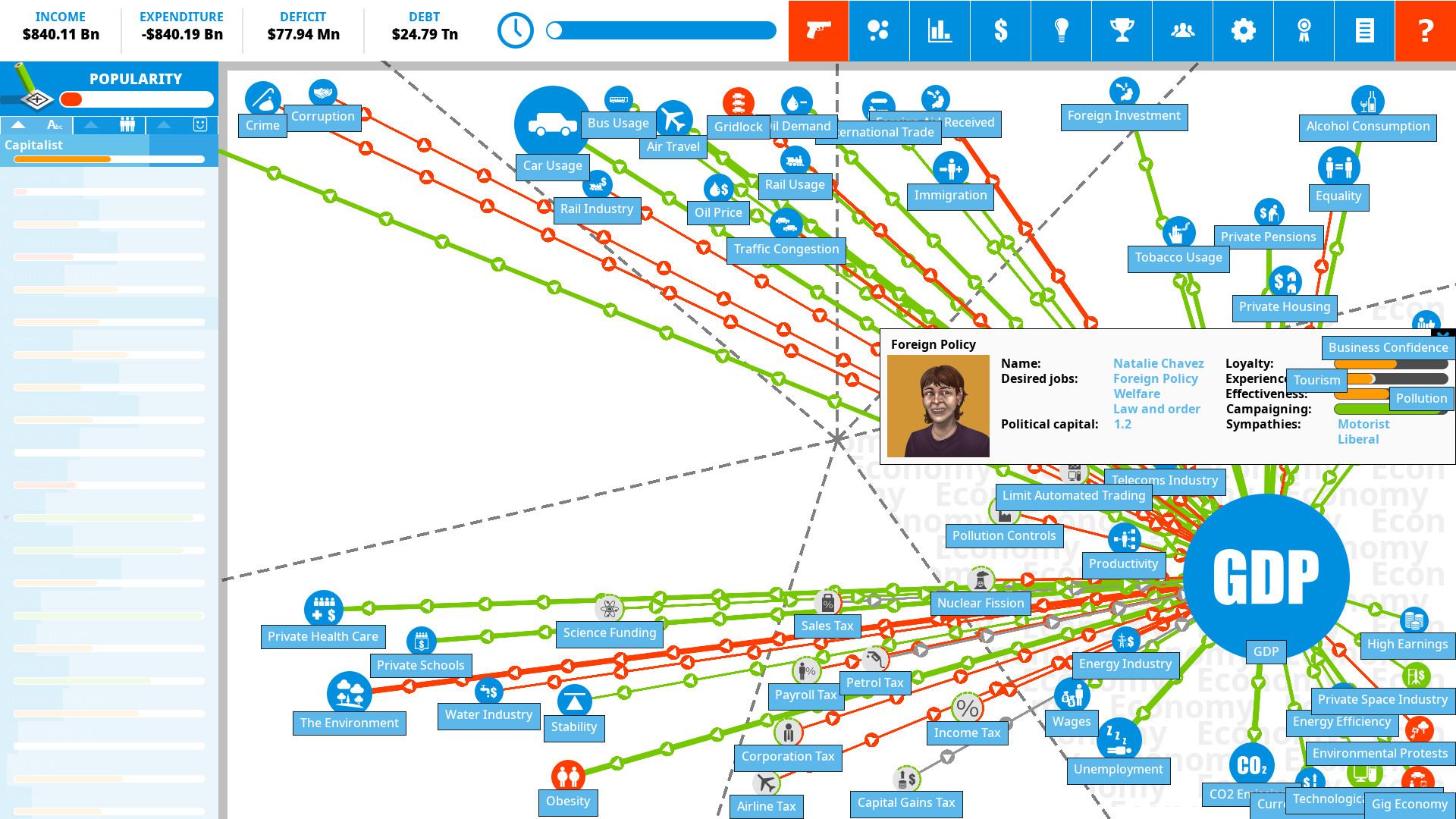
For all of your policy tweaking needs:
https://store.steampowered.com/app/1410710/Democracy_4/
https://cdn.akamai.steamstatic.com/steam/apps/1410710/ss_94f...
howmayiannoyyou
Global economy. It's not one village.
The US Fed has to ensure liquidity for all global USD users, to include USD derivatives, USD denominated loans and USD denominated trade instruments; and it has to do that at the same time trillions can sit nearly idle (not contributing to transactional velocity) on balance sheets worldwide.
Impressive, no doubt and good on you though!
undefined
Get the top HN stories in your inbox every day.
I made this game in order to try to wrap my head around central banks, inflation and macroeconomics, in order to get a better understanding of the aftermath of the global financial crisis and the current period of high inflation.
Here is a blog post that goes into further details: https://benoitessiambre.com/simcb.html