Get the top HN stories in your inbox every day.
SavantIdiot
vannevar
Glad to hear I'm not the only one who wants a dumb car. Unfortunately, the idea of electric cars has become bound up with the notion of software-driven cars. I want an electric car with analog controls, no touch screens or over-the-air updates, and minimal software. A car that I feel like I own, rather than one I'm getting a click-through license to use.
Buttons840
You know the dark pattern of presenting a license agreement over and over until it's accepted? I predict one day someone will make the argument in court that they always declined the EULA (perhaps the one in their car) hundreds of times, but one day accidentally brushed "accept" with their finger, and that doesn't constitute legal acceptance, especially since they've demonstrated an effort to decline the EULA, but because of dark patterns, they never can permanently reject the license.
Judgmentality
Fun fact - if you buy the car new, you may have the "option" of being presented with these choices before purchase. And you can actually refuse! The dealer will be confused as hell, but they are hell-bent on selling a new car, and will actually void it if possible. I know because I've done it. You don't want the weird spyware (OnStar, Carnet, etcetera)? After agreeing to buy the car, refuse to accept the terms (they legally require your signature for this), and they'll find a way to get around it. If they refuse then go buy a different car, because fuck those guys.
Obviously this will vary by manufacturer and feature, and it's getting harder as time goes on to remove this shit from your vehicle.
worik
I thought (IANAL) that EULA with screeds of text and a "Accept" button have been ruled invalid (as in not enforceable in a court) many ties in most jurisdictions.
Am I wrong?
duped
If I'm the dark pattern developer I'm not logging when the EULA is accepted or how many times they declined it.
moron4hire
Uhhh, you don't click through a EULA in the car. You do it when you sign the purchase agreement. Do you not read those things?
crooked-v
Mazda has been actively removing touch screens in new models. The screens are still there, but the touch part is replaced with physical controls for cabin features/radio and a puck controller for other stuff.
grahamburger
I know HN loves to hate on touchscreens in cars but I don't really get it. Both cars I own and almost every car I've rented in the last few years (that's quite a few) has had a touchscreen. This is pretty much always how it works: 1) The most used functions have physical buttons and knobs, often on both the steering wheel and the center console 2) Touchscreen is used for uncommonly done things, like adding new Bluetooth connections and adjusting radio settings 3) If the vehicle is moving there are limits on touchscreen use (like the touchscreen will refuse to work after X clicks, or disallow some functions, or both.)
This seems ... fine.
pleb_nz
A few manufacturers, expensive ones included, are reverting to screens and physical controls.
I think there is proof your eyes spend more time off the road when using a touch screen compared to physical controls
judge2020
Note that backup cameras are now a mandate for US cars: https://www.autotrader.com/car-news/new-backup-camera-rule-c...
GuB-42
So you want a mechanical door lock, manual windows, no car stereo, no power steering, no thermostat, no cruise control, etc...
The problem with that dumb car is that it is missing that very convenient feature. So you want a dumb car but with feature X, because feature X is really great. But the other guy will not care about X and will think it is bloat, but Y is really important, while for someone else, it will be all about Z.
In the end, to satisfy everyone, you will need X+Y+Z, everyone will think it is bloated but you can't remove a single feature without someone complaining... As in, I want things light but don't remove my feature.
Unless it is custom made bloat is almost inevitable.
northwest65
> mechanical door lock
Power central locking doesn't need a microcontroller, code, or a touch screen, or updates.
> manual windows
Electric windows doesn't need a microcontroller, code, or a touch screen, or updates.
> no car stereo
Car stereos do not need a microcontroller, code, or a touch screen, or updates.
> no power steering
Power steering doesn't need a microcontroller, code, or a touch screen, or updates. Hell it doesn't even require electronics.
> no thermostat
Thermostats are mechanical...
> no cruise control
Cruise control doesn't need a microcontroller, code, or a touch screen, or updates.
potta_coffee
Since when is power steering a "smart" feature? Power locks and windows are mechanical devices, solenoids powered by the car battery. The only computerized feature you listed is cruise control and we've had that for years and years. I don't think that this is an "either / or" proposition where we have either a car running off bloated software or a car limited to 1950's features. As far as I'm concerned, cars from the mid 1990's to mid 2000's are peak.
CogitoCogito
> So you want a mechanical door lock, manual windows, no car stereo, no power steering, no thermostat, no cruise control, etc...
I think an extremely small minority of people who want a "dumb" car don't want those features. I feel like you're just making up a strawman here. It's pretty clear (at least to me), that the people who want a dumb car are talking about things integrating with your phone or being displayed on a touch screen. I think anything that existed 20 years ago is not regarded as dumb by basically anybody.
randcraw
The features you mention aren't any more "smart" than an intermittent wiper is, which was invented long before electronics appeared in cars, much less digital logic.
US luxury cars in 1965 had all the features you mention. They were delightfully dumb and simple to operate. That's what I want now: knobs, sliders, and buttons that move and click when my finger pushes them.
Jill_the_Pill
Electric windows and power steering are unlikely to be tracking your location.
ok123456
It's not inevitable. At one point we made a 6th gen Honda Civic.
jjav
Not sure how it is today (haven't bought a new car in many years) but all of these things used to be selectable options a la carte.
It's not particularly difficult for the manufacturer. All the cars had the wiring for all the features since that's the hardest part to do after the factory, but doesn't cost much. Control modules and actuators can be added very late in the assembly line (sometimes even at the dealer prep) so you only get the ones you want to pay for.
holoduke
Post 2000 and pre 2010 cars are essentially Just like modern cars except without the bloated infotainment crap.
myshoesareblue
You might like the VW e-up!/Skoda Citigo-e. Bare bones electric cars -- even the battery meter is an analog needle! Just has a plastic mount for your smartphone above the center console and a USB port. No giant touchscreens! Real knobs!
yurishimo
Sounds like something that will never come to the USA unfortunately. All new cars are required to have backup cameras as a standard safety feature, so at that point, the car company will ship the whole CarOS anyway.
worik
Yes I want one of those.
I did not know till you said how much effort Skoda is putting in.
My next car is in that line up...
(Prefer level II to level III automation tho)
zippergz
1000% agree. I do not want a car that is a smartphone on wheels and I have no idea why so many people find this attractive.
arpyzo
I own a 2014 Subaru Impreza and my brother in-law a 2017. I've driven both extensively. Sometime during those years, Subaru switched from knobs and levers to a touchscreen and the controls are so much worse!
1. The controls on the 2014 are obvious, easy to find, and my choices are readily apparent. In the 2017 I have to search for them and often guess their meanings. If I'm actively driving, I just give up because it's too distracting.
2. The controls are not as responsive. Sometimes there's a lag. Sometimes they don't respond at all.
3. There are bugs with the digital controls that simply don't exist in the analog versions. As an example in the 2017 the radio turns on every time the car gets started regardless of if it was on when the car was turned off.
bayindirh
I drive a 2002 Focus MK-I, and I can use all controls rather blindly, just by feeling them.
I hope to buy a similarly ergonomic vehicle when this one becomes unmaintainable.
randcraw
I understand why buyers like digital novelties in cars: they're flashy and sexy, and they make your 4 year old car look old by comparison.
I also understand why car makers like digital flash: your 4 year old car doesn't support your latest iPhone, network, or peripherals, so you're motivated to buy a new one every few years.
(And of course, old car tech distracts your driving LESS, however that fits into the picture.)
I think we will never see cars with modular digital tech that can be updated. A car with replaceable digital hardware and software won't rapidly go out-of-date the way current cars do. They would cost far less to update than replace. So nobody wants it... except perhaps grownups.
Minor49er
The only smart aspect that I might want in a car is a GPS so I can leave my phone at home. But I'm not sure I would even want that since the car could be tracked at any time.
jonpurdy
I recently bought a used 2016 Spark EV (having a baby and needed something other than my motorbike). It does have a touchscreen, but mostly for extraneous information and radio functions. Everything else has dedicated knobs and buttons. (The one dumb thing is that the fan speed updates on the screen, rather than just having ticks above the knob.)
It is a California "compliance car", which means it was just a modified petrol Spark, so it didn't have product managers trying to jam in unnecessary touch-based interfaces.
I just hope that all companies building electric cars don't move in the all-touch direction of Tesla.
jonplackett
This is the exact same stupid thing that happened with DSLR cameras.
Old SLR cameras had a ring around the lens for f-stop and another dial on top for shutter speed.
New DSLR cameras even now hide all that stuff in a menu on the touch screen, as if it isn't something you want to change ALL THE TIME - and develop instant muscle memory for.
justaguy88
I'm guessing that all-touch is just cheaper these days, no QA testing for all the little mechanical bits
neilpanchal
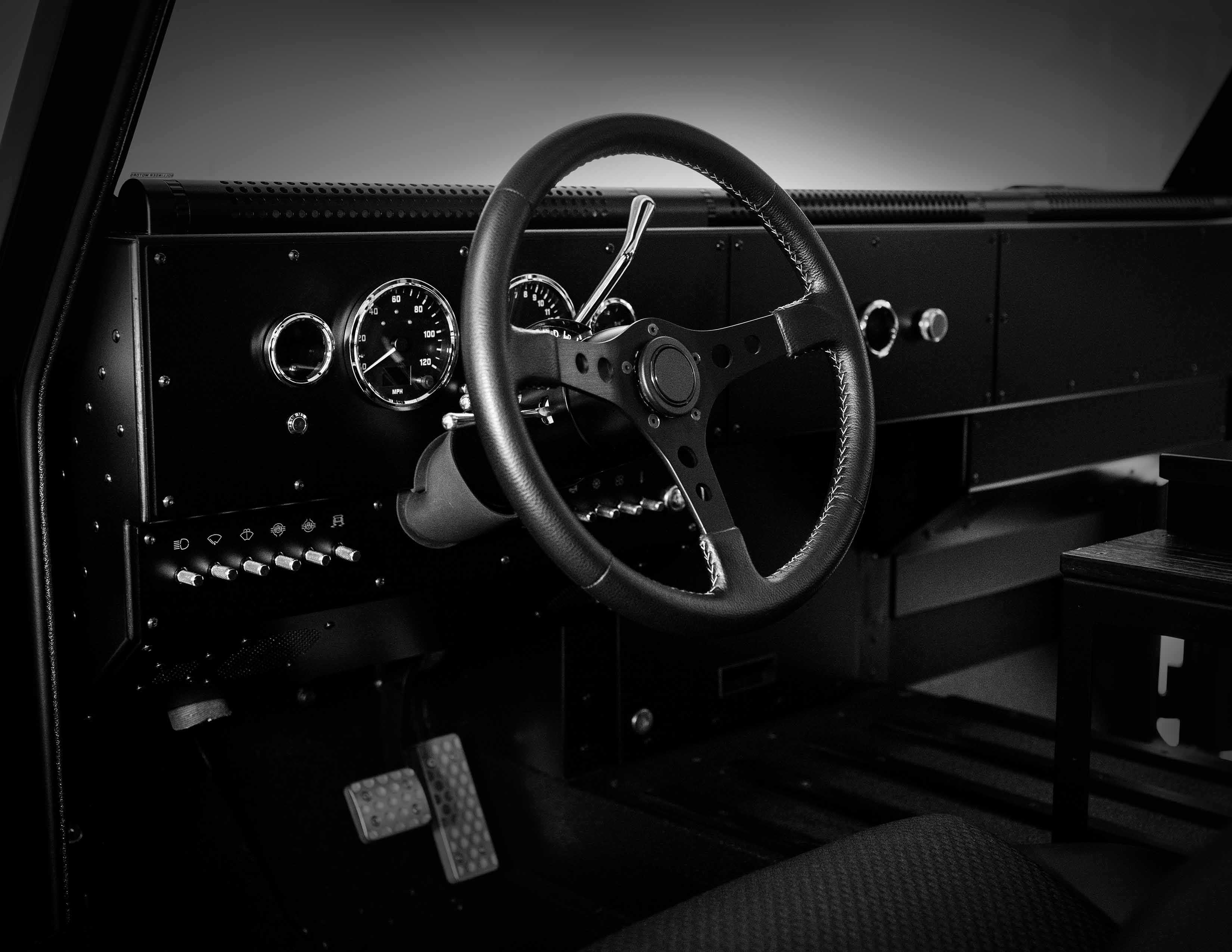
Check out Bollinger motors [1]. Electric chassis, all analog, no screens. Here is a shot of the interior: https://bollingermotors.com/wp-content/uploads/2019/10/CLOSE...
Animats
On the other hand, a row of 15 or so identical toggle switches isn't the right answer either.
atweiden
I drove an Electra Meccanica Solo in Victoria BC a few years ago, and it was exactly this. The founder of the company wanted to design the air cooled Porsche of EVs. All analog, minimal electronics, incredibly nimble. One of my favourite aspects of it was the sound it made under acceleration, think: Star Wars Landspeeder.
(You can faintly hear it over annoying background music in this video [1].)
It felt better to drive than a Tesla, even though it was orders of magnitude slower. Unfortunately, last I heard they were trying to tone down the Landspeeder-esque “cabin noise”. I’m not sure if the current executive team at Electra Meccanica even realizes what they have.
_benj
I have a more optimist view about the industry being able to cope just because we have two more industries that have gone the same transitions, aeronautical and aerospace.
Back in the day airplanes where just knobs and levers, and we didn't have the reliability that safety that we have today.
With aerospace, I mean, software engineering as a discipline started with aerospace!
If we write "starup code" (i.e. CRUD web app) for cars we'd still be in huge trouble, but if the automotive industry can adopt the redundant systems, enforce VERY high levels of software testing, and other practices for those other industries I think we could see some interesting things coming from the industry
scarier
I'm sure you didn't mean it quite so bluntly, but characterizing the history of aviation safety as a triumph of computer control systems over analog ones misses the mark by a pretty wide margin--even if we're just talking about the advances that only computers have provided. Probably the only way a modern car is technologically less sophisticated than a passenger aircraft is its inability to substantially steer itself (and this problem is orders of magnitude more difficult for cars than planes).
A lot of the systems we take for granted in our cars (ECU, ABS/stability control, adaptive cruise control, steer-by-wire, OBD) were pioneered in the aviation industry, and both industries' safety records have been massively improved by the ability to do digital design/analysis (CAD, FEA, CFD, etc). Then once you start talking about advances in computer-aided manufacturing and QC/QA processes, training, failure analysis, human-machine interaction...
One of my perennial frustrations with current tech is the idea that putting a computer in the control loop necessarily makes things safer.
_benj
> One of my perennial frustrations with current tech is the idea that putting a computer in the control loop necessarily makes things safer.
I completely agree with you! A simple electronic component is a lot more fragile that a mechanical counterpart that is unfazed by ESD, vibrations or whatever other things that can kill a electronic component, or a circuit board for that matter.
My point is more along the lines that a computer in a control loop makes things different, not necessarily safer. But with the flexibility that a computer brings to the mix, if used properly a computer can add some safety features that would be hard to implement with only analog/mechanical parts.
It seems to me that we have reaching a ceiling with what we can do with mechanical systems, although I do believe that we often get lazy and opt for software convenience instead of using mechanical reliability where it would be beneficial.
So all in all, computer control systems are not safer just in themselves, but they can be, if not in reliability, at least in monitoring health and providing warnings before things are critical (i.e. a temperature reading instead of waiting to see smoke coming of the hood of a car)
numpad0
I don’t want to imagine how Program Alarm 1202 looks like on a SpaceX Starship running Chromium instances on Intel Atom, the latter half of which is how they’re planning to do it.
jaywalk
The stuff running inside Chromium on Intel Atom processors is not mission critical.
_ea1k
> I have a more optimist view about the industry being able to cope
TBH, I have similarly optimistic views, but for completely different reasons. The truth is, the worldview has changed completely in the past 100 years.
In the old days, if you failed at operating a saw, you hurt yourself badly. Now we slowly are starting to expect sawstop and other solutions to reduce injury.
The same thing is happening in cars. We no longer expect perfection of the human as we augment them in various ways to both reduce the frequency and severity of collision. Its the early days yet, and its very much the "startup code" mindset with cars having way more bugs than its ever but also producing safer outcomes.
Car software is getting worse, but we're better off for it.
temporallobe
Car guy here. Yeah, I’m with you. My favorite car was a ‘96 Tercel with mechanical steering and a 4-speed manual. It even had manual roll-up windows. It had less than 100 HP, but it was simple as hell to operate, very fun to drive, cheap to maintain, and extremely reliable up until I sold it with nearly 400k miles on the odo. I put an aftermarket stereo and speakers in it and I was set. Only reason I sold it was because my wife hated it and a friend needed a cheap reliable car for his idiot son who proceeded to neglect and destroy it quickly after taking possession.
Modern cars are absolutely terrible in the UX department, but they are a hell of a lot safer, so there’s that.
jrwoodruff
Those mid 90s Japanese sedans were awesome. Relatively compact overall, zippy little 4 cylinders engines and manual transmissions. I had an Accord from that era, and loved driving my dads nerdy-as-hell Nissan Sentra. That car was shockingly fun to drive.
tim333
1990 mx5 still going! It's a good car though a little rust. The only thing I miss from more modern cars is the engines are a bit more efficient in modern ones - more power less fuel.
Re electronics the sound system and sat nav (iphone) are boxes you tack on and don't have to be part of the car.
dzhiurgis
Just sold my 1990 Bluebird. Didn't pass warrant of fitness, but otherwise drove amazingly well.
throaway46546
92 Civic owner here. Love my car.
GeorgeTirebiter
I still drive my '94 Lexus. California is kind in that way.
beckingz
Mid 90s Accords were incredibly long lasting.
clairity
> "Modern cars are absolutely terrible in the UX department, but they are a hell of a lot safer, so there’s that."
tangentially, "safety" is highly cargo-culted. things that seem so obviously safer are taken without question as better, but in many cases, such features really only provide a false sense of security along with substantive unintended consequences.
most safety features in cars (e.g., lane-keeping) allow people to be less skilled and less attentive at driving, rather than lowering crash/injury/death rates. the better solution is to make people better and more attentive at driving through more rigorous training/testing, more thoughtful design, and importantly, culture, rather than just technology for its own sake.
azornathogron
Modern cars have more design features that improve crash survivability (better airbags, better crumple zones, tested with more realistic crash tests, etc). Those seem like a pretty unalloyed improvement to me.
I'm not saying you're wrong about the things you mentioned, but cars really have got safer, in important ways.
crooked-v
> rather than lowering crash/injury/death rates.
Motor vehicle deaths per 100,000 have been on a consistent downward trend since the 70s (1.53 per 100,000 in 2000, 1.11 per 100,000 in 2019), so, no, death rates have in fact been lowered.
notJim
> things that seem so obviously safer are taken without question as better, but in many cases, such features really only provide a false sense of security along with substantive unintended consequences
This is not true at all. There is definitely testing of cars by groups like the NHTSA and Insurance Institute for Highway Safety. For example, they've found crash rates were 14% lower on cars with blind-spot monitoring. Modern cars are far safer than older cars.
IgorPartola
For anyone wondering what progress in terms of safety looks like, give this 77 second video a view: https://youtu.be/xtxd27jlZ_g
betwixthewires
Most safety features are nothing like lane assist. Lane assist is not a representative example of what most safety features in a care look like. Most safety features are crumple hoods and pillars, safety glass, airbags and seatbelts.
Additionally, you think it is a more feasible solution to change culture than to make the safe operation of a car less reliable on the human element? How exactly do you "make people better and more attentive?" Training? Please elaborate on what that would look like.
Cars are designed a lot more thoughtfully than they used to be. An example not related to safety is cupholders. Remember when two flat rings on the dash were considered acceptable for holding a cup? Safety wise I'd say designing contingencies against inattentive drivers is thoughtful design.
throwaway0a5e
The "spewing BS is order to show the world how much you care about safety" part of the safety cargo cult bothers me a hell of a lot more than safety features enabling less attentive behavior.
If I had a nickle for every social media user who's screeching about how airbags are all that's good in the world but who doesn't understand the inherent tradeoffs to a bag of dense air occupying the space in front of the driver or how a crumple zone is basically a single use spring I would use the money to hire people to beat the first group of people over the head with highshcool physics textbooks.
I wish we'd regress to '50s attitudes about safety simply so that the people who care about safety no longer have to be held back by the people who crap all over everything by wanting to be seen caring about safety.
potta_coffee
I have a 97 Miata and a 95 4Runner. Both high mileage, both amazing cars mechanically. They both have power steering and power windows but everything works on both cars: every knob, button, window, still works. I've had several newer cars that have degraded much more quickly than these two. Both cars are much better to drive IMO than newer cars, with some caveats. You can't drive like a dummy and expect these older cars to kick in computerized traction control systems to save you from yourself. I personally like a car that lets me be the driver.
itsoktocry
>My favorite car was a ‘96 Tercel with mechanical steering and a 4-speed manual. It even had manual roll-up windows.
I had a 1993 Tercel, same gearbox, manual windows, vinyl interior. It had a leaking head gasket when I bought it, and I drove it for 150,000 km without putting a dime into it outside of oil changes and tires, filling the coolant as needed. Simple cars are basically indestructible.
duped
Counterpoint, I'm not a car guy and I think too many people own them. But when I'm in a car my priorities are safety, mileage, seat comfort, climate control, sound quality, and smartphone support. I don't really care how much it costs to maintain, and I haven't changed my own oil in over a decade.
Modern cars are fine in the UX for what I do. I'd rather not own a car than drive manual, and even vehicles from 10 years ago aren't competitive in creature comforts or gasoline consumption.
rightbyte
I find it more stressful to drive automatic. You need to be more careful with the gas pedal to get just the right amount of acceleration, since too much will make the car shift down and rev up. Also there is the risk of uncontrolled acceleration by mixing up the gas and brake pedal and not having the clutch as a double safe.
neoromantique
>gasoline consumption.
That's only true if we talk about hybrids.
>even vehicles from 10 years ago aren't competitive in creature comforts
That depends a lot on your priorities, I drive a nearly 20 year old premium car that holds up very well against many new cars
giardini
The mid-90's Toyotas were wonderfully reliable vehicles but the plastic parts are failing.
Maybe I'll give up and dive into retro cars fully with a post-war Citroen 2CV? Naah!
andrewia
If you want the simplest car possible, you can look at models designed to sell in volume worldwide. I'm talking the Hyundai Venue crossover, Hyundai Accent subcompact sedan, Honda Fit/Jazz hatchback (recently discontinued for the US), Ford EcoSport crossover, etc. They are designed to be serviced in poor conditions. They will tolerate removal of electronics like the infotainment because some countries' base models have simpler configurations. In the case of the Honda Fit, the climate control dials physically move the ducts! And repair documentation and parts will be plentiful because there's a large market for parts suppliers to compete. Also look at body-on-frame fleet vehicles like a base Ford Ranger or F-150, but be ready to forgo stuff like cruise control.
There are EV equivalents too, like the Chevy Bolt and Hyundai Kona EV that offer range in the 200s of miles with make driver assists as an optional upgrade. Even with complicated powertrain electronics, EVs are still more reliable than ICE cars because any iffy software is made up for by lack of mechanical parts. The repair procedure is the same as mechnical parts - just swap the faulty part out for a working one, and the "upstream" supplier will probably take the broken module to reflash software or frankenstein together half-working PCBs to make another refurbished module to sell.
If you're worried about remote compromise, it's pretty easy to avoid IMO. Open the dashboard and yank the cellular antenna, and never pair the infotainment to Bluetooth or Wi-Fi (or just yank the 2.4 GHz antenna). Those are basically the only avenues for wireless attacks into a vehicle unless you count the TPMS and key fob radios, which seem too simple and low-bandwidth to offer an attack surface. And if an attacker can access your car's physical ports, they could already attack you in other ways like by weakening the brake lines. Other new electronics, like MOSFETS instead of relays in the BCM, have actually made the car more reliable so they should be fine. Other newly standard features like blind spot monitoring are (1) solid state, so they won't fail often and (2) tolerate failure or complete removal.
numpad0
It’s so wrong that tech inclined wants cheapest models for the reason that those are objectively better. The entire car industry is going to go iPhone all over again.
jfengel
They're not objectively better. They're more suited to what they want: a device with fewer features but more direct control.
Lots of people want a car with more features, and don't wish to control it directly. They would rather have a solid-state device that can't be repaired, but doesn't need to be. They don't want to upgrade it themselves; ideally, they don't want it to need upgrades until they buy another one.
But you've got it exactly right: many consumers want the car industry to go iPhone, for the same reason they want iPhones. That's neither objectively worse nor objectively better. The only objective thing is that a ton of consumers want it, because it suits their needs. And part of that is achieved by avoiding development by the kinds of techies who think that their preferences are objectively better.
notJim
It's true, there are no tech people driving Teslas or late model luxury cars. As you say, there is universal agreement with you, because your opinion is the objective truth.
thatfrenchguy
> Hyundai Kona EV that offer range in the 200s of miles with make driver assists as an optional upgrade
I have a base model Kona EV and it has a ton of driver assists. And they're pretty great frankly.
bobajeff
Yeah, I like the tech behind Tesla but am turned off by. 1) The large, distracting screen in the front of the car. 2) The subscription model of the car's firmware.
If electric cars ever become widespread I hope I can find a used one engineered without that stuff. Otherwise I may have to stop buying cars.
nogridbag
I recently purchased a Kia Telluride. Perhaps I'm now biased because I love the car, but I think it has an excellent combination of tech and usability.
1. It still has buttons and knobs for the things that should be buttons and knobs (e.g. climate control, volume, etc).
2. The heads up display is the killer feature that should be standard on all cars (as is only available on the top speced Telluride). It displays speed, speed limit, blind spot monitoring, lane departure, automated steering, navigation, etc. Unfortunately I don't think Android Auto or Apple Carplay's navigation can be displayed on the HUD - only the OEM Kia nav.
3. The "Smart Cruise" aka Highway Drive Assist aka Adaptive Cruise Control is essentially self-driving minus lane changes. It's engaged with a single button on the wheel and presented in the HUD. It takes corners smoother than I'm able to. I often feel it's turning too early and fight the auto driving but in almost all cases it's correct and my inputs are delayed.
Kia's mobile app for remote start, climate control, valet mode, etc. is pretty terrible though.
Infinitesimus
2021 Sonata (Limited) here and I echo your sentiment. I spent a lot of time and realized that only Hyundai and Kia provided a good mix of the things I wanted in a smart way.
Mazda's anti-touch stance makes it a non-starter for Android Auto/CarPlay
Toyota, Subaru and Honda have abysmal infotainment interfaces and didn't seem to invest in me enjoying the interior of a car.
Nissan CVTs have questionable reliability . Etc.
The lane keep assist on other average vehicles is so laughably had compared to what Hyundai and Kia have pulled off. These systems actually keep you centered instead of bouncing between lanes (hello Mazda). Blind spot cameras, birdseye cameras, HUD, little touches like the car slowing down automatically for you on some mapped curves when using cruise control etc. (Also I've used that stupid smart park thing waayy more than expected. I love it)
I'm still disappointed that car reviewers don't focus on such usability issues and instead rag on about performance of the engines or "its a toyonda so it is reliable" and ignore such small but practical tweaks.
crooked-v
> Unfortunately I don't think Android Auto or Apple Carplay's navigation can be displayed on the HUD - only the OEM Kia nav.
From what I understand Android/Apple have software capability for second screens/HUDs now, but it's on the car manufacturer to support that. There are some BMWs that have it.
bozzcl
Regarding HUDs... it's the one feature I desperately want for my next car. I've been looking into aftermarket options, but all of them are ridiculously cheap and bad or vaporware.
rootusrootus
> If electric cars ever become widespread
Exclude Tesla and most all EVs on the road today are just normal cars that happen to be electric.
wyre
Why is special about Tesla that makes them not a “normal” car that happens to be electric?
Koshkin
> If electric cars ever become widespread
I have a strong suspicion that soon enough after that we will be able to build electric cars from kits, cheap and with no frills. We are on a cusp of a new technological revolution.
itsoktocry
>soon enough after that we will be able to build electric cars from kits
I'm skeptical.
An internal combustion engine is a complicated, engineering marvel. But a complete engine, as a unit, isn't difficult to remove/insert. It's big, heavy and awkward, sure (so are electric motors and batteries), but an experienced person can do an engine swap in a couple of hours. And yet there aren't many people building ICE cars from kits. Why not?
Because the drivetrain is only one part of what makes a good car good.
wyre
A few years ago I found a source selling EV conversion kits for vintage vehicles. It’s definitely a possibility to DIY an electric car.
I could imagine it being like DIY synthesizer kits. Do it yourself if you have the skills and time to put it all together, or spend a bit more for it to come pre assembled, or “some assembly required”.
I would be curious about the safety regulations behind this.
elihu
You can sort of do that now by buying a gas-powered car and a conversion kit. It just tends to be expensive, and the kits don't always include batteries and battery boxes.
Example: https://www.evwest.com/catalog/product_info.php?cPath=40&pro...
I wish EV tax credits applied to conversions and not just new vehicles. It would make conversions a lot more economical, and maybe we'd start seeing low-cost mass-produced conversion kits designed for popular vehicle models.
nerd_light
May I ask why you think that? (Sincere question, not meant to be snarky). Even assuming electric car assembly is simpler than an ICE powered car, there are still a lot of large, heavy, and expensive components. And that's setting aside all the regulations around it being a "street legal" vehicle, which can place odd constraints and vary from location to location.
I could see there being ways to build your own, just as you could build your own house or laptop if you acquire the right parts. What makes you think that people will broadly want and use kits? (or am I misinterpreting what you're saying?)
ClumsyPilot
I am confused, why would someone want a car from a kit?
It's made of hundreds of parts, some weight more than a grown man and you could seriously injure yourself or assemble it incorrectly. It's not gonna be an ikea kit.
We've created assembly lines for this exact reason and they are really good at their job, why would you go backwards unless you are seriously into DIY or an arctic explorer flatpacking them?
smolder
There are relatively simple conversion kits that have good motors and controllers and allow for regenerative braking. I don't see building an EV getting much simpler than that.
psychlops
The first collisions of speeding custom modified cars will put an end to any individual innovation there.
cosmodisk
And we all need to pray for HP not to get into the automotive industry,or we are all screwed.
tim333
We'd probably get notices that our fuel has expired and must be replaced with new genuine HP fuel.
NotSammyHagar
What do you mean by subscription model of the firmware? There's no payment or anything you have to do to keep getting upgrades of the is.
xxpor
Subscription model?
jude-
Some of the extra infotainment stuff (read: media content) is subscription only. Some functional extras like full self-driving or faster acceleration are one-off purchases. The rest of the software -- all the things you'd expect the car to do -- comes with the vehicle and gets regular OTA updates.
markbnj
Two months ago I sold a dead-simple Toyota truck I'd driven for 14 years and bought a new, loaded Honda. The difference in the complexity is of course astonishing. The yota didn't even have usb. You could climb into the engine compartment and sit there. The Honda has pretty much everything a modern car can have, and you can't even see empty space in the engine compartment.
I _could_ get on your "just give me simple" bandwagon. A part of me was proud of the low-tech, rusty durability of the Toyota, I admit it. Still, I'll also admit I like most of what the Honda can do. I like the phone integration and that I can toss it down on a pad and it will charge while I drive. I like that the wipers, headlights and high beams all activate when needed without input from me. I like that it remembers my seat and mirror settings and restores them when I enter the car. I like keyless entry and remote start. I like the backup camera. I like adaptive cruise control, collision mitigation braking, and lane keeping assist. I like torque vectoring all wheel drive. Heated and ventilated seats are awesome.
Of course, if I were to try to keep this car for 14 years I might regret it, I don't know. Honda makes good cars but there's a boatload of stuff to break, lol. I think I might be better advised to trade it in at five years or so, but I do like the tricks it can do.
toast0
> high beams all activate when needed without input from me.
Not a hard trick since high beams are almost never needed. Only to tell people it's their turn to go at the 4-way. They're only marginally more useful than fog lights.
tim333
Depends where you live. In the city yeah. On country roads with no street lights though they are good.
markbnj
I'm not sure that the difficulty of performing a trick is related to its utility, and it doesn't really make sense to compare the usefulness of high beams and foglamps since they are indicated in completely different situations. Foglamps are mounted low and are usually yellow and meant to illuminate the road surface in heavy fog. High beams are counterproductive in fog.
betwixthewires
I drive an old car partly for this reason. I've never had a car younger than 10 years old. My previous reasoning when I was younger was that I don't want to deal with the inspection requirements that come with OBD2 cars. Now I'm not so much worried about that with all the extra nonsense they're putting into them. My favorite car ever was older than I was, I loved it, an old ramcharger with power windows.
My current one has some "modern" archaic crap in it that was all the rage when it was built, it's GM so it has the OnStar buttons in the rear view mirror that are useless, along with complementary antenna on the roof. It's stock stereo controlled the alarm, it has all sorts of compartments that are nowadays mostly useless and IMO just an excuse to cram something in every spot. A lot of the "features" are just dead fads. The seats have lumbar shit in them and warm up. The warmer is useful in the winter I guess. Still with the bloat it is significantly better than the Frankensteins that commercials have convinced people they need nowadays.
My next car is either going to be a ~1995 4runner or a ~1994 diesel f-350 that I build myself. I do miss the corner windows.
giantrobot
I'm definitely in the same boat wrt complexity. My pickup has just enough extra electronics to be a quality of life improvement over a model that lacked those features. It doesn't try to drive for me and second guess my actions in unexpected ways. It doesn't give me unfathomable warning beeps that only serve as a distraction trying to figure out what's causing the beep.
At the same time it's important to recognize there's a difference between software bloat and growth. Security fixes often cause code to grow (checks, verifications, etc). That growth isn't bloat. The previous version of the software was exploitable because it lacked the checks that were added. Adding drivers or better handling edge cases in drivers grows code but isn't bloat.
Even "bloat" that's only added on-disk size (a secret Tetris game in some code) that doesn't affect normal code flow isn't the same as bloat as adding some advertising telemetry in the middle of a critical code path.
Not all code growth is bloat and not all bloat is equal.
jacquesm
Nothing worse than automotive software. Buggy, slow, terrible user interfaces, outright dangerous and in many ways much worse than the systems they replace or augment.
The automotive industry has a long long way to come - assuming it will happen at all - before they can be said to be responsible software vendors.
Case in point: my - former - C class Mercedes that made two pretty good attempts to kill me by slamming on the brakes in a situation where that was totally unexpected and caused a perfectly safe situation to turn into a critical one. If not for playing ping pong for many years I highly doubt I would be writing this. After the first instance I had the whole car checked out to see if there was any fault in the system, the answer was that it was all working perfectly (that time the car had braked whilst on a very narrow bridge sending the car into a skid which I managed to correct before going over the side). Three weeks later it did it again, this time apparently because an advertising sign in a turn generated such a strong radar return that the car thought I was about to have a frontal collision. Again, out of nowhere an emergency stop.
I sold the car and got one where the most complex piece of software is the aftermarket radio, it has ABS and an ignition control computer but nothing in the way of 'advanced safety features'.
My vehicle actively trying to kill me is something I can do without.
So: as far as I'm concerned much less software on board of cars, open source it all if possible and roll it out much slower so we can get the bugs out.
liquidise
I’ll pile on with my own anecdote. Last winter I flew home to Maine to visit family. Rented a ‘21 Nissan Altima. It drove well until there was typical New England snow/slush mix.
While driving on a flat straight stretch of road the car suddenly... yanked itself sideways. Thank god no oncoming traffic was present and I was able to course correct safely. I immediately drove home and paid careful attention to the wheel response. It kept feeling like it wanted to yank me off the road.
Once home i broke open the manual and found 4 different “driver assist” and “driver comfort” functions. After disabling them all the terrifying behavior ceased.
I’ve lived my whole life in Maine, Rochester NY and Colorado. I’ve never felt as unsafe in a car as I did with those software features enabled in about an inch of snow.
Bonus, it also has collision detection warnings on the side of the car. It was convinced every puddle I drove through that splashed slush beside the car was an object I was about to collide with.
TeeMassive
> Bonus, it also has collision detection warnings on the side of the car. It was convinced every puddle I drove through that splashed slush beside the car was an object I was about to collide with.
That's the problem I have with people who tries to rethink our relationship with cars; it's obvious that they live a Californian lifestyle. "Just share your car" "Electric and solar is the way" "AI safety with cameras is a must"
Yeah, sure.
SkyPuncher
> Once home i broke open the manual and found 4 different “driver assist” and “driver comfort” functions. After disabling them all the terrifying behavior ceased.
I have these and absolutely love them. Sometimes, they do need to be turned off in bad weather, though.
jacquesm
The problem is that you don't know ahead of time when 'sometimes' is which is worse than nothing.
cyrks
One of the main problems is that we have many different software teams trying to solve the same safety feature driven functions in many different ways with many different solutions, outcomes, and decisions along the way. This leads to a very fragmented base of software with varying levels of safety, none of which is tested to the same standards. The result is that consumers don't know of the car they are buying is truly safe at all
judge2020
This is something agencies like NHTSA and/or private companies like IIHS are supposed to solve, but most active safety technology testing is just ‘does it work’ in very easy scenarios - the test suite needs to include many environments and tough conditions if it wants to evaluate these systems more broadly (The only issue being when car companies optimize for those specific tests, or ‘when the measure becomes a target’).
Red_Leaves_Flyy
Anyone want to fund me? I’ll test the every living heck out every smart car in existence in every condition from perfectly flat straight drag steps to dirt roads in the mountains with a foot of snow and white out conditions, to unmarked pot holes riddled roads in torrential down pours. I’ll also test the usual stuff like does the car detect the kids playing in traffic, or the dog darting after the squirrel. I’ll video the test from numerous angles, cut in awesome music and sounds effects and upload everything to the internet. I’ll also write long articles about the intricate nuances of each vehicles responses to the tests and create scoreboards for categories like least likely to run over children, or most likely careen off a bridge if there’s a sign at the perfect angle.
6gvONxR4sf7o
> The automotive industry has a long long way to come - assuming it will happen at all - before they can be said to be responsible software vendors.
It's worse than that. The very best in the software industry has a reliability problem. And carmakers are certainly not among the best in the software industry.
systemvoltage
Holyshit, thanks for the heads up. If I rent a new car, first thing I’m doing is disabling all this crap.
As long as pre-2010 cars are available, I’m gonna continue driving them.
jacquesm
It couldn't be disabled either without breaking out the wire snips and selectively disabling stuff and hoping that that would not have further averse affects. That car had a radar unit behind the front license plate and a camera mounted in the windshield. No idea which of the two was responsible for the false triggers.
HellDunkel
Frightening. My friend had a similar incident (but he drives like a complete nutcase).
Is there no „code of conduct“ what automotive software must not do in any case?
amelius
Probably these companies ignore any existing legislation to have more disruption powers. Lawsuits from fatal accidents are just the cost of doing business.
jacquesm
I would assume incompetence before malice and living in some kind of idealized bubble compared to field testing and dog fooding their own product in a very large variety of circumstances.
One car executive that I've known said this: "The very best test drivers are our end users, in the first week after release we learn more about a car than we do in the months of field testing prior.". I am not going to name the individual but it makes good sense and I have seen the same with all software products released to the general public.
HellDunkel
I work in the field and never had this impression. There are a ton of standards, safety related procedures and so on. But many of those are at least questionable. At the same time management is asking for more and more „features“. Many are just gimmicks or diluted by too many cooks. No one ever asks for GOOD software. Folks at the top have ABSOLUTLY NO idea what that could mean other than the absence of bugs.
at_a_remove
I have a stock head unit on my car, based on QnX, I'm told. It has some amazing limitations. I will throw out a couple:
First, you cannot delete radio stations. You can overwrite a radio station, or you can unplug your car battery, but you can't just flat up delete a radio station you have plugged in. CRU, I guess.
Second, it sort of recognizes .mp3 files in the USB drive, but not .wav, and it certainly doesn't understand .m3u playlists. Baffling.
It's just so ... clunky and dumb.
sbierwagen
I bought a car with an aftermarket radio that has a DVD player in it, which I've never used. When you turn it on, it displays a message warning you not to watch a DVD while driving. Sure, whatever. While the warning message is up, you cannot adjust the volume. I have to make sure to turn down the stereo before parking otherwise there's a solid five seconds on startup when it can't be turned down. Insane.
betwixthewires
I just have to get in on this one.
I have this old aftermarket $30 brand new at the time crappy little stereo. No optical drive, the thing doesn't even have an AM receiver. But it does take SD cards, USB drives and AUX. Perfect. That's exactly all an aftermarket system should do, maybe Bluetooth, but I don't use Bluetooth so I don't care. I can fit ~60 albums on one 8gb SD card. Goodbye buffering in the boonies, goodbye book of CDs.
There's no way to navigate directories besides just skipping to the next one. Fine. I've seen some that let you open a menu and navigate using the volume knob, but no SD cards. I tried very hard to find one that has an SD slot and more advanced directory navigation. The two are apparently mutually exclusive. So instead of getting to decide what to listen to, my unit mostly functions as a commercial free music only radio station with a wide, diverse selection of exactly things I like. I can deal with that.
It doesn't load the directories or files in any particular order, like it builds an index by randomly loading directories as they're read and then the files inside. At least it doesn't mix up files between directories. I can deal with albums being out of order I guess. But why it doesn't just load them in alphabetical order is beyond me.
Nothing but MP3 support. I even wrote a bash script to turn FLAC files into MP3 files just for the car, and it can even split FLAC by CUE file. Works just fine for me.
The thing has a predetermined EQ animation. It does not actually correspond to the output, its just an animation. Why? Who knows. But it does.
All in all I've been using the same unit for 5 years across 2 different vehicles. I like it I guess. The window smashers seem to know it isn't worth anything, which is great. If I could navigate better, it loaded directories and files alphabetically, and had an AM receiver, it would be the last aftermarket system I buy for the rest of my life.
Aperocky
lol that is crazy.
Just leave the control to the person behind the wheel, but somehow that's too stretched of an idea.
I hope the F150 E truck will not have those 'automatic' features. but then again, I kind of wanted lane keeping and follow so maybe that's just the necessary evil. Maybe 'modes' where it gives all controls to me when I wanted it?
finolex1
Counterpoint: My Subaru has averted at least 2 collisions till date by applying an emergency brake (admittedly not in any life threatening situation, though it did save me a considerable amount in potential repairs). Though yes I agree, the option to turn off features is certainly helpful.
jacquesm
You may want to go through some additional driver education, if your emergency braking system activates several time in a short period of time that is a possible indication that you may not be on the ball. But happy to see that you ended up avoiding two accidents :)
flavius29663
lane keeping is making me dizzy, at least on the rav4 where I had it. It's a constant battle between me and the computer about where to keep the car in the lane, making it such that the car constantly sways: 1. corrected by me, 2. then corrected by the computer, goto 1.
If I don't correct at all, the system is getting mad at me for not keeping the hand on the steering wheel.
Auto follow is again somewhat risky, you can't really rely on it, sometimes it brakes too late.
oldgradstudent
Autonomous Emergency Braking (AEB) can be dangerous, but these systems are being put into cars with the flimsiest data to support them.
No serious trial has been performed to test whether the benefits outweigh the risks.
fomine3
oldgradstudent
> https://www.iihs.org/news/detail/evidence-mounts-for-effecti...
Exactly what I said. No serious trial (or any trial).
What they describe is an observational study where they compare the same make or model with different levels of safety equipment.
The obvious confounding is that they're comparing people who care enough about safety that they are willing to pay for additional safety features, compared with people that are not willing to pay.
There's a reason we have double blind randomized controlled trials in medicine. The alternatives just don't work.
mthomasmw
Serious question - what alternatives are left for those of us who want a dumb car? I've spent the last three months finding out I can't get solar panels installed without a high-fidelity power-monitor tap connected to the provider's cloud, logging every appliance I use and what it's doing. Same deal with cars - they are on the internet and they generate evidence used to convict, and geofencing is coming. Other than stockpiling cars from 2010 - will we have alternatives?
https://www.fox13news.com/news/evidence-showing-drivers-spee...
rootusrootus
The vast, vast majority of all new cars sold today either don't have any kind of uplink to the cloud, or can have that capability easily removed (e.g. OnStar from GM). It's really only some of the EVs (the non-compliance ones like Tesla, really) that are software-heavy and blazing a new anti-privacy trail.
mixmastamyk
Don't they still record and just upload when you go to the dealer and they plug in the cable?
bri3d
There is an extremely limited amount of diagnostic data recorded by most cars (Tesla aside) - absolute limits, performance counters, and freeze-frame diagnostic data. There simply isn't much storage, and again, Tesla aside, most manufacturers don't want to have to buy high-write capable flash of the sort that could cope with constant logging.
The most invasive is probably airbag blackbox data, which is stored upon deployment and not routinely uploaded besides as part of an investigation.
As far as I know based on extensive reverse engineering of many modern European vehicles, no location data is routinely stored or uploaded to a dealership tool by any of them.
quacked
I don't think there are any. If you got to the point where you somehow managed to source the labor, materials, and space to manufacture "dumb technology", you'd be sued into oblivion by competitors who wouldn't want you to eat into their profit margins.
I think the market is huge. Imagine a company that suddenly started selling all-metal consumer appliances with minimal functionality, controlled by old-fashioned switches, buttons, and knobs, designed to be repaired. They'd be insanely popular. Of course, that lack of subscription-model pricing and the high labor costs of worthwhile designers and manufacturers would also destroy the company, but my god, a boy can dream.
covidthrow
The key is to hunt for commercial-grade appliances. In some cases, they can be found and offer similar form factors to consumer devices, and in others you may be out of luck.
Commercial kitchen appliances, washers/dryers, and flat panel displays can be sourced to your expectations. Just prepare to spend 1.5-3x as much right out of the gate.
fock
the problem is that most of these are horrendously oversized for private use. So I would like to have a commercial agitator to create yeast dough; these aren't even that expensive for their small series and local production - compared to e.g. kitchen-aid stuff -, but I both don't have the space/floor to put down a 4sqft/1000 pound appliance and I certainly don't need a 5 gallon bowl for my dough... I'm sure you could create and sell a home-sized variant of these, but yeah, distribution won't be easy.
I have to admit though that I sometimes dream of setting up a company, which just goes through all these relatively low-tech, electromechanical things and cyclically produces these. Problem is: it's capital intensive, low-margin, low-growth and requires you to keep people around. At this point you've lost everyone nowadays even if it is sustainable (nothing goes to waste when making these repairable) and keeps skills alive (which both the US and EU are paying extreme prices for through the military acquisition procedures).
In this vein I also suspect that most people could easily afford to get their whole furniture sourced in a "raw wood" edition (to be painted/oiled) from local woodworking shops, as the price difference is virtually nonexistent (built a bed with the help of friendly non-CNC-shops: was 12h of work, which clocks in at maybe 900USD. Material was 300.). If I go to a non-ikea, but industrial/imported furniture-store, similar quality would have cost me ~4000USD. But of course, a healthy ecosystem of woodworkers and designers would not concentrate wealth.
bombcar
Note that commercial-grade appliances may have unexpected side-effects. I have a speed queen commercial coin-op washer and it's highly reliable and easy to work on, but you can't do anything but a full cycle on it.
jkepler
Won't t 3D-printing metal appliances be more and more widely feasible in coming years? And, at least here in the EU, right-to-repair [1] labeling gives consumers the ability to more efficiently vote with their wallets. Its also happening in the US [2]
[1] https://repair.eu/ [2] https://fr.ifixit.com/News/8748/right-to-repair
scythe
Liquid steel requires enormously high temperature and magnesium/aluminium require an argon atmosphere. Titanium requires both. So unless you're going to make everything out of zinc (assuming we don't run out of zinc!), this may not be the cheap fix you're hoping for -- and zinc isn't very strong.
undefined
mthomasmw
Vitamix
quacked
Looks great. It reminds me of my microwave, which has two dials on it and is better than every other microwave I've ever owned.
brundolf
They'd be insanely popular in circles like HN. I think you have a warped perspective of what the typical buyer is enticed by.
rootusrootus
> insanely popular in circles like HN
Heck, even then I expect it would just be popular with a very small, very loud niche within HN.
cmiller1
> Other than stockpiling cars from 2010
As a car enthusiast this sounds laughably new to me. My main vehicle rolled off the assembly line in 1991. Unfortunately it's a "hobby" and a labor of love because if you're not wealthy enough to pay for a shop to handle maintenance of your classic cars then you're spending your weekends working on them.
simondotau
I get the allure of older cars but personally I wouldn’t ever daily drive a car that didn’t have vaguely modern crashworthiness. To me 2010 sounds like an ideal middle ground between maximising mechanical safety and minimising the encroachment of bad software. Ideally you’d want a reasonably new safety-rated car where the entire radio can be swapped out for an aftermarket double-DIN unit.
paganel
I found the latest model of the Suzuki Jimny the closest to what you described, that is when it comes to new cars. Unfortunately it has been withdrawn from the European market (where I live) because it doesn’t meet environmental standards, hopes are that it will be re-introduced labeled as a “utility” vehicle.
Afaik it is selling like hot-cakes on the markets where it is still present (like Australia), maybe if enough future potential customers ask for it Suzuki will decide to also sell it on the US market.
arminiusreturns
Speaking of Suzuki, the Samurai is ripe for a comeback in the US imho.
vikingerik
I bought a new Nissan Kicks last year (the lowest-end crossover SUV) and it seems pretty dumb. It has no internet connectivity as far as I can tell. It has a touch-screen, but it's pretty much just for the backup camera and audio controls, everything else has physical controls. It does have a computer that is involved in operating the CVT, but besides that it never gets in my way. And it does have sensors for the safety features (blind spot warning, etc) but that stays out of my way too. (The one annoying exception was when I had a bike rack on the back. I couldn't drive in reverse, the collision detection kept sensing the rack as an obstacle and slamming the brakes.)
Mostly-dumb cars still exist on the lower end of the manufacturers' lines. But yeah, who knows how long that situation will last, or if you'll be able to get anything technologically dumb with premium power and handling.
cowanon22
> I bought a new Nissan Kicks last year (the lowest-end crossover SUV) and it seems pretty dumb.
Not sure about 2020, but 2021 has Automatic breaking, pedestrian detection, and collision detection standard. There are likely a few hundred thousand to millions lines of code in these various systems. Even "dumb" cars today have tons of software, it's just hidden since it doesn't require user input. Literally every aspect of your driving is fully computerized - braking, acceleration, engine spark plug ignition, transmission, steering, etc. The infotainment is often relatively simple compared to all of the other software running internally.
jacquesm
That's more or less what I did though. I have a 2010 VW bus and a 1997 personal car. I fully expect these to last me the rest of my life.
stagger87
I just bought a 2018 Subaru Crosstrek that's surprisingly dumb. All mechanical controls and a basic infotainment system that isn't required for the car to operate. AFAIK it doesn't have any cloud capabilities and isn't connected to the internet. I imagine the latest models are the same since they look similar inside.
yardie
EVs are quite simply and there has been a small, but growing base of users using AC induction motors on sailboats. I imagine you're going to need a pre-OBDII car and some mechanical skills and convert it to electric drive. After that you'll have a car that has half the range of a modern EV do to weight optimization.
floren
I've got a 1985 Jeep CJ-7 sitting in a shed in another state right now. The 4-cylinder engine sucked when it was new, and 35 years of entropy have not been kind to it, especially the labyrinthine emissions control systems. But I'm holding on to it because I think it would be an absolute hoot converted to electric... plus, it's got such a small gas tank and bad gas mileage that a 150 mile electric range would be no worse.
e40
Why pre-OBDII?
jpindar
Yeah, OBDII is great and has nothing to do with the UI, privacy etc. issues people are trying to avoid.
rightbyte
> pre-OBDII car
If you remove the ICE you don't need to "marry"/VIN code activate the ECUs likely. Just as long as the steering lock is mechanical.
waiseristy
I'm amazed that in this entire article Autosar wasn't mentioned once. The giant 2 ton elephant in the room here is automotives reliance on god-awful "kitchen sink" style standards. Try reading through the various Autosar docs and ask yourself if you expect robust bug-free code to be written to comply with it.
There needs to be a complete cleaning-of-house in automotive software.
I2C, Flexray, Ethernet, CAN/CANFD & OBD, LIN, what are we even doing?
ARXML, FIBEX, DBC, fuckin kill me.
"Unmanaged complexity" a.k.a "we've never thrown away a single technology or standard even once"
obidan
I worked in the automotive industry and I can totally confirm. The worse thing is, there are now AUTOSAR experts and AUTOSAR tools and AUTOSAR Tool Experts and within that tool there’s a ARXML generator that’s generated with another tool …
There’s no way this can ever become safe, robust, software. The worse part is, there’s so many careers that depend on this obscure skillset that I am unsure a change can come from existing companies.
waiseristy
Dont even get me started on the tooling. Vectors, Elektrobits, Dassaults, Conti's, tools are probably one of the biggest drains on collective computation power outside of crypto and ML.
Not to mention working in this space is fucking soul consuming. I was considered an "AUTOSAR expert" for a time, and that essentially meant having enough programming and systems knowledge to work on the entire stack. But never writing a single line of code, only clicking buttons in these god damn tools and watching them crash constantly, loosing hours upon hours of work
jedberg
The problem with this is that auto companies are not software companies. They may have good engineers there, but they are hamstrung with a culture that considers software as an add on cost center at best.
Perfect example: I have no way to report software bugs to Honda. I've found a few and collected detailed reproduction data. The best I can do is give it to a sales rep in the service department and hope they send it "up to corporate".
Compare that to Telsa, which has bug reporting built right into the software in the car, as well as bug bounty program.
And then there are updates. Honda found a bug where the speedometer would just crash and not show your speed anymore. This is was pretty bad, but I had no idea about it until I went into the dealership. There was apparently a recall but I would have had to find that myself, I didn't get a notice. Honda has no built in facility to notify people of software updates and recalls. And then once I found out, the only way to fix it is for a dealership to apply the update. There is no over the air update and no way for me to apply it myself.
Car companies need to learn how to be software first, or things will get very dangerous.
ketralnis
On the other hand, having seen the software industry I don't really want its values applied to cars.
Games used to be shipped on chips to customers with the assumption that they could never be updated, but now the expectation that that's possible results in multi GB release day patches. Games used to be shipped to consoles without network access but if Blizzard goes out of business tomorrow, Starcraft II will just fail to boot because the software you get isn't enough to run the game. Games used to make most of their money by selling you a fun game that you wanted to play, but now they make most of their money from DLC's or selling in-game currency.
I don't want my car to move fast and break things. I don't want my car to fail to drive me to the hospital because it has updates to install. I don't want my car to drop features it had when I paid for it because some PM's bonus depends on me using their monetised features instead. I don't want my car to be measured by "works on my machine"-level QA. I don't want my car reporting telemetry. I don't want my car's UI to become unuseable over time because the developers shipping constant updates to it are working on the newer hardware instead of the hardware I have. I don't want parts of my car to stop working because an app developer doesn't support my car anymore. (I've lost access to many an iOS game because of this without changing any hardware myself.) I don't want my car to stop working because it doesn't support TLS 4.0 or 6g and the licence server requires it. I don't want my car to stop working because it can't find the licence server because Volvo went out of business, or even just decided they didn't want to support me anymore. I don't want my car to fail to unlock because of a network blip. I don't want my car to suggest I go to McDonald's instead because of an advertising deal.
That's what embracing the software industry's norms will get you. Awful QA, shortsighted dependencies, terrible incentives, and the ability to monetise you.
TwoBit
OK but with the complexity of games today there is no way such a game could be released bug-free. Could games be released better than they are though? Probably. We needed game software updates in order to allow the 10x complexity increase, but developers took advantage of that to also give them a couple more months of development time.
jedberg
Not every company embraces those sorts of worst practices. Especially hardware companies. Tesla and Apple are good examples of this. They have strong QA policies and make their money from hardware so they don't have to do all those "you must be connected" tricks. Sure, both still have bugs, but not like web apps and games.
Most of what you listed applies to web apps and games, not bespoke software for hardware.
ketralnis
Apple and Tesla specifically are not good examples of this https://www.zdnet.com/article/tesla-yanks-autopilot-features... & https://www.npr.org/2020/11/18/936268845/apple-agrees-to-pay... These both come from the habit and ability to remotely change what's already on my device without my knowledge or consent
eaa
Have you tried to contact an official car service center or official car dealer on this topic?
They may have no way to "report a bug", but they have to deal with customer complaints and issues which need service. It is possible that car service will actually report an issue to SW vendor.
jedberg
> The best I can do is give it to a sales rep in the service department and hope they send it "up to corporate".
TwoBit
I feel like this really is the biggest gap between Tesla and others. Other car companies treat software as an afterthought and may never recover.
iso1210
I have to admit I was unnerved the first time I got in a car with an electronic hand brake - certainly something I would not want if I were buying a car. Especially as there was a "Microsoft" logo next to it (presumably for the terrible in car entertainment system which was touch screen only)
The encroaching of software into cars does remind me of the old joke though.
At a recent computer expo (COMDEX), Bill Gates reportedly compared the computer industry with the auto industry and stated "if GM had kept up with the technology like the computer industry has, we would all be driving $25.00 cars that got 1,000 miles to the gallon."
In response to Bill's comments, General Motors issued the following press release -
If GM had developed technology like Microsoft, we would all be driving cars with the following characteristics -
1. For no reason whatsoever, your car would crash twice a day.
2. Every time they repainted the lines in the road, you would have to buy a new car.
3. Occasionally your car would die on the freeway for no reason. You would have to pull over to the side of the road, close all of the windows, shut off the car, restart it, and reopen the windows before you could continue. For some reason you would simply accept this.
4. Occasionally, executing a maneuver such as a left turn would cause your car to shut down and refuse to restart, in which case you would have to reinstall the engine.
5. Only one person at a time could use the car unless you bought "car NT", but then you would have to buy more seats.
6. Macintosh would make a car that was powered by the sun, was reliable, five times as fast and twice as easy to drive - but would only run on five percent of the roads.
7. The oil, water temperature, and alternator warning lights would all be replaced by a single "General Protection Fault" warning light.
8. Occasionally, for no reason whatsoever, your car would lock you out and refuse to let you in until you simultaneously lifted the door handle, turned the key and grabbed hold of the radio antenna.
9. Every time a new car was introduced car buyers would have to learn how to drive all over again because none of the controls would operate in the same manner as the old car.
10. You'd have to press the "Start" button to turn the engine off.
panopticon
Number 7 is also already true in some cars. You have almost zero gauges and just get an engine light when something's amiss. Then you need to use an OBDII reader to know what's wrong.
dalbasal
5 & 10 are already here... the rest aren't far.
beckingz
That last one is true for most cars now...
andrewmcwatters
Maybe not a "dumb" car, but yes, I would like to see more good analog options if the digital alternative is getting screens in cars that look utterly embarrassing compared to yesteryear's netbook-sized screen fad.
If you're going to put tech in my car, you better go all the way. I'm talking a huge screen, fast multicore processor or redundant systems, touchscreen to UI update response times under 5ms.
None of this nonsense where you're getting some baby embedded system and the screen updates over 30-50! ms. Shame on these manufacturers. In 50 milliseconds at 65 miles per hour, I think you've moved like over 4 feet. That's ridiculous.
Say you've got an interaction that takes 150ms. At highway speeds you've moved the entire length of a car.
This stuff is simply unacceptable. I mean to the point where I want regulations on how slow your crap software can be. If I'm moving 4,000 lbs down the road, I don't want to be distracted. I want the exact same responsiveness as an analog physical switch or knob.
fighterpilot
Is there an established word for the chronic build up in annoyance of waiting a few hundred ms each time you click something on a smart phone or computer?
andrewmcwatters
Yeah. It drives me nuts that in tech we pay more attention to processing power over things like response times and latency.
Who cares if you have hardware that’s 15% more powerful than last year if nothing has moved meaningfully in my actual experience.
fighterpilot
It's why I prefer desktop/local software whenever it's available and whenever it's something I need to be using often. Cloud software is usually noticeably slower.
Latency should be a UX priority.
fomine3
I believe 5ms E2E is impossible. https://danluu.com/input-lag/
andrewmcwatters
Yeah, my numbers are off by quite a bit.
jonshariat
Link isn't working but Selzered's link does.
What is interesting is that graph half way down: in 2010 the software cost of the car was 35% and they project by 2030 it will make up 50% the cost of the car.
As a consumer, I don't want anything but Apply Play or Android Auto in my car with a display. Why not cut costs and go a different direction? Am I really in the minority of consumers?
mlac
I 100% agree with this. I want climate control knobs and buttons, a basic AM/FM radio, and a CarPlay/android auto screen. Everything else is noise, and as Toyota would put it, MUDA (Waste / non-value added).
In my view, there is no reason for an auto manufacturer to invest heavily in their infotainment systems anymore - it just isn't a competitive advantage for most cars. Almost all users who buy the upgraded trims will have a smart phone.
fmntf
I work in the automotive. I think that this is the trend. At the begin, smartphone projection was just calls, music and navigation. Now such systems are interested in signals coming from the car.. guess why!
seltzered_
bad link, should be: https://spectrum.ieee.org/cars-that-think/transportation/adv...
geonic
150 million lines of code in a Ford F-150? How is that even possible? A Volvo with 100 million lines including 3 million functions. This sounds like generated code to me. I can’t believe this is handwritten or even necessary.
eaa
Easily. There are lots of MCUs, and the "infotainment" unit contains big amount of code including an OS like linux or qnx or android.
kfarr
Yeah they must be including all underlying os and libraries in that LOC not to say that it's all official Ford created code. Still insane tho
TwoBit
A lot of that is third party libraries, same as with PC and phone software. And the OS itself.
kmote00
Someday in your future, you will jump in your car for an emergency drive, and the screen will say, "Updating. Please wait..."
eaa
And then trying to apply downloaded update and rebooting... in a loop. Or segfaulting. SW should make everything easier and more flexible, right? ;)
havocsupreme
A bit of a naive question I admit, but how do you even test hundreds millions of lines of code to ensure they all fit perfectly when different ECUs have different suppliers, and by customizing the car you can have different types of chips? Just curious how integration of all the components is done.
Also, there seem to be a lot of recalls due to software issues, so I wonder if there's any open source or anything close to it that has tools such as CI or VCS for newer electric car companies that use ECUs from different OEMs?
Get the top HN stories in your inbox every day.
Short answer to the lede: no, the industry cannot cope. Or rather, it will limp along with bloatware, bugs, and malware exactly the same way we see desktop OSes bloat, or the way we see routers and set-top boxes hacked to become botnets.
In my 40+ years in the industry I've yet to see code get SMALLER. With the exception of Linux kernel 1.0 in the 90's which was a step backwards into smaller, more compact code, code has always bloated.
Damn. I just want a car with as FEW knobs/buttons/levers as necessary. Literally: make it as simple as possible. Like an golf cart! Is anyone else out there with me? I feel like Walter from The Big Lebowski regarding this: has everyone just gone crazy?