Get the top HN stories in your inbox every day.
mabbo
loceng
The Ice Storm as it was aptly called.
We were lucky that we were on a road designated as an emergency route, and though power was down, our internet still worked.
My dad was handy so he set me up on my laptop with a car battery, and my life as a shy, hypersensitive, introvert who found solace being away from people and on my computer - learning to code through adding features and a fixed ASCII interface for the text-based MUD I was building - debugging as I went, using my mother's university account server to host it initially; he also brought in a BBQ and heated the house with propane - not recommended as you need to know the cautions.
Photos: https://www.google.com/search?q=1998+ice+storm+canada
hylaride
I grew up south of Ottawa and remember this storm well. Ice 10cm thick on downed power lines and transmission towers. I lived in a rural town south of Ottawa (Winchester) and school buses would be cancelled on any rain that happened when the temperature was below freezing. The literal first day of the ice rain (that lasted for a solid week) was on the first day we were supposed to go back after the xmas break. School was out for two weeks (so a straight month off). On top of that, it was the year of the Mike Harris teacher strikes, which meant we got a two week break a few months earlier. When we did eventually return to school, the army and requisitioned our gymnasium and they cooked us all free cafeteria food for two weeks.
Winchester was an Ontario Hydro hub, so I was only without power for about a day and a half (we had a wood stove, too). So this nerd had internet and video games. The only "tough" job I had to do was help my grandfather clear his driveway of the thick ice, which took hours (salt was impossible to come by at this point).
mcjoken
I was also outside Ottawa(West) at the time. I remember hearing the trees collapsing as they failed under the weight, it was like mini explosions. We were out for about 48 hours but our neighbours' line to the road down their long driveway failed and so they were out almost 2 weeks.
daveslash
Came hear to also say "I remember that". Glad to see fellow Ice-Stormers here. We were in Maine, on the coast. We were lucky enough to have a wood stove for heat. And we were close enough to the ocean that the kids (me) would go down to the ocean at high-tide to fill up 5-gallon buckets with sea-water. We used those to flush our toilets for a full week. Oh, And I had to walk to school in that ice storm - up hill, both ways ;-).
loceng
You reminded me my dad something similar for the toilets - living close to Lake Ontario. :)
ghaff
I'm a bit surprised you had either a laptop or broadband Internet (as opposed to dial-up) in 1998. I may have had (barely) a work laptop by then but I didn't get home broadband until maybe a couple years later.
throw1234651234
Laptop with a car battery? 12V DC to 160 or whatever AC?
drewzero1
Laptops (and computers in general) run on 12V DC and 5V DC (and more recently also 3.3V DC) internally. Modern laptop chargers tend to put out around 20V DC to charge the battery and stepped down by power management circuits. Not sure if it was already 20V in '98 or if laptops were still using 12V DC to charge the NiCads, I seem to remember car chargers that plugged the laptop directly into the cigarette lighter.
thedanbob
Probably a DC-DC adapter, bypassing the power brick entirely.
Spooky23
One of my former colleagues worked on disaster response in the northern Adirondacks and areas around the border. From his tales, it was pretty harrowing, basically bringing the region into circa 1880 technology overnight.
It was pre-911 before emergency response was well funded which made things more challenging. They were dealing with frozen everything, no power, no cellular, impassable roads, etc.
ganafagol
And yet, to this day, power lines are still not put under ground in most of north america.
Sure that costs, but it saves your butt in times like these.
mechEpleb
Power lines are not put under ground in most of the world. Nobody wants to pay an order of magnitude more to hedge against occasional downsides in reality.
Humdeee
I thought the same thing. I was 11, in 6th grade and remember it pretty clearly. We had the wood fireplace going non-stop, and yet we had it fairly easy in comparison with 'only' 2 weeks without power in the Ottawa area.
I remember walking over huge snowbanks on our front yard and it was all frozen solid. We could almost walk straight up onto the house roof.
apricot
My parents lived in the countryside in the middle of the "dark triangle". They went without power for about 30 days in the middle of winter. They lived in the basement around the wood stove. Dad was an obstetrician, and Mom was his secretary. They kept the home office open and he examined his patients using a flashlight, then candlelight when the batteries ran out.
s0rce
I remember that, luckily we were spared in Toronto.
Scoundreller
> Once at its destination and hooked in, its V12 had to be run at a specific, constant rpm' to generate AC current at 60 hertz, the frequency used by most North American utilities.
I don't think this is exactly right. I'm sure it wasn't consistent either, but few loads really cared too much.
From the article's link, about a different locomotive doing the same thing:
> Conrail actually had a set of standing instructions on how to provide quasi-commercial power from a locomotive. For an SD40-2, you attach to the bus before the diodes. Operating in notch 6 runs the generator at 647 RPM. Since the AR10 is a 10 pole machine, that gives 64.7 Hz power. You could tweak the governor to get it closer to 60 Hz if you really wanted to, but for powering everything but clocks, it's close enough. I think the method for regulating the voltage was to disconnect the load regulator from it's governor-powered vane motor and dialing the voltage in manually. The output is 3 phase power. Max output in notch 6 is about 1000KW. If the avg home draws 2-3 KW on the avg, that'd power several hundred homes.
collin128
Not an engineer but I used to sell generators. I believe constant rpm eng/alternator is pretty common practice. From memory and a quick Google search, 1800 rpm produces 60hz and 1500 produces 50hz in newer alternators. I'm unfamiliar with these engine/alternator combos so they likely operate slightly differently.
Most power generating units operate at a relatively fixed rpm for longevity and will ramp a little during heavy load.
Source: https://www.generatorsource.com/Generator_Frequency_Conversi...
Also pulled up an old spec sheet for a Cummins and it had the same rpm/Hz specs.
Link to PDF: https://www.google.com/url?sa=t&source=web&rct=j&url=https:/...
Edit: added link to spec sheet
eigenvector
Diesel engines for power generation will have a governor control that sets the throttle based on the load to maintain whatever rpm is required for 60 Hz (constant speed control). The load in this scenario is uncontrolled and the genset simply follows it.
A diesel locomotive's engine controls are about producing the right amount of power to match the operator's throttle control. Electrical frequency at the generator (alternator) terminals is irrelevant since that output is being rectified to DC anyways. This is great for a train, because it means you can have full power at any speed - the speed of your train and the speed of your engine are completely decoupled from each other. But if you now connect this normally variable frequency AC output directly to 60 Hz loads, you will need to figure out how to set the throttle to best maintain something close to 60 Hz and your power output will be limited.
bluGill
If you buy a large engine for a generator the manufacture will have one pin on the ECU for the 50/60hz switch which just changed the RPM. Generators are not enough of a market for the manufactures to make their own engines (unless they have other divisions that also need an engine for something else) that meet emissions, but they are large enough a market overall that companies that make engines want to get in on the extra profits they can by selling to the market (they get to spread the cost of emissions development across more engines), and the 50/60hz RPM needs are only a few hours to code/test on top of all the other work they are doing anyway.
There may be minimum quantities in your engine order, though the contract will provide for spare parts which might get you a single replacement many years after the generator is manufactured (if the rest of the engine is still available)
Ballas
Older/basic generators would run at fixed frequency to generate the correct frequency. I believe the voltage is regulated by regulating the field strength in the rotor. Modern generators have inverters that handle the output and regulates the 60Hz/110V or 50Hz/220V etc. In this case the RPM is controlled by the wattage required (with a min and max RPM). Motor -> alternator -> inverter -> load
namibj
It depends on the size.
The larger the generator, the more likely you have a constant-RPM setup.
jhoechtl
1800 rpm 60hz / 1500rpm 50hz given a four pole alternator.
One of the reasons old stationary engines (in Europe) in the pre-governator time ran at a fixed speed of 1500 RPMs
exikyut
I understand that more load reduces frequency and less load raises frequency.
Maybe something got lost in translation and "specific, constant RPM" was describing (a feedback loop of) "watch the frequency and keep it steady" as opposed to "always use this value"?
--
Also, wow. Seriously, wow. A locomotive running flat out could power several hundred homes. Transportation is expensive, both from a relative cost perspective, and also from a resource(-wastefulness) perspective. Electric (specifically grid-connected) trains also suddenly make a bit more sense.
petertodd
> Transportation is expensive, both from a relative cost perspective, and also from a resource(-wastefulness) perspective.
It really isn't. That locomotive running flat out may use a lot of energy. But it's also moving an enormous amount of freight, making the energy used per unit mass fairly small. For instance, CSX estimates it can move about 1 ton of freight 492 miles per gallon of diesel: https://www.csx.com/index.cfm/about-us/the-csx-advantage/fue...
Your trip to the store and back will probably use more energy.
dredmorbius
Running rail relatively slowly and on the level is low-power. Put hills or other load factors (start/stop, speed up / slow down, even wind) into the mix and it can go up. Elevation most especially --- railroads will go up to a thousand kilometers out of a straight-line route to avoid elevation gains.
A passenger car should get 20-30 miles (30-50 km) per gallon, so unless your store run is several towns over (or you're in the sticks), probably less energy moving a ton 500 miles by rail. Though yes, personal autos are, relative to size and cargo capacity, profligate energy users.
rebuilder
Well, my hybrid electric car gets, on a summer day, about 70 km per 10 kWh charge. So if the locomotive can produce about 24000 kWh in a day, it could power 2400 35 km round-trip commutes.
Now a freight train will run at, I don't know, 120 km/h? So, theoretically, it could run 2 880 km in a day. As we can see, that's a lot less than the combined 168 000 km 2400 hybrid cars could drive.
So if we're comparing a train pulled by a locomotive like this to single-occupant hybrid electric cars, the train would have to transport 60 people to be about equivalent in efficiency. That seems very doable, you could fit that in a single train car. Also the 1000 kW power output is the peak output, I can't imagine a locomotive would be anywhere near it's max power very often.
Did I goof in my calculations? I may well have! But based on these numbers, trains seem pretty efficient.
reasonabl_human
Freight train implies cargo transport, while you’re generally correct from my point of view, I think the more apt comparison would be freight train vs. semi
Also, looks like your car gets ~230Wh / mile, that’s pretty efficient compared to teslas, what kind of EV do you have? Are teslas just that inefficient or are you including ICE hybrid engine use in that measurement? Model 3 gets ~315 - 350 Wh / mile
johnwalkr
I used to work in the freight railroad industry. One instructive thing to demonstrate how efficient rails are, which I got to try once or twice: one person can move a fully loaded railcar with a pinch bar (basically a crowbar with an extra lever element) behind a wheel.
Spooky23
If you really want to have your mind blown, consider that one locomotive can move the equivalent of 400 trucks, and can be run in tandem to move more.
Trains are similar to solar panels... they are operationally super efficient but require a large capital investment. Where they work, they are magic.
Electric infrastructure is even more capital intensive, i would guess that if using was even marginally more efficient, it would have been implemented as railroads benefit from that efficiency. Equipment exists to accept grid power in diesel (Amtrak trains pulling into Penn station in NYC switch).
Symbiote
I think the main motivations for electrifying a railway are:
- flexibility and independence of power source. Switzerland can use hydropower, France can use nuclear power, many places could use coal power and not worry about losing rail transport in an oil shortage.
- reduced maintenance costs (no diesel engines; reduced weight of the trains causes less wear on the track)
- more power, i.e. faster trains, increasing the capacity of the railway line. Passengers approve, and freight trains can accelerate better meaning it's easier to run them between passenger trains.
The US and Canada have less to gain with these than many other countries.
cgh
> Also, wow. Seriously, wow. A locomotive running flat out could power several hundred homes.
That's exactly what happened in my hometown, which generated power via a locomotive that was literally up on blocks. You could hear it grinding away from quite a distance. They only got connected to the grid when I was in my 20s and long gone.
shsbsi
“ Electric (specifically grid-connected) trains also suddenly make a bit more sense.”
On a first glance it would appear so, but it a terrible idea in practice. At least for freight. Commuter trains are often electric (15 Hz? I forget), mostly for local air quality problems.
Train engines are incredibly efficient. Only the largest marine engines are better. These engines are large enough that they approach the thermal efficiency of the thermal plant producing electricity.
So no real gains for CO2 emissions. (Wind and solar don’t count at a first approx. since we’re talking about marginal E use. The train not connected on to the grid frees up production at a thermal plant to lower its production)
But you also loose a lot of resiliency. In extremis, a diesel Trains don’t need anything to run. In case of an ice storm you have to rebuild big infrastructure. Train can help you transport that if they’re independent.
amluto
Electric commuter trains have other major benefits. They stop and start frequently, and electric train sets can accelerate and decelerate faster than diesel. On the upcoming electric Caltrain, this will save quite a bit of time for long commutes. I believe that many electric trains can also regenerative brake. They can operate safely in long tunnels, unlike diesel. I suspect that diesel locomotives are considerably less efficient under the varying load conditions of a commuter train than they are for long freight routes.
And, as far as I know, all major high speed trains are electric.
willyt
Electric locomotives on freight trains are pretty common in Europe probably because they can have a much higher power output in a smaller unit.
A pair of TGV power cars, one at each end of the train, has a max power of 12MW at full acceleration, you would need about 14 of these diesel locos for the same output.
The power here is 25kV at 50Hz apart from some commuter lines. Also modern electric trains can use regenerative braking to dump the braking energy back into the grid. It’s pretty common.
machello13
Where do you think electric trains get their electricity from?
LargoLasskhyfv
From the skies! The overhead wires are antennas sucking it out of the air.
shsbsi
“but few loads really cared too much.“
There’s some room for error, but frequency is the a very important metric for the utility to get right. The reason is that motors start to burn when the frequency is significantly off of the design f [1].
So, the blower in your furnace will die (-> no heat in the home). Your laundry machines’ motor burn. You ovens convection oven burns. Etc.
You’re better of with rolling black ours (Texas forgot the “rolling” part) than get the frequency wrong.
[1] think of a motor as an LCR circuit. There’s a natural f, and if youre far from it it will cause heating of the windings
anticensor
> Your laundry machines’ motor burn.
Modern laundry machines have sophisticated power electronics between mains and drum motor.
caf
Operating in notch 6 runs the generator at 647 RPM. Since the AR10 is a 10 pole machine, that gives 64.7 Hz power.
This part doesn't quite make sense though, because it mixes RPM (per-minute) with Hz (per-second) without scaling.
647 RPM is 10.8 Hz, and more poles should increase the frequency not decrease it - 10 poles means you'd multiply it by 5, so would give you 54 Hz.
hwillis
probably 54 Hz- split phase power has a GND, positive phase, and negative phase: https://techblog.ctgclean.com/wp-content/uploads/Split-Phase...

Alternating phases would be hooked up to one phase or the other, with negative phase poles connected backwards. I know traction motors are brushed, so probably the generators are as well. If that's the case then you should be able to just bolt new wires on (brushes are consumables, so they are easily replaceable).
edit: managed to misread your conclusion as it would be 110 Hz, lol.
mindslight
I wonder what they did with the 5 phases? Use them asymmetrically and let the engine struggle with the unbalanced load? Also it seems like this feed would be no good for powering 3 phase motors, or really any phase-phase load. Although maybe city hall back then was only on single phase power, and they could balance circuits between all 5 phases, with the probable addition of temporary electric heaters etc.
totalZero
With what part of it do you take issue? I don't see the discrepancy...
rob74
I think the only actual reason why the power frequency has to be precise is so all the power plants can be synchronized. But in an emergency situation, you don't really care if it's 60 or 65 Hz...
VBprogrammer
Wild variations are bad for heavy inductive loads like transformers and motors. Within 10% is unlikely to damage anything though.
vinay427
The last paragraph on Amtrak has nothing to do with CN or the rest of the article. Either the author is just unaware of Canadian National or they chose to include an unrelated point on Amtrak for some reason.
CN is not a "Canadian Amtrak" or even an Amtrak competitor. It's a publicly-traded freight rail company that doesn't currently operate passenger service. The US obviously has analogs: Union Pacific, Norfolk Southern, etc.
Reason077
Exactly. “Canadian Amtrak” is VIA Rail: https://en.m.wikipedia.org/wiki/Via_Rail
Like Amtrak, VIA is a federal government-owned operator of intercity passenger rail services. And just like Amtrak, it operates mostly on tracks owned by private freight railways such as CN.
Rendello
And like Amtrak, it's a hollow husk of what it once was: https://www.youtube.com/watch?v=n1G0Lyh3uik
Ensorceled
Where in the article did they call CN the "Canadian Amtrak"?
vinay427
In the last paragraph, they claim that Amtrak is the closest thing in the US.
> Unfortunately, though, the closest thing the U.S. has to a national rail provider like CN is the chronically under-funded Amtrak
johnwalkr
It was a crown corporation (like Canada Post is) until 1995. I checked the date since I wondered if it was already privatized. CN and CP are really recognized and somewhat romanticized brands in Canada as they are a really important part of history, to connect the country from East to West. Are the freight railroads not well known in the US?
One funny thing is the Canadian CN is..CN. It has extensive operations in the US
johnwalkr
Oops, I meant "American CN is..CN"
jefurii
The point of that last paragraph is the sarcastic last sentence:
> Big business, after all, should be expected to put its interests first, no matter the cost to the public, be that a delayed train or weeks-long power outages in the dead of winter.
If CN is a business, kudos to them for contributing to the civic good during a time of crisis, unlike so many American corporations.
Fjolsvith
> unlike so many American corporations.
Such as the United States Federal Government under the current administration?
Ensorceled
Did the last paragraph change? It calls CN, the Canadian Nation Railway, a "national rail provider" NOT "Canadian Amtrak". A rail provider can provide either freight or passenger. The words "Canadian Amtrak" don't even appear in the article.
vinay427
I still see this in the last paragraph:
> Unfortunately, though, the closest thing the U.S. has to a national rail provider like CN is the chronically under-funded Amtrak
I quoted "Canadian Amtrak" as an expression of my own making, not one from the article.
Ensorceled
That's not how quotes work :-)
The article is saying Amtrak, a half baked VIA, is the closest thing they, in Texas, have to CN. That's not saying CN is close to Amtrak.
If my buddy has a Humvee and I say, "Unfortunately, the closest thing I have is a Schwinn", I'm not saying their Humvee is a bicycle.
johnwalkr
FWIW I understood and appreciated your highlight of this inaccurate sentence by reversing it into a short phrase.
rhplus
Did the last paragraph change?
Yes: Update: Feb. 23, 10:12 a.m. ET: An erroneous reference to CN as a national rail provider has been removed, the railway having been publicly traded since 1995.
rossdavidh
Yeah, it has little to do with the current situation in Texas, either. While it was a nasty week, there were always public buildings (including event centers, schools, hospitals, etc.) which still had power. The blackout came for anyone who was not on a grid with such a high-priority building. So there was never a time when hauling a train engine to town hall would have made sense, in Texas last week. Still an interesting story, though, if one subtracts the last paragraph.
lainga
It's the outrage tax for a segment of readership
chrisma0
So the train moved under its own power on the asphalt? The train cannot steer, right? So they had to get the direction just right when moving it onto the street from the train tracks... impressive!
Aeolun
Theoretically you can get the wheels to turn in a certain direction. The challenge is doing it while under 40 tons of load.
analog31
I'd guess you could "steer" it to some extent by pulling the front wheels with a truck.
pseingatl
The US Army had a nuclear power barge which tied up in Panama and provided power to the Canal Zone for several years. See, https://en.wikipedia.org/wiki/MH-1A Query whether Navy ships could be tied up in Houston and connected to the grid.
bluGill
I believe the US navy has the the ability for many ships to supply power to the city when docked. One job of the Navy is to go to a port near a disaster and help the city recover, so if the ship can supply the city with needed power that is very helpful in some disasters. (when it isn't moving it has a lot of spare power) Most ports don't have the ability to use power from a ship (and even if they do it is questionable if that will survive the disaster)
Ichthypresbyter
It was done in the late 1920s/early 1930s with the aircraft carrier Lexington, which powered Tacoma, WA, during a drought which affected hydroelectric generation.
The thing is that Lexington was very unusual for an American ship in having turboelectric propulsion, where the steam turbines were connected to generators which produced power for the electric motors which turned the propellers. Most US Navy steamships- including all of the modern nuclear-powered ones- use a mechanical transmission to connect their steam turbines to the propellers directly. They do run some generators from the turbines for so-called 'hotel load'- operating the ship's electrical systems- but the output of these is relatively limited.
Some other countries' nuclear submarines do have turboelectric propulsion- I think the Russians have used submarines to power isolated Siberian cities in emergencies- and the USN's new Columbia-class SSBNs will. But the amount of electricity you could get from any current US Navy ship would be limited.
aftbit
Interesting... Why has this mechanical transmission setup persisted so long in American Navy ships? Perhaps it is more efficient? I would naively expect it to be more expensive, require more maintenance, and be less flexible than a diesel-electric setup like trains use.
Ichthypresbyter
IIRC the weight of the generators was a big problem- particularly when the Washington Naval Treaty had to be taken into account.
The US tried building turboelectric submarines twice, but in both cases they were heavier and slower than equivalents powered by geared turbines. Apparently advances in electric motor/generator technology in recent years have reached the point where it's practical again.
_joel
There are a few large floating powerstations in use commercially now, like https://www.miningreview.com/energy/mozambique-100-mw-floati...
I'm not sure you'd be able to float that down in poor weather, however.
Tade0
Japan had a nuclear-powered cargo and later research vessel, but she started her journey with an incident:
https://en.m.wikipedia.org/wiki/RV_Mirai
And had to be converted to running on fossil fuels.
LargoLasskhyfv
https://en.wikipedia.org/wiki/Otto_Hahn_(ship)
> She had covered 250,000 nautical miles (463,000 km) on 22 kilograms of uranium.
aftbit
It seems like the incidents were mostly political. Supposedly nobody was harmed and there was no substantial radiation release.
pseingatl
In Panama, the barge was known at the Thor, wikipedia says the Sturgis, maybe there were two?
Gravityloss
The first nuclear power plant was a nuclear sub on a pier.
tyingq
"Both locomotives were powered by Alco 251C prime movers; 131.4-liter, single-turbo diesel V12s making some 1,950 horsepower"
So each cylinder displaces ~11 liters. I know there's bigger out there, but that's big to me.
jacquesm
https://www.youtube.com/watch?v=a5NVOGmrb7w
is pretty impressive stuff and this one:
https://www.reddit.com/r/MachinePorn/comments/mfjdz/this_is_...
Is nothing short of amazing, there are some pictures with engineers going down into the cylinders with stepladders... 1800 liters / cylinder displacement.
supernova87a
Well, if I have remembered correctly, train power equipment is not that fundamentally different from dedicated electrical power generating equipment.
In fact, I believe for a lot of engines, the mechanical energy rarely is used directly to power wheels -- it usually (for diesel-electric, for example) is powering a generator that then is feeding electricity to motors + wheels.
So, maybe not such a stretch to take the power/electricity off to other purposes?
NamTaf
Correct. Modern locos basically receive AC, convert it to DC, then convert it back to AC for the traction motors. Whether they receive AC through a pantograph, or a self-contained engine + generator, doesn’t really make a whole lot of difference.
The power generation is fundamentally the same as in marine purposes, too. In fact, the modern engines such as the EMD 710 or GE 7FDL, often come in non-mobile stationary/marine operation configurations for these purposes.
eigenvector
Correct, most modern locomotives are diesel-electric and not fundamentally different from a large standby generator that would be found in a hospital or data center. The locomotive has the great advantage of being easy to move, although a bit of MacGyvering would have been needed on the control/operation side since a traction power engine probably doesn't have a ready-made 60 Hz governor control.
Teknoman117
I don't know of any that actually have mechanical linkages.
The whole point is to use the alternator + electric motors as a CVT basically. You want the engine to be able to use it's maximum power at any given speed. The amount of gears you'd need for a mechanical transmission for the big freight locomotives would be absurd.
namibj
There are diesel-hydraulic locomotives, which use a torque converter (and optionally a transmission) between the driven wheels and the engine.
johnwalkr
Some replies already, but just to add (sorry, train nerd here).. It's not for a lot of locomotives, but virtually all locomotives. Early diesel locomotives tried to use a mechanical transmission but this mostly failed because you can't scale the technology up well, and this is my own speculation but I think you need to be able to shift under full load. The transition from steam didn't happen until diesel-electric was invented. This combination is also good for reducing wear on brakes, as you can use the motor as a generator and resistors to dissipate power as heat. I don't know of a locomotive that uses regenerative braking, but it's used on some passenger trains in Japan. Not by storing energy in batteries, but by feeding into the local power grid!
Diesel-hydraulic was also tried for a while but was largely unsuccessful. For special applications, like maintenance equipment or moving things in a railyard, you can still find some diesel-mechanical and diesel-hydraulic equipment.
If a freight train stops, depending on its length, it must reverse to add slack between cars. Then it starts by effectively pulling each car one by one. You can hear it as a bang-bang-bang if you're nearby, depending on the coupling method between cars. If a train loses momentum on a hill, it may have to reverse and start from the bottom.reaperducer
Reminds me of when Houston had power problems following Tropical Storm Allison, and jet engines were loaded onto flatbed trucks and parked downtown to power the skyscrapers.
Noisy, but effective.
sargun
Jet Turbines are actually surprisingly good for power plants. They run on all sorts of fuel and are very efficient. I believe GE refurbs some old airplane engines into power plants.
VBprogrammer
Combined cycle gas turbines are about the most efficient least polluting non-renewable power we have available. They are basically using a gas turbine as a heat source for a steam turbine engine.
Unfortunately you aren't going to load that onto a truck so that would be a straight gas turbine which is great for power to weight, cost and reliability but not efficiency.
throwaway0a5e
Jet turbines have a much narrower range of efficient operational speeds than combustion engines. The Navy figured this out circa 1900. For emergency power where you have basically unlimited potential load and can add more stuff to ensure you won't need to throttle below your sweet spot and don't care about wasting fuel to keep the lights on anyway that's fine but freight locomotives and shipping stick to their legacy piston rings because the overall system efficiency winds up being greater in their use cases.
ashtonkem
Boston has some jet powered train track snow blowers, albeit for very different reasons (heat, not electricity).
seanmcdirmid
There is that Russian tank attached with two jet turbines on its turret used to put out natural gas (or oil?) field fires.
I wouldn’t be surprised if a snow blower was using the jet turbines more for its blow ability than its heat ability.
namibj
Yes, there are actually fire-fighting "tanks" [0] that disperse water into the exhaust of a jet turbine to get long-distance spraying [1].
[0]: https://upload.wikimedia.org/wikipedia/commons/c/c8/Abgasloe... [1]: (There doesn't seem to be a comparable en site, but images and machine translation work): https://de.wikipedia.org/wiki/Aerosoll%C3%B6schfahrzeug
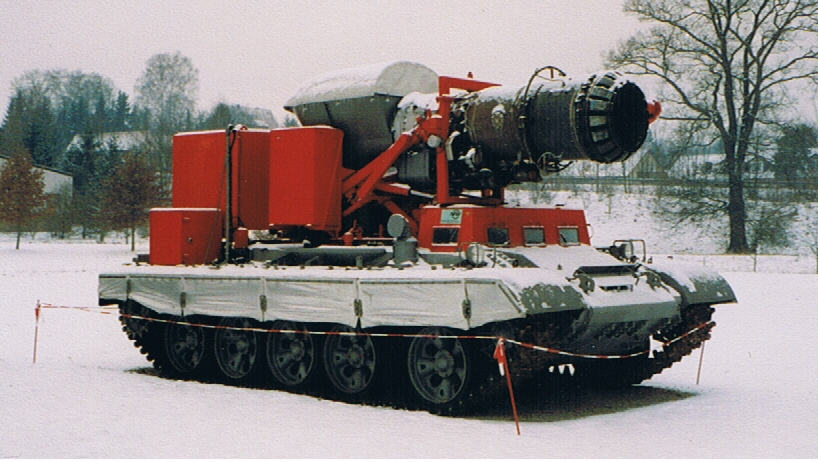
lostlogin
A thing like this, known as a GAG (Górniczy Agregat Gaśniczy) was used at the Pile River mine in New Zealand after an accident there.
bonestamp2
Some airports have truck mounted jet engines that they use for clearing light snow from runways.
Lammy
Why not both? https://en.wikipedia.org/wiki/M-497_Black_Beetle
leereeves
I doubt that would be allowed by the current administration. Even actual power plants that don't meet current environmental standards were restricted last week in Texas. They were allowed to run, but required to sell power for no less than 10x the usual price.[1]
It seems like a diesel train or jet engine would be even worse for the environment, per kWh, and even less likely to get federal approval.
https://www.energy.gov/sites/prod/files/2021/02/f82/DOE%2020...
sudosysgen
Diesel trains and jet engines are actually quite efficient and are already subject to regulations and thus don't pollute that much.
njacobs5074
Wow. That's like a real-life "Mike Mulligan and His Steam Shovel"[1]
[1] https://en.wikipedia.org/wiki/Mike_Mulligan_and_His_Steam_Sh...
noisy_boy
I love this. There is something about the power of train engines that is very appealing, even though there might be other bigger engines out there. Maybe it is the pulling aspect due to them being in front instead of driving that makes me think of them like iron horses.
Teknoman117
An "Iron Horse" is one of the oldest terms in the book for describing rail locomotives (dating back to the early 1800's).
These days they're basically rolling generators (powering electric motors and using their sheer mass for traction).
undefined
asudosandwich
Iron horses. I like that.
WalterGR
https://en.wikipedia.org/wiki/Iron_horse
"Iron horse" is an iconic literary term (currently transitioning into an archaic reference) for a steam locomotive, originating in the early 1800s when horses still powered most machinery, excepting windmills and stationary steam engines. The term was common and popular in both British and North American literary articles.
jacquesm
This was my first trip to Canada, and of course it had to coincide with the worst ice storm in living memory. We made it to Montreal and then immediately got snowed in, the road from the airport into Montreal was more like a tunnel between two walls of snow and ice thrown up by the snowblowers. Quite the experience. Fortunately after a week or so we could leave for warmer territories (Toronto, so 'relatively' warmer) but it is an experience I'll never forget. It took many months to restore the damage done by that ice storm.
Tade0
This makes me think: a locomotive's cruise power consumption is around 1MW, LiFePO4 batteries are currently $137/kWh, so for the price of a single machine($500k) one could have a rail car with 3MWh on board, which could be used in places where there's no overhead power supply.
I assume that just putting miles of cable along the track is more cost-effective, but it can't be used everywhere.
mlavin
The closest that's actively used is Wabtec's FLXdrive, which is a battery-powered locomotive run between two conventional diesel-electrics. Not a bad idea, since braking with the electric motors otherwise dumps the energy as waste heat. There's also the Railpower Green Goat, which is diesel-electric with a storage battery.
https://trn.trains.com/news/news-wire/2021/01/04-wabtecs-flx...
bluGill
The power density of diesel is enough better than you can get a lot more out of it, and it is a lot faster/easier to refuel (at least for now). There is a limit to how long you want the train, so if half of the train is batteries it doesn't work out.
Miles of cable along the track is something the big railroads have looked at. If fuel goes to (and stays at) $8/gallon they will do it. Right now it isn't worth it, but the costs are easy to analyses.
The above is for freight rail. For passenger rail electric lines work out different, no serious operator of passenger rail uses anything else. Tourist attractions (generally running steam) are not serious. Diesel engines can be a useful backup for when wires break. Diesel is also useful on marginal lines that are only run at all because they already exist, but you would never build. Everything else - probably the majority - is incompetence.
Symbiote
> Diesel engines can be a useful backup for when wires break
In reality, this doesn't happen -- the capital cost of idle diesel locomotives would negate (and more) the money saved with the electric trains.
If catenary is damaged in Europe (usually by storms), rail services are suspended until it's repaired. Repair is a very high priority.
(For one thing, it's unlikely to be safe to repair the catenary if trains are still running.)
fomine3
Tokyo Metro operates trains with battery backup since 2016.
https://www.toshiba.co.jp/infrastructure/en/topics/back-numb...
bluGill
Very good point. A diesel backup implies you can borrow it from some freight service, or have one in your tourist attraction fleet, and the problem isn't your wires but the wires feeding you.
Get the top HN stories in your inbox every day.
Me, reading the headline: "Aw shit, was that us in '98?"
Open the article: "Over the week spanning Jan. 4-10, 1998..."
That was honestly a wild time. I was almost 12. School was closed for 2-3 weeks because they couldn't promise there would be electricity to heat the building. The ice kept breaking power lines or crushing the transmission towers from the weight (ice is heavy!). Imagine your car, covered in a 1-2 inch thick layer of very solid ice, encased.
People died. The military had to come in to help. My family was fortunate that we had a wood stove in the basement that kept the house warm and cooked some meals on. We lost power a few hours at least every day.
Crazy time.
Edit: For those interested in this, the Wikipedia article (https://en.wikipedia.org/wiki/January_1998_North_American_ic...) has some great photos and description. 1,000 transmission towers/pylons destroyed, 35,000 utility poles. Whole forests devastated.