Get the top HN stories in your inbox every day.
cbmuser
kstenerud
Actually, prices excluding taxes and levies look pretty similar: https://www.cleanenergywire.org/news/german-household-electr...
And in Germany and Denmark, taxes and levies ARE the main price drivers. The maintenance costs are amortized in the per-kwh cost to consumers, same as with nuclear or gas or coal.
Single houses can't live off just solar energy because they aren't diversified like a nation can be (in terms of storage, routing, diversity of technologies, etc).
Nuclear is nice in theory, but unfortunately they are managed by humans, and humans do stupid things like run them past their decommission date or fail to locate backup generators above flooding level or skimp on maintenance and inspections. And nuclear accidents create no-go zones that last millenia. Only truly "meltdown-proof" reactors would avoid this problem, but R&D into this is terribly slow and seems to be obstructed at every turn by incumbents.
cbmuser
You will never get the market prices from the electricity exchange.
In particular, those prices aren’t stable and are often negative or soar up to 4000 Euros per MWh in Germany.
Please, for the sake of an honest discussion, look at the actual data in Germany.
And, no, there is neither a strong fossile nor nuclear lobby in Germany. The renewables lobby is - by far - the strongest lobby as the overwhelming majority in Germany supports renewables.
Germany has already invested more than 500 billion Euros for the transition to renewables and we are still among the dirtiest electricity producers and we are still building new fossile plants.
100% renewables based on wind and solar does not work and will never work on a large scale.
Retric
Germany is further north than Maine, it’s excessive early adoption is a poor model for solar adoption globally. Though it did drive the industry forward which provides global dividends.
coddle-hark
I’ve read somewhere that meltdowns are impossible in modern reactor designs, is that not true?
orwin
It is impossible with Gen3+ (that include a core catcher).
However, i have studied Gen3 and Gen3+ designs, i think Gen3 design are really safe enough, even if knowledge decline as much as it did on Trantor: anybody with small training could keep one functionning if they follow the simple rule: if something unexpected happen, Don't touch anything.
Gen3+ add a new surface of attack, a digital one, while the main issue in Gen3 is not fixed (for information, the main security issue is the pool). I'm not a fan.
undefined
undefined
gridlockd
Those taxes and levies are used to finance the renewables, so it makes no sense to leave them out of the picture.
These renewables produce a lot of power that isn't needed during their peaks, which gets sold at low or negative prices on the market, yet is compensated for with the full subsidy.
During their troughs, you need another source of power, usually natural gas, which is expensive, or coal, which raises the baseline production and therefore exacerbates the peak production problem. The result on CO2 emissions is pretty damning.
This is the danger of picking "winning technologies", you are telling the market to waste resources. Instead, you need to incentivize the market for your actual goal and then let it do its thing. Putting a price on CO2 would've incentivized all sorts of technologies that reduce net CO2 emissions.
kstenerud
And we're doing exactly that: Putting a price on CO2, and also subsidizing renewables to kickstart the industry and get some production scale going. Seems like the fastest route to full renewables. You can even see the effect of the market manipulation starting in 2008: out-of-pocket costs on solar have dropped 8x since then.
No problem of this magnitude is ever solved with a single-prong approach. It calls for some far-thinking: Figure out which energy sources will eventually be the cheapest to harvest sustainably, and then take a financial hit now for a bonanza later. Complaining about the price comparison today is just silly, considering that people in the industry only look at out-of-pocket money when making their decisions.
Retric
France production is ~70% nuclear but consumption is well below that. They export subsidized Nuclear at a loss and import rentable and fossil fuel generated power. https://en.wikipedia.org/wiki/Electricity_sector_in_France#/...

Frances issue is the demand curve isn’t a steady state so Nuclear needs on average more supplemental power than solar to make up the difference. Unless you leave plants mostly idle at extreme cost or have vast energy storage you can’t get to even 50%. Consumer rates are heavily subsidized and their close ties with Europe’s grid mostly hides these issues. However power plant utilization still hovers around 80% which means the country pays significantly more for nuclear than countries with better utilization.
Things would look much worse for France if surrounding countries increased Nuclear generation as the seasonal, night time, and weekend surplus would increase.
Slartie
Your critique would be a lot more valid if you would admit that nuclear power proponents also usually "forget" about the systemic costs of nuclear power, such as the incredible costs of deconstructing old plants, the costs of storing the waste in a safe place for thousands of years, and the costs of insuring against catastrophic failures in plants that might make wide swaths of land around them uninhabitable...oh wait, that insurance is so expensive that effectively nobody provides it at any cost. Nuclear power thus can be regarded to have infinite systemic costs.
pydry
Also that Germany is front loading investment in green technology and building that into electricity prices while France already built its nuclear power plants decades ago.
It's obviously cheaper to use existing infrastructure than to build new infrastructure.
One day Germany will be able to coast on the green infrastructure it is building today.
Nonetheless, if you take two countries with only coal and one only builds nuclear while the other builds solar and wind I would expect the latter to have far lower electricity prices based on LCOE and variability costs. Even without externalities nuclear is incredibly fucking expensive.
audunw
Aren’t most of Frances nuclear reactors really old? Of course nuclear is cheap decades after you built them. Most of the costs are during construction. Isn’t it unfair to complain about not counting systems costs for solar, but then doing a comparison that basically if ignores most of the costs with nuclear (if starting from scratch)
Seems to me that France has built up a lot of debt in terms of old reactors that need to be decommissioned and replaced. As far as I’ve read, their plan is to replace most of those with renewables (targeting 50% renewables)
I feel like I see this all the time - nuclear advocates being extremely nitpicking about cost and challenges with renewables, while ignoring or brushing off those of nuclear power. I’m not against nuclear power, we should put more R&D into it to hedge our bets. But I’ve yet to see a compelling case for a huge bet on nuclear power that’s not ridiculously simplistic.
We all know that energy storage and synthetic fuel production is the missing key to going all in on renewables. But we also know that breakthroughs in these areas are absolutely essential to making transportation CO2 neutral. So going nuclear doesn’t avoid solving that problem. I’d argue that going for renewables is a huge benefit in that it channels more money into energy storage, increasing R&D, making it easier to solve the climate crisis across the board.
We can return to nuclear power in 2-3 decades and hopefully free up some of the land claimed by solar and wind power plants.
bjelkeman-again
As a point of comparison, Sweden had the following distribution of power production for electricity in 2019 [1], at a comparable price to France (a bit higher) [2].
Electric production tWh
Nuclear 64.3 39%
Hydro 63.6 39%
Wind 19.9 12%
CHP 8.1 5%
Industry 6.6 4%
Other 1.5 1%
TOTAL 164
Where CHP and Industry was 75% biofuels. Renewables are about 90 tWh. Production has increased over the last years mainly due to new wind power. Installed solar is still small (0.2% of production) but nearly doubled in installed capacity from 2017 to 2018 (231 MW to 411 MW). With gCO2/kWh about 60. [3]
[1] https://energimyndigheten.a-w2m.se/FolderContents.mvc/Downlo... [2] https://ec.europa.eu/eurostat/statistics-explained/index.php... [3] https://www.svensksolenergi.se/upload/fakta-om-solenergi/sol...
Youden
> Hydro 63.6 39%
Switzerland, the country I live in, also has a ton of hydro (60% [0]) but the thing about hydro is that it's entirely dependent on geography. Iceland has 100% renewable electricity [1] but that's due to its geography.
Same goes for all renewables. Wind depends on areas where wind is harvestable and solar depends on daylight hours.
Not saying this to say that you're wrong or your point is irrelevant or anything, just that the energy solutions applicable to one country don't apply to all.
[0]: https://www.eda.admin.ch/aboutswitzerland/en/home/wirtschaft...
[1]: https://www.government.is/topics/business-and-industry/energ...
cbmuser
Exactly. Hydro will work only if you have a large amount of lakes and mountains per capita which is true for countries like Austria and Norway.
jnsaff2
I see that you are angry but "completely useless" is not really helpful.
Anyway I'll bite, I work at a startup that does demand side flexibility with electric hot water heaters (and working on other devices as well). We install our controller at customers homes and steer the water heating according to: electricity spot price, greenness of energy and also participate in frequency stabilisation markets. Customer saves by using cheaper electricity and earning money by allowing their heater to be used in the grid stabilization, in effect they get the money that would have gone to the gas peaker plant for firing up during an imbalance event.
A 300L water heater stores about 16kWh of energy as heat and has a heating power of about 3kW. Aggregating thousands of homes together and making sure the water is heated when it's best for the system is one of the ways we're working on the problem of intermittency.
The funny thing is that in our key market (Finland) the homeowners have dimensioned their water heaters to only heat at night when the electricity was usually cheaper. This meant that a family of 4 could use water all day without it getting cold and heat it during the day. Now we can flip this around and store energy when it's best.
Demand side flexibility is key (along with storage and electrification of transport and heating) to enable green renewable generation to come up to the levels we need. Sure, we don't have solutions for the last 1% of the problem but we're far far away from the last 1%.
_Microft
Why would people have to go without power if there is no sun at their place? We do not go hungry either when there was a bad harvest in our area. We just transport goods in from where they can be produced.
Intermittency is only a problem when one has a medieval image of self-sufficiency in mind. Solutions are either averaging out peaks and dips temporally (by storing energy e.g. in pumped hydro plants, in batteries, ...) or geographically by moving power where it is needed and from where it is currently being produced. You do not even lose gigantic fractions of the power in the process: high-voltage direct current power lines have losses of around 3%/1000km. China, for example, has power lines that move a dozen gigawatt over a distance of over 3000km. It can be done.
whiddershins
What are the security implications of a total abandonment of regional self-sufficiency?
_Microft
What's your concept of regional here?
For physical goods, we have ditched self-sufficiency a long time ago. Your government might sustain emergency reserves for grain, food or oil and gas but even that lasts only a few weeks. Here is what Germany has stockpiled for emergencies for example: [0][1][2].
Mutual dependency does not have to be a bad thing either. It keeps both sides from doing stupid things (assuming a balanced level of dependency in both directions).
[0] (german) https://de.wikipedia.org/wiki/Bundesreserve_Getreide [1] (german) https://de.wikipedia.org/wiki/Zivile_Notfallreserve [2] (german) https://de.wikipedia.org/wiki/Strategische_%C3%96lreserve
orwin
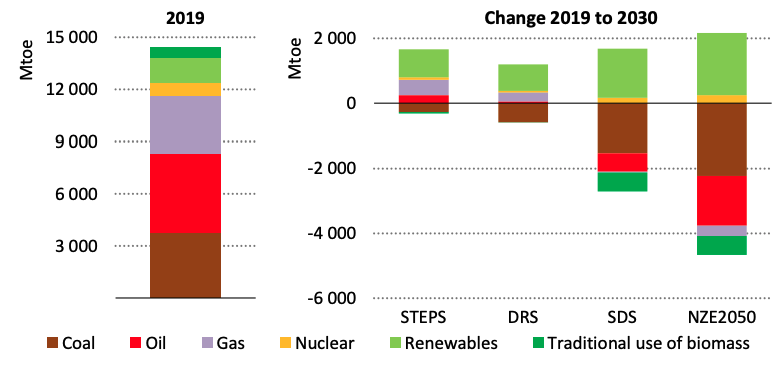
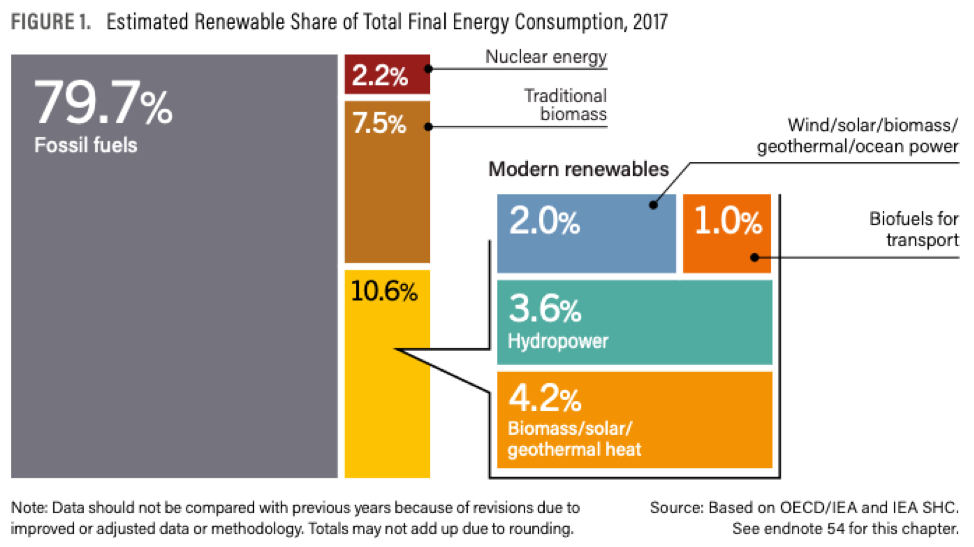
Yes, but i think you don't have the orders of magnitude here. The image showed in the article [0] doesn't separate the different energi use making it look like the NRE have more impact that they really have. You might want to look a that instead [1]. In reality solar accounted for less than a percent of used power in 2016.
From wikipedia [2]:
```Worldwide growth of photovoltaics is extremely dynamic and varies strongly by country. As of 2020, there are at least 37 countries around the world with a cumulative PV capacity of more than one gigawatt. By the end of 2019, a cumulative amount of 629 GW of solar power was installed throughout the world.[2] By early 2020, the leading country for solar power was China with 208 GW,[3][4] accounting for one-third of global installed solar capacity. By the end of 2016, cumulative photovoltaic capacity increased by more than 75 gigawatt (GW) and reached at least 303 GW, sufficient to supply approximately 1.8 percent of the world's total electricity consumption.```
So the installed power in 2016 is at least 303 GW. Let's check how much it produce (and btw, solar is not like wind or water and can't easely be disconnected from the grid, at least for large solar farms, so broadly: solar power generated = solar power used).
According by ourworldindata [3], 328.2 TWh in 2016 and 724 in 2019, so it roughly double every two years. That's the good news.
And the cost have nothing to do with this. The bottlneck is twofold: the installation (peopl trained to instal the solar panels as well as the land usage, and the other one is the production. That can keep doubling every other year, but one thing won't, and that the mines. The growth decline already started for wind power generation because of the first bottleneck (the demand don't follow the offers), i'm afraid the second one will limit the solar panel usage.
I've read that installed solar was 3% of installed electricity in 2019, so roughly .3% of electricity used. Electricity generation is 1/3 of our GHG emissions, and we need to limit those to 0 by 2050, or at least by 2070. This is not hte way. It will help, but this is not the way.
[0] https://www.carbonbrief.org/wp-content/uploads/2020/10/Scree...
[1] https://www.c2es.org/site/assets/uploads/2017/10/estimated-r...
_Microft
> This is not the way. It will help, but this is not the way.
There is no this way (i.e. no 'silver bullet') to fix the climate crisis. If we want to tackle the problem, there will only be lots of smaller it will helps that - in total - will make a difference then.
gridlockd
You'd think that if this was an easily solvable problem, the great engineering nation of Germany would've solved it, instead of just firing up the coal plants.
To store just a fraction of the needed power would require millions of large expensive batteries, whereas pumped hydro storage requires geological features that are in limited supply.
Once you factor in all these costs, suddenly the "cheapest electricity in history" becomes really expensive.
pfortuny
Well, the great engineering nation of Germany brought us the Dieselgate.
pjc50
Political issues: the coal lobby is strong in Germany despite its "green" image.
adrian_mrd
You raise some good points and there are likely many reasons for the total price of electricity production eg retailer margins, transmitters, age/quality of infrastructure, regulation at different tiers (state, federal, local), etc, in addition to the ones you raise.
But if you are factoring in total costs for nuclear, you also need to factor in the security risks and costs (eg terrorist threats to nuclear plants), costs to dispose of nuclear waste, inability to provide housing close to reactors, etc, as well.
rogerthat_au
I run a startup (www.de.energy) that opens up solar as an asset class and funds solar commercial and industrial projects in India and Africa. The last project we funded was for 31,500 INR per kW ($425) and we are currently about to fund a few projects at $364/kW for Tier 1 equipment. This is more expensive than utility scale projects. The estimates in the article are what we are seeing on the ground.
Yes, it is accurate that solar can't supply more than 30-40% of the energy mix. But we are still far from reaching that level of supply in the developing world and faster the cost reduces, the better it'll be for continued deployment en masse. Battery innovation as well as other tech will continue to improve the amount of solar in the energy mix.
Edit: You may also find this helpful - https://de.energy/blog/solars-future-is-insanely-cheap-2020-...
_jgdh
I’ve had this question for a long while but no one to ask it to. You might have the expertise required to answer it.
When I see new solar projects that have tendered absurdly low prices, are the bidders bidding with today’s solar prices or are they betting that solar prices will fall further, allowing them to eventually make a profit? For example Adani solar won a contract to supply energy at INR 3 or $0.05 per kwh. Is that the price of building and operating a solar in 2022 or is it the price that the winning bidder hopes it’ll be in 2024 when they’re building the second and third phases of their contract?
rogerthat_au
Your question goes to the core of what we do. Cost of solar on today's price is already really low and the calculation is being done on prices today. Keep in mind per kW yield of solar in India is very different from in the US or further north.
For example, at a cost of 30,000 INR/kW ($405), and a bid price of INR 3, assuming yield of 4.25 kWHr/day per kilowatt, we are looking at an IRR of 10.5% over 20 years. Now add long-term debt to the mix and we are upwards of 12%. Solar doesn't have any moving parts and this assumes operations and maintenance at 15%. If the cost squeezes further by 2024 - the IRR is even more attractive.
Goldman, Walburg, Pension funds, etc are deploying billions in solar for this reason - IRR upwards of 10% over 20-25 years with low risk. That's why we started this business too :)
_jgdh
Yeah it’s a great business to be in. As long as the climate doesn’t change, you’ll be pumping out electricity from a plant at an unbeatable price - since there’s no input apart from maintenance costs. How long do solar panels last before you need to replace them though?
Since you’re so on well informed about this here’s another question. I notice that battery prices are roughly halving every 3 years. At what point does it become cheaper to attach batteries to Indian solar plants than it is to operate coal powered plants?
undefined
undefined
pabs3
What is the best storage for solar? Batteries, molten salt or pumped hydro?
Is anyone using excess solar energy for desalination plus pumped hydro?
rogerthat_au
We've only used Li-ion or led acid so far. Li-ion is much better long-term for a number of reasons. We like the idea of ESS flow, but haven't had a chance to use it yet.
No experience w/ solar for desalination or hydro as its outside our focus right now.
Tipewryter
    solar can't supply more than 30-40%
    of the energy mix
rogerthat_au
I meant solar on its own.
Solar + battery is where the future of solar is, but the economics of batteries don't work yet relative to grid electricity price in the developing world. So far we've deployed solar+battery in petrol pumps and a few off-grid locations. In the markets where we operate, on grid, it is economically not an option yet.
toomuchtodo
This is demonstrably false. Batteries and solar are already cost competitive.
https://www.bloomberg.com/news/articles/2018-09-17/solar-wit...
https://www.utilitydive.com/news/new-mexico-approves-100-ren...
itsoktocry
>the best locations and with access to the most favourable policy support and finance
So in a world of rock bottom interest rates, incentives, subsidies and "revenue support mechanisms" geared toward green projects, solar is the cheapest alternative? That's not surprising; it's the goal.
kstenerud
The point is that we're finally there. That the market has been manipulated through government incentives is not as important as the fact that developers will now see renewables as more favourable in future projects. This is about momentum more than anything else, and momentum is hugely important when your horizon crosses decades.
The money ecosystem in play now favours renewables more than non-renewables, and that's reason to celebrate.
jimbob45
Doesn’t the issue of cloudy days remain though? I’m genuinely asking - the last I checked, solar efficiency took a backseat to battery storage as the step preventing us from moving forward.
kstenerud
There's plenty of R&D into cloudy-day solar collection, and there's also wind, tidal, hydro, as well as many clean battery technologies ranging from chemical to heat to gravitational. Not to mention traditional backup systems and smart grids.
We're not so fragile that cloudy days will shut down our energy grid.
pjc50
What is "forward"? While 100% isn't feasible today, currently deployment is low, so it's still easy to achieve real CO2 and cost reduction by increased deployment.
(Away from the equator, seasons are more significant than cloud or day/night cycle..)
pfdietz
The cost of various storage technologies is declining, and should be quite affordable by the time they are needed. This retro shadow being cast back from the expected future is among the reasons nuclear cannot get investment now.
rrmm
I would guess that capacity is designed wrt average insolation and not peak; spot market generation takes care of the peaks.
Ekaros
Or during winter above Artic Circle... As only meaningful pricing metric is average price for whole year in location of consumption. Anything else is just cheating.
qz2
I await our idiotic governments taxing it heavily to support dying petroleum industries next.
konjin
People don't want to hear it but saying 'solar is cheap when the sun shines' is like saying 'coal is cheap at the mine'. You need to send it to where it is needed and when it is needed.
Storage methods need tens of trillions of investment to reach that capacity and power prices would have to increase 10 to 100 fold to cover those investments.
Solar is not a solution for an industrial civilization.
ben_w
Reports estimate Tesla’s batteries cost them about ~$150/kWh; assuming they last ~1000 cycles, that’s a lifetime cost of $150/MWh.
That’s adding x7 over the “cheapest electricity in history” solar and x2.5 for the relatively expensive solar in Europe and the USA, definitely not x100.
And even that’s assuming you have to store all the energy before it gets used. Before I left the U.K., I had two different rates for energy depending on the time of day — cheaper at night because demand was lower.
socialdemocrat
Do you think building solar farms causes existing gas plants to collapse or something? No, that capacity is still there and you can run it when the sun doesn’t shine.
It still saves you money, because the fuel costs more than the solar power. It also reduces CO2 emissions in the period the sun shines.
I guess your counter argument is “but it doesn’t remove ALL the CO2!!”
But why should it? That is a long term goal. First we remove all CO2 emitted when the sun shines. We still got plenty of work to do there. Only when that has been done all do we need to think about storage. By that time storage solutions will be cheap.
konjin
>Do you think building solar farms causes existing gas plants to collapse or something?
Yes it literally does. My employer has shuttered three out of their fleet of nine gas power stations because they are no longer peak competitive with batteries. And base load designs aren't competitive with solar since they are more expensive and will only be turned on during extreme events, like a snow storm, or an extremely hot night.
Sucks to be us when we need electricity during an extreme event though.
pjc50
You should look at what prices solar and storage are actually being deployed at. Your comment is very much saying things can't be done while people are actually doing it.
konjin
I work as a quant for a power company.
I have very much looked at what the prices are doing and the answer is "making my employer filthy rich and making the grid unsustainable over the next decade".
Solar and batteries are eating the profit from base load and peak generators. Yet are unable to provide the sustained power requirements to keep the grid going on a day that gets over 35C.
If you like having power in hospitals at all hours you can't let solar and battery storage invade the grid without regulating it such that the grid survives.
Nationalization of the grid assets and a massive nuclear building spree is the only solution if we want children to grow up in a world where brownouts are the exception.
qz2
Completely.
Not just storage but we need to work on energy efficiency as well. We just smoke a huge amount of our generated energy.
cbmuser
I‘m not sure why you are being downvoted but you are 100% correct as I have explained in detail in my top comment.
konjin
Because people want easy solutions.
Being told that "we have locked in enough climate change already that by 2100 industrial civilization will be impossible anywhere and by 2200 so will agriculture." is not something anyone wants to hear.
If we were serious about climate change we would be spending the next 20 years under martial law building nothing but nuclear powered CO2 scrubbers and producing enough food to keep us alive. Anything else is superfluous.
Or you can vote for Biden and get a vague promise that by 2050 we will be emitting as much CO2 as we were in 2000. And the less said about Trump the better.
The difference in policy options in the US is like the difference between jumping out of a plane and jumping out of a plane tied to an anvil.
xvilka
Good. Time to build solar power gathering satellites and a laser to deliver the power to the surface.
femto
Or (more likely?) a network of HVDC cables encircling the Earth, much as the world is currently enmeshed with optical fibre. The sun never sets on the solar network.
It's actually a real thing with the gradual roll out of HVDC between countries. Eventually the gaps will be filled.
https://spectrum.ieee.org/energy/the-smarter-grid/lets-build...
im3w1l
Oil and gas pipelines have lead to many geopolitical conflicts. Wouldn't these cables have the same issue? Maybe more redundancy in the network makes it less of an issue?
ben_w
Going to space is still so expensive that it makes more sense to build a global HVDC power grid even though antopodal 800 kV connections of current designs would have 60% losses over that distance.
(And that’s assuming you get less than 60% losses going from electricity to light, through the atmosphere, back to electricity; and the ground station is free or negligible cost; and nobody worries about orbital death rays either malicious or accidental).
pjc50
Why? This is worse on every possible level; cost, energy efficiency, safety. Just put panels on your roof.
rrmm
Hey, what if we just covered the roads with solar panels?! There are lots of roads! Or maybe we put solar panels on the bottom of the ocean, no one is using that space! /s
ben_w
Roads may well be a good thing to cover, depending on the costs of the structure. And I don’t mean “solar roadways” — a roof keeping the rain and the snow off isn’t worthless, and the extra lighting cost is small compared to the solar energy because neither streetlights nor car headlights are as bright as sunlight.
And (/s notwithstanding) people have considered floating PV on reservoirs to avoid evaporative losses.
GordonS
What kind of power could such a satellite realistically gather, and how much would be left by the time if reached Earth? Curious to know how this would be beneficial over a land-based solar array.
ben_w
Depends what you mean by “realistic”. Realistic by cost? Right now, tens kilowatts to low megawatts, and similar losses to sunlight at whatever wavelength.
Realistic in the sense of “if the $2 trillion per year currently spent on energy was spent on bootstrapping known tech but in space”, rather a lot more.
Tade0
I think the risk of laser-induced mortality would be too high.
progfix
I'd rather see high sea, autonomous swimming wind and solar power plants that store the power as hydrogen which gets shipped to land.
justinclift
Having some nation, or satellite hacker(s), be able to do Bad Things to targets on the surface doesn't sound appealing. :(
barrenko
Cheap just means someone else (or even you indirectly) is paying.
oblio
This an entirely pessimistic point of view that assumes that human innovation does not exist.
Many cheap things have hidden downsides, but not all of them, and some of them have fewer and smaller downsides than you seem to be assuming.
VyperCard
No it doesn’t.
maallooc
Yes it does.
cbmuser
Yes, it does. Come to Germany, we have lots of solar power and the highest electricity prices worldwide.
socialdemocrat
Due to high consumer taxes on electricity. Look at France. They did not pay for their nuclear power through consumer taxes but through general taxes hence the price looks low. Somebody else paid in other words. French taxes are higher than German taxes.
Germany is a poor example as it shut down perfectly fine nuclear power, thus incurring a cost on replacing it. UK has cut emissions more than Germany but had lower prices.
maallooc
Okay, and that must include the expensive price and environmental concerns of maintaining ESS to ensure energy continuity, the price to run fossil fuel plants to prepare for cloudy days, expanding the power grid to remote solar locations, disposing used solar panels and inverters, chemicals and water to clean the panels, and many other hidden fees to make solar viable, right?
crispyporkbites
By that logic you should factor in the environmental costs of fossil fuels when calculating the costs of that.
But oops nope we don’t pay that now, we’ll just let future generations handle it.
maallooc
Umm yes we do? We factor in these costs to every energy source, at least in our country, and solar is not even remotely cheap.
socialdemocrat
No you don’t because if you did, fossil fuels would not have been competitive at all.
And if solar isn’t cheaper is you are getting ripped off or you live in a cloudy place or far north.
crispyporkbites
If we burn fossil fuels at scale for 1000 years, will the planet remain habitatable? Will the human race survive?
Did your country factor that into the costs of fossil fuels?
fareesh
Don't know why you are downvoted. As a layperson I have no idea what the correct answer is to this - i.e. once you factor in the manufacturing, replacement, maintenance, backup plant, batteries, etc. what is the net gain?
Get the top HN stories in your inbox every day.
These comparisions solely account for the production costs and not for the system costs of solar energy and are therefore completely useless.
Solar panels will always require a backup power plant as the Sun isn’t shining 24/7 and storing large amounts of electric energy isn’t trivial.
I‘m really disappointed that this kind of non-sense gets posted on HN over and over again.
I‘m from Germany, we have 50% renewables in our electricity mix and our electricity prices are the highest worldwide.
France has 70% nuclear and their consumer electricity prices are half of the German ones.
Additionally, France emits only 50 grams of CO2 per kWh while Germany emits 400 grams on average per kWh.
I know lots of comments will counter-argue „Yes, but the high taxes in Germany.“ but those aren’t the main price drivers.
The main price drivers are the costs for subsidizing solar and wind (the so-called EEG-Umlage) and the costs for keeping backup power plants available which are allowed to produce only when solar and/or wind won’t deliver as both solar and wind have precedence over other electricity providers in the electricity net (the so-called Netzentgelt).
Solar might be cheapest when you consider the pure production costs per kWh but it’s not the cheapest when you consider the costs for a conplete system to provide electricity for a population.
Even single houses aren’t able to live off just solar while every house can live solely on power from a nuclear power plant which provides electricity 24/7.