Get the top HN stories in your inbox every day.
patio11
perakojotgenije
Do you have a reference for this newspaper trivia? I've just mentioned this "butter smell" to a friend of mine who lives in Japan and got told that it's not a thing and that it doesn't exist.
ddellacosta
What does your friend not believe exists? It's easy to find references to the term online:
https://ja.wikipedia.org/wiki/%E3%83%90%E3%82%BF%E3%83%BC#%E... 日本では、「バター」が西洋風の象徴として扱われ、西洋の物や西洋かぶれに対して「バタ臭い」と形容することがある。
"In Japan, butter is used as a symbol of the west, and the term 'batah-kusai' is used to represent western objects or the slavish imitation of western approaches."
(half-assed mediocre translation by me, there's probably a better way to translate 西洋かぶれ in particular)
Kotobank simply has 西洋風である。また、西洋かぶれしている。 https://kotobank.jp/word/%E3%83%90%E3%82%BF%E8%87%AD%E3%81%8...
Etc. etc. https://duckduckgo.com/?t=ffab&q=%E3%83%90%E3%82%BF%E3%83%BC...
ddellacosta
lol and I just realized now that I even wrote it wrong in my search
https://duckduckgo.com/?q=%E3%83%90%E3%82%BF%E8%87%AD%E3%81%...
needle0
FWIW, the word “batakusai” has become so ingrained in the language that one might not think of butter, the food topping, when you mention the word. (much like how you don’t always directly think of Jesus Christ specifically when you casually blurt out “Oh my god!”)
patio11
Should be in Partners for Democracy: Crafting the New Japanese State under MacArthur.
amelius
Lives in Japan, or was born and raised in Japan?
VRay
FWIW I never heard of that either, despite living in Japan on and off for a couple of years, marrying a Japanese woman, and being decent at Japanese
My guess is that it's just a 1960s meme that's fallen out of use
Actually, I've never seen or heard of any of the butter-related stuff.. Maybe those butter tools are a regional thing, or they're relatively unknown. I've never seen them on TV, and I couldn't find any butter dishes for sale when I was looking for one in Tokyo, so I ended up having to use a plastic box from the dollar store.
My in-laws were furious when I kept hiding butter in a tray outside of the fridge so it'd stay soft, and all their friends agreed with them that I was being a crazy foreign fool
perakojotgenije
Lives in Japan since 2 years ago
vijucat
My first day in Japan, I switched on the TV and was immediately thrust into a program where different designs of nail cutters were being analyzed. The angle of the cutting blades, etc; The cutting of the nail was inspected in slow motion video capture, and an Excel sheet of how far the nail flies, how neat the cut was, etc; was filled and a Winner was arrived at. I've never seen anything like it and I watched all 30 minutes of that program! It was a fascinating demonstration of what I believe is called "kaizen". I really like the attention given to everyday objects in Japanese design.
ekianjo
> It was a fascinating demonstration of what I believe is called "kaizen"
It's not kaizen, it's the perpetual appetite for novelty rather than anything else. Also Japanese TV programs are anything but legit, everything is scripted ahead of time and there's not such thing as a winner which does not happen to buy ads on the same network.
throwaway189262
Japanese tools are insanely good. I bought a specialized plastic cutter from a Japanese company a couple years ago. It was expensive, but I couldn't find another that took less than 4 weeks to ship.
It's built more like a smartphone than a cheap hand tool. Fully machined, no parting lines, very tight tolerances. The plastic is quite strong, maybe nylon. The steel cutter is definitely hardened and non magnetic so possibly stainless.
And in Japanese fashion, as far as I can tell this company only makes plastic cutters
ginko
Talking about nail clippers: I always found it weird that nail clippers seem to be the most common device for cutting your finger nails outside of Europe. Over here we have specialized scissors[1] for this which seem to give a lot more control and better results. Anyone seen these elsewhere? I guess they’re a bit harder to use?
quietbritishjim
Nail scissors have a better cutting action but nail clippers are much easier to use, especially with your less-dominant hand.
I'm a huge fan of Stylfile clippers [1], which have a scissor-like cutting action but clipper-like form factor. They were created by one the wonders of the UK version of The Apprentice (but don't let that put you off!).
[1] https://www.amazon.co.uk/Stylfile-AV5P1a-S-Clipper-Nail-Clip...
anonymfus
> Nail scissors have a better cutting action but nail clippers are much easier to use, especially with your less-dominant hand.
The main problem is not hand dominance of the user, it's chirality of the scissors themself. When you cut with scissors in the correct hand with a conventional grip, you force blades closer together which helps with a cut, but put the same scissors in the other hand and your fingers will now drag the blades apart.
Hence there are three solutions: you can have a pair of scissors with opposite chirality, you can try to grip wrong chirality scissors such way that you don't drag their blades apart, or you can have high quality scissors with pivot pin tight and strong enough that you will not experience that effect.
The scissors in swiss army knifes/cards for example are both high quality and allow for alternative grips.
undefined
fomine3
This is my favorite nail cutter that's just like scissors. I can't back to normal nail cutter.
mcguire
That would explain why I once spent a week in Amsterdam with excessively long fingernails---I'd forgotten to bring some and I don't like shears (they give worse results and less control).
kace91
In spain at least we mostly use nail clippers as well, I've only seen specialized scissors used for babies for some reason.
benhurmarcel
Same in France. Both exist but clippers are more common.
cesarb
Both nail scissors and nail clippers exist here in Brazil. I don't know which is more common, but both are easy to find.
egeozcan
I'm living in Hesse and here the clippers are popular (Even sold in REWE). But maybe it's regional?
PaywallBuster
Maybe specific to your home country.
Most people use clippers, the scissors usually show up in woman's bags
centimeter
Japanese designed and manufactured tools are always a delight to use. Whenever I go to Japan I always find myself picking up some new beautifully designed and made object. The last time I was in Tokyo it was lighters. I bought probably $300 of various lighters from Tokyo Pipe Co. I don't even smoke!
Unfortunately it's getting harder and harder to find products actually made in Japan, and despite what many people want to believe, Japanese obsession with perfection makes a big difference in the quality of manufactured goods. Makita doesn't manufacture in Japan anymore, and quality has suffered. Fujifilm stopped making several of their lines in Japan, and quality suffered. Very sad.
mauvehaus
Some of the higher end Makita stuff still is. If you spend enough on a circular saw, they still make them in Japan. They also make a 6" and 12"(!) handheld power planer (not the stationary "lunchbox" style) that are AIUI made in Japan. That 12" planer goes for a couple grand US. That's the KP312 if you're curious.
Japan, incidentally, has a long timber framing tradition that's still relatively common in modern construction. This is part of the reason you'll see Makita and Hitachi tools in your US timberframer's kit; they still make the tools in Japan for the active local market.
secondcoming
Yes, the AvE youtube channel has two recent video of Makita drills literally going up in smoke. Which is a real shame as I really needed a drill and was all set for splashing out on a Makita.
centimeter
I think their more expensive drills are still pretty nice - the ones AvE keeps blowing up (what the hell is his business anyway?) were bargain bin ones. It's just sad that makita has any bargain bin lines at all.
I looked at what the best drill-drivers I could reasonably buy were, and there's almost nothing that's not made in China these days. Even Hilti makes its battery powered tools in China.
chris_st
I have nails which are (evidently) really hard; if I try to use the standard American 89-cent "Gem" cutter, I can squeeze the handles until they touch and it won't go through my nail.
Mentioned this to a co-worker, and he pointed me to Seki Japanese cutters. Extremely sharp, extremely well made, fantastic. They go through my nails like butter.
TazeTSchnitzel
It's not nail cutters, but perhaps other readers would be interested in NHK World's (English-language) programme which explores a different aspect of Japanese culture each episode, usually through the lens of a specific object (scissors, coffee, stationery, expressways, etc…): https://www.youtube.com/watch?v=ilPC-uJ8Yuw
andykx
My grandfather bought a knife in Japan while on a business trip in the 80s. The owner of the shop used to call him once a year (now they communicate via email) and ask if he needed to ship it back for any repairs. The repairs are free.
At this point, he considers this guy a friend. It’s a really interesting relationship. In my experience, the only similar relationship that most Americans might have is with the person who cuts their hair or with a bartender.
tkgally
I don’t cook much and I don’t need any fancy cooking knives, but I still enjoy browsing in knife shops in Tokyo and Osaka. (I've lived in Japan since the 1980s.) The breadth and variety is amazing, and the knives are often beautifully displayed.
Two shops I remember particularly fondly are in Osaka: Kunishige [0, Japanese only] in the Tenjinbashisuji shopping street and the Sakai Ichimonji [1] shop in Namba. The latter is in a street full of restaurant suppliers, and several other cutlery shops are nearby. There are similar shops in Kappabashi in Tokyo [2].
[0] http://www.tenjin123.com/shops/國重刃物店/
thelastname
On YouTube there is a show called Japanology that discussed such things. Very interesting, even the episode about moss.
paulgregorylang
Could you provide a link? A search on YouTube provides a lot of similar sites and/or videos are using “Japanology” in their titles.
v3v3
"BEGIN Japanology" is the official name.
GuB-42
As a French guy, I like the "grater" knife, I may even buy one, but the "right angle" one feels weird.
But I may have an alternative explanation. The article talks about order and Japanese sensibilities, but to me, a right angle cut in a butter slab doesn't look particularly pleasing.
Instead, what I think it is to make precise cuts easier when the butter is hard, for example if it came out of the fridge. In this case, it can require a significant amount of force to cut through the slab, and making a straight cut can be difficult. With the tool, you push straight down, so you can use more force. And the right angle shape stabilizes the blade during the cut.
kebman
A French girl once asked me, "Why is there no salt in your Norwegian butter?" This really got to me. It forced me to ask existential questions like, "Should there really be salt in butter?" But the fact is, putting salt in stuff is an old conservation method. Because of it, unsalted butter was looked upon as fresher, and thus of higher value when used as spread or in cooking. As far as I know, the idea of unsalted butter was actually popularized by French gourmands! But as newer and cleaner dairy production methods came about, the production of unsalted butter became more common. On top of that, the colder climate in Scandinavia means that unsalted butter keeps for longer than in warmer countries. So that's why Norwegian butter isn't salted. But yeah, as for the "grater knife;" I think it just made it to the top of my wish-list for Christmas!
Tor3
But Norwegian butter is salted. It's just that you can also buy unsalted butter (and extra-salted butter, lactose-free butter (only sold in smaller 250g sizes while "normal" butter is also sold at 500g), and butter from sour cream. And a couple more. The salted variant is the "normal" butter (center in the picture in the link), the rest are variants. https://www.tine.no/merkevarer/tine-sm%C3%B8r/produkter/tine...
ad404b8a372f2b9
Salted butter is mostly used in the Brittany region of France, there's a joke that goes: "How can you tell a girl from Brittany likes anal? > She has unsalted butter in her fridge."
Bit vulgar but culturally interesting I thought.
benhurmarcel
It's originally from Brittany, but salted butter is very popular in all of France.
coddle-hark
This is really interesting because here in Sweden pretty much everyone uses salted butter, you can buy unsalted but it’s not common at all.
The most popular sandwich spread (bregott, a mix of butter and rapeseed oil) comes in three main variants: “normally” salted, lightly salted, and extra salted.
unwind
Yes! In Sweden nobody puts actual butter on bread, we have loads of different butter-based "spreads" for that. Bregott (literally "spread good/well/tasty") is probably the most common and engineered to be spreadable straight from the fridge.
Proper butter is for cooking but primarily for baking.
I am 45, have been interested in cooking for 20+ years, read many cookbooks and so on. I learned about butter dishes and the idea of having butter out on the counter to make it spreadable from the internet. I dare say that practice does not happen here.
Kosirich
In Denmark most of the butter is salted and the Danish are definitely a butter nation. I'm wondering how nobody tried to introduce some of this "japanese butter tools" to Denmark. There might be a business case here.
spyke112
Probably because we eat lots of Kærgården[0] and other mixed butter products. Which inicdentally is easier to spread, and melts at lower temperatures.
[0] Butter mixed with vegetable oil and stabilized.
sleavey
Kerrygold in Germany is sold in the standard gold wrapper but unsalted. I was really surprised having come from the UK where it's salted and utterly delicious. If you want the salted stuff you have to hunt for silver labels, and I have only started to find these recently and only then in the biggest supermarkets.
Butter preferences around the world are strange.
kevinconaway
Interesting. Here, in the US the gold wrapper is salted while the silver wrapper is unsalted
rmetzler
There is also salted Kerrygold in Germany. But I think the wrapper is silver.
romanoderoma
Italian here, from a quite warmer country.
There shouldn't be any salt in your butter.
There is no salt in milk, there is no salt in butter.
Unless you want salted butter, in that case you can simply buy a slab of salted butter.
unixhero
I really enjoy the way Italians are so normative about their food.
freeone3000
Yes, this is what everyone else is talking about, salted butter.
thaumasiotes
In the US, salted butter and unsalted butter are both sold in stores. In general, you eat the salted butter directly, and you might use either salted or unsalted butter in cooking.
The only reason we use unsalted butter is if a recipe specifically calls for it. But it's widely available.
eslaught
I've heard that unsalted butter makes it easier to measure the salt to put in a recipe, since you don't need to reverse engineer the salt content of the butter. But in practice I don't find this very compelling because (in my experience) the salt is pretty standardized. I generally convert my own recipes back to using purely salted butter so I don't have to stock two kinds of butter.
vl
We use only unsalted butter to reduce sodium - everything else already has to much salt in it.
dragonwriter
I almost always cook with unsalted butter (unless all I have is salted, or it's a recipe I'm familiar with and comfortable with salted butter in) because it provides more freedom to control salt-fat combinations, and salt levels are one of the things I am most likely to find wrong (in either direction) with unfamiliar recipes.
I occasionally also use sold-as-unsalted butter in directly-served applications, because it lets you play with different finishing salts instead of just getting it mixed in with the butter.
skavi
When you say eat directly, do you mean as a spread?
monadic2
I use unsalted butter for all my cooking and use. Never grew up with salted butter and don't miss it. The vast majority of my family and friends back home (new england) use unsalted margarine (which I refuse to allow in the house).
I'm interested though, I've seen salted butter and wondered who was buying it. Now I know—literally everyone around me.
andi999
Wait. What? The first time I learned that there is salted butter was in scandinavia, and now you are telling me you dont do that anymore? Admittedly it was a long time ago in what feels far away..
nhebb
I don't want to get between a Frenchman and his butter, but I just use a potato peeler for cold butter. I find it works well enough. I've also used a cheese slicer, but I found it harder to control the thickness.
romanoderoma
I second this.
Or simply use a regular knife, either the teeth or the back, depending on the type of cut you want, to scrape the slab's surface.
I love Japanese strive for perfection and their tools, but I feel butter cutting is a solved problem.
read_if_gay_
Scraping it off the slab works well enough but then spreading cold butter on a slice of bread still sucks.
082349872349872
We don't cut our butter, but instead use a regular knife to scrape[1] curls off the top for spreading. (changing sides every now and then so the top of the butter winds up with a dihedral "roof" shape) Depending upon temperature of the butter, one has to use different speeds and feeds, but the correct ones for easily spreadable curls come quickly with practice.
[1] other scraping folk arts: hand-carved toy "christmas trees" with wood curls (originally, I think, suitable for use as tinder. These days we use chemical blocks as starters) and raclette, a dish involving scraping molten blobs off a wheel of cheese.
Freak_NL
This article makes me wonder about the shapes butter is sold in worldwide.
Everyone who ever looked up a recipe online knows Americans use those 113g 'sticks' of butter (this seems to be the exotic option), but it looks like most regions use bricks/slabs.
The Japanese ones look to be standardized on 200g.
A lot, if not most, of Europe seems to do 250g bricks, which often have a printed measure on the inside of the wrapper to help you cut off 50g pieces for baking.
Canadian butter seems to come in huge unwieldy blocks of 454g (four US 'sticks').
Any other form factors in common use?
unscaled
Japanese butter actually comes in many sizes, and unlike what this article says, it comes both in slabs and sticks.
You can get a 100g stick, which has pre-cut slots every 10g. This one is easy enough to break evenly with a normal knife: https://livedoor.blogimg.jp/ddmp-mmpj/imgs/5/4/549fd611.jpg
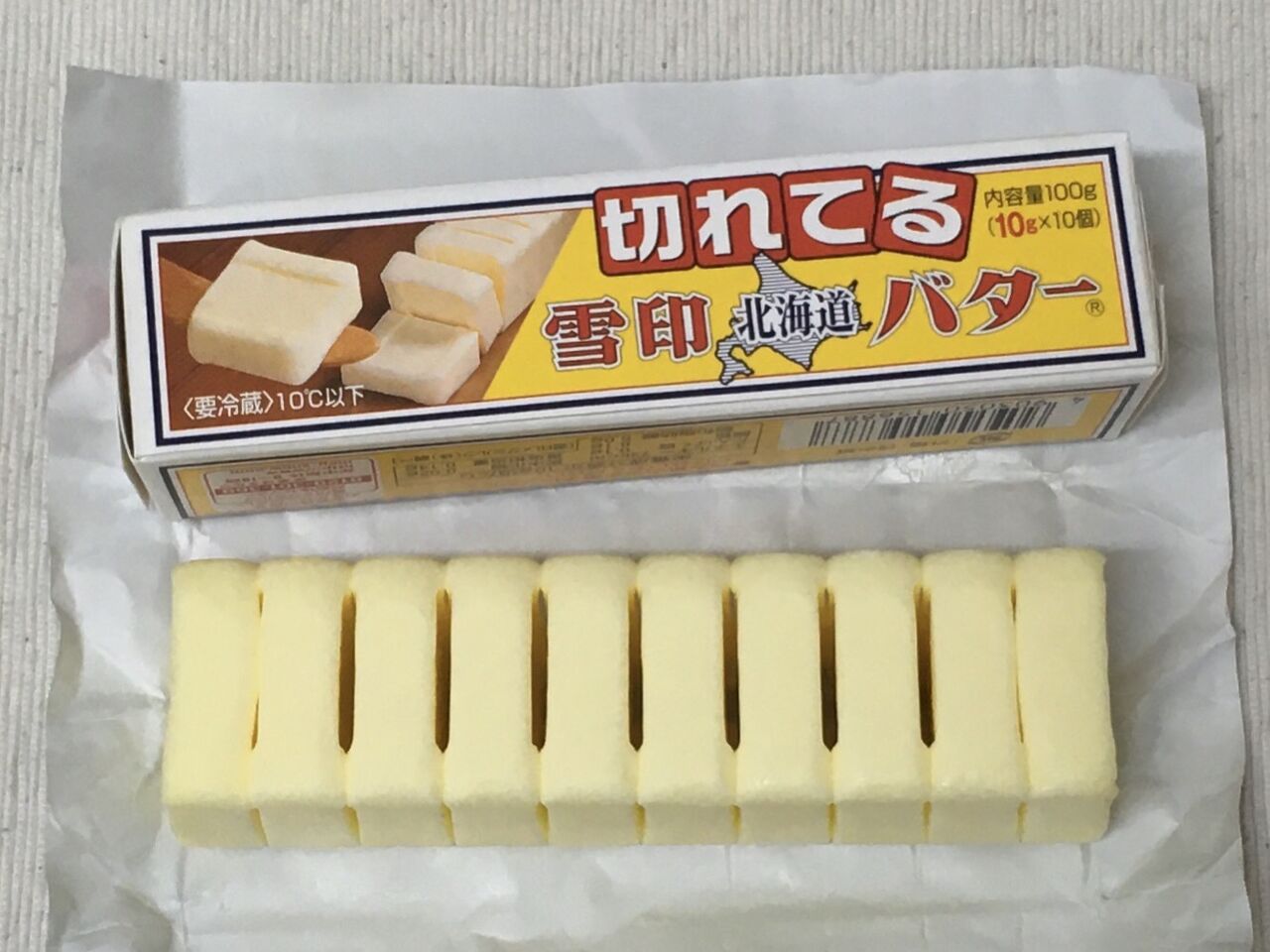
This is not very far from the standard American 4oz stick, as far as I understand, and for most Japanese households it might be enough.
Beyond that size you can commonly find 150g and 200g slabs in supermarkets, and huge 450g slabs in bulk-oriented supermarkets (like Hanamasa or Gyomu) and specialty shops (like Tomiz). I tend to use butter quite regularly for cooking so I'm generally buying the 450g ones, as it is quite expensive here.
I guess the reason many people here mention they've never seen these kind of tools in Japan, is that you wouldn't find them in a normal house. Relatively few people bake at home here (or even OWN an oven) and butter is mostly used for toasts. If you have an insatiable kodawari (pedantry) for nicely cut butter cubes, I guess you could just go ahead and buy the pre-cut sticks.
I am using the wire grill cutter myself though, so I know it exists. And I'm pretty sure that these different cutters are heavily used in cafe's restaurants, which often serve butter toasts. They tend to serve fancy-looking toasts like this one: https://storage.googleapis.com/mbs-recipe-and-restaurant-ass...
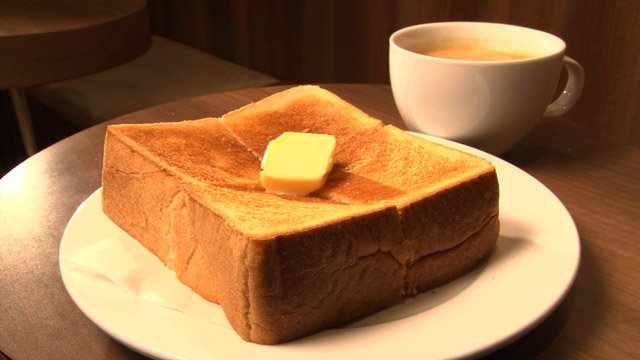
Yes, the toast bread is quite thick (though usually not as much as this), and the butter is frequently served as a perfectly slice on top. So perhaps having tools for perfectly slicing butter in right angle out of bulk-size slabs is not so surprising.
082349872349872
We buy 200g (table, in tub) and 250g (cooking, as slab, with wrapper measure) but it looks like there's a wide variety https://www.coop.ch/fr/nourriture/produits-laitiers-oeufs/be... of which I'd say the other I most commonly see are 15g (single service).
Edit: looks like you all have more than 250g and 500g, but not as much more: https://www.ah.nl/producten/zuivel-eieren/boter
Freak_NL
Yeah, in the Netherlands it is almost exclusively 250g bricks (excepting tubs for spreadable butter blends and margarine of course). Variations exist mainly for high end butter and bulk packaging.
dawnerd
In the states we've been getting more and more 'European' butter thats sold in 227g slabs.
I do prefer the sticks, they seem to keep a little longer and make baking easier.
derbOac
Yeah I see a variety of forms. Usually sticks which I prefer also but also "two stick"ish and "four stick"ish slabs. I also see logs of rolled butter, which are about three sticks worth or so rolled into a cylinder. I also see square slabs, maybe the mass of a stick or so, and sometimes tubs. The tubs are convenient for spreading but not as much for baking.
I usually prefer the sticks, as you don't have to cut the larger slabs.
justsid
In Canada we have both a slab of 4 sticks, but also 4 individual sticks in a cardboard box. I like that one a lot, since a stick of butter is too little and a slab the size of 4 sticks is too much. 4 sticks in one pack is perfect.
As a side note though, it’s not just packaging. I’m originally from Germany, and we don’t use salted butter there. In Canada it’s all salted butter by default.
permo-w
You definitely get the sticks in Cape Town, South Africa (along with packets of ham that say “edible” in big writing on the front). The butter is also ungodlily expensive, and margarine is in very common use
thelastname
A package is made of ham?
pjc50
I'm a total convert to "spreadable" butter, which is blended with vegetable oil to reduce viscosity and sold in tubs of 250/500g size.
layoutIfNeeded
Butter is already spreadable if you don’t refrigerate it.
nickbauman
probably less healthy than real butter. "Vegetable oil" is almost always canola oil, which is more appropriate in your automobile crankcase than in your body. Temperate oils in general aren't good for you: they evolved to have their nutrients available at colder temperatures for a germinating seed to grow in the spring. They rancidify readily as it gets warmer.
KozmoNau7
I would love to see some peer-reviewed sources on those claims, specifically that canola oil is actively bad for you, that "temperate oils" are bad for you in general, and the rancidification claim (I keep mine in a cupboard and I have literally never had it go rancid).
I cook mostly with (actual genuine) extra-virgin olive oil or peanut oil, since I prefer the smell and taste over the more commonly used canola/sunflower oil, and yes you can fry in olive oil just fine. But I still want to see some credible research that supports your claims.
Edit: here's a good article with plenty of citations that strongly disagrees with your claims: https://www.hsph.harvard.edu/nutritionsource/2015/04/13/ask-...
undefined
gruez
[citation needed]
cesarb
A common form factor here in Brazil is a plastic cup, for instance https://www.itambe.com.br/portal/produto/manteiga-com-sal-po... (that one is 200g, there's also a 500g cup, and a 200g slab which is easier to use when cooking).
wiredfool
There are two stick form factors in the US, the east coast long skinny stick and the west coast short fat stick. Each of them are 4oz.
yegle
If you live in the US, you can actually purchase these products from amazon.co.jp (Amazon Japan). They support switching the website language to Chinese and English. When you switch to English, everything including the comments are translated.
You do need a separate account on this website and you cannot delete the account (unlike Amazon US).
Shipping from Amazon Japan is faster than from Amazon US if you are not an Amazon Prime user.
morganhankins
Looks like the "right angle" cutter is the Kaijirushi KHS Butter Knife
https://www.amazon.co.jp/-/en/FA-5162-Kaijirushi-KHS-Butter-...
cmwelsh
I like the associated butter tub (frequently bought together section), what are the imperial butter sizes for it at my local American grocery store...?
spike021
Yeah Amazon JP is great, plus it's handy to already have one if you plan to make a trip to Japan. Both times that I went, I already had an account so it was super easy to order the SIM I wanted from Amazon to my hotel a couple days before arriving.
As far as shipping to the USA, YMMV, but when you can order items with delivery here then it's super awesome and generally fairly quick (aside from during COVID times with slower logistics).
EE84M3i
You were able to order a SIM card online? Did you have to do anything to activate it? I was under the working understanding that Japan required government ID verification for SIM cards.
_-___________-_
SIM cards are widely sold at vending machines in airports and train stations in Japan. I believe that the ID requirement is waived if the SIM has limited validity, as these tourist-oriented SIMs do.
spike021
It was a tourist one (something like 10GB for 21 days). You just open the package and activate it with a credit card on the company's website. I think you need to provide flight info for your return trip leaving the country and that's how they verify you're a tourist.
throwaway189262
You can do this with Amazon.co.uk too
The UK is my go-to source for black market medical products. You can get contacts shipped without a prescription because its not required in the UK. Also some OTC cosmetics and sunscreen is way better because they don't drag their feet on approving new ingredients for 20 years like the FDA.
rwmj
I recently ordered a couple of Japanese books from Amazon Japan and they were delivered in under 48 hours (to the UK).
homero
Sounds fun, I'm making an account. How do you pay? I see internet money and atm options.
rwmj
I pay using my ordinary (UK) credit card.
akdor1154
I don't know whether to thank you or curse you.
maroonblazer
The 'noodler' tool is brilliant. Butter lasts longer when refrigerated but spreading cold butter on bread is a recipe for destroying the bread or toast.
https://s3files.core77.com/blog/images/1105453_81_102355_0lI...

barrkel
Butter also lasts longer when it's covered, as long as the ambient temperature doesn't get too high.
We generally keep at least 100g of butter in our butter dish (i.e. under a cover) on the kitchen countertop, more if it's not summer.
As a child in the west of Ireland, we'd go through a pound of butter a week. I can't even find butter sold by the pound (or 500g - I'm not fussy) in the UK, blocks are generally 250g.
sedatk
as a fan of Kerrygold, I respect Irish butter. For some reason American butter doesn’t even come close. French, perhaps.
throwanem
If you're in the northeastern US, you might be able to find Amish butter. By mass it's cheaper than Irish, and I can't tell a difference in taste or texture between the two. I definitely can between either and regular stick butter, though - I won't use that in sauces any more.
tboughen
Kerry gold is glorious. Last time I was in France, all 20 types of butter In the local supermarket were disappointing because they were all unsalted.
antiterra
Plugra is a European style butter made in the states that is pretty good and widely distributed
thebooktocome
Mass-market American butter is designed for shareholder profits, not taste.
needle0
FWIW, I’m a Japanese native living in Japan and have never seen any of these unusual butter knives. I wonder where they’re sold.
tapland
And I’m a Swede and have seen them all sold in stores, although the grid one is rare nowdays (we use prepackaged serving size ones if needed).
And the butter cover looks about the same size as ours.
mensetmanusman
I like the french butter dish:
https://en.m.wikipedia.org/wiki/French_butter_dish
Takes advantage of butter being hydrophobic, and stores it upside down!
warabe
I've been living in Japan since I was born, but I've never knew these products. Thanks for sharing this!
I think I am gonna buy this one. https://www.amazon.co.jp/-/en/Stainless-Steel-Cutter-Butter-...
It seems Butter Cutter(lattice shaped one) can only be used for "soft" butter, but it must be helpful anyway.
jungletime
Just curious, how popular are butter croissants in Japan?
warabe
It’s quite popular I believe. You can buy one anywhere. Quality varies, though. Why did you ask me that?
jungletime
I'm hoping to visit Japan one day.
zemnmez
as an english person, these tools all seem to be for working on butter that’s fresh out of the fridge; they’d be impossible to use on normal, room-temperature soft butter.
There’s something funny about inventing a tool to solve a problem that only exists for such a simple cultural reason (assuming butter goes bad quickly if not refrigerated)
Also, really odd how this article thinks of normal, unsliced butter— normal to everywhere else in the world but the US as some kind of pre-technological tradition.
edit: a friend pointed out to me that in lots of other places in the world, butter probably just melts to the point of becoming useless, so it has to be kept refrigerated, which is something I never considered before, feel pretty dumb about that
Waterluvian
Really enjoyed reading this.
I have a problem with articles that usually either try to bash or over-romanticize Japan. Could definitely use more articles like this one.
antiterra
It’s not bad but ‘need for order’ and ‘would be too visually chaotic for Japanese sensibilities’ are borderline. Japanese people eat sloppy katsu curry and noodles that are no less chaotic than shredded butter. Also, plenty of people in Japan do not live or work in immaculately organized quarters.
unscaled
Also, as most of the commentators from Japan here noted - most people here have never seen or heard of these utensils.
There are obviously some differences in how the Japanese eat stuff, but in general I can't say that Japanese are noticeably fussier when it comes to daily dining habits.
I think visitors often get the wrong impressions because what they see is:
1. Nice restaurants (not necessarily expensive ones), which are very particular about how they serve their food. 2. Enthusiastic hosts who go out of their way for infrequent guests - especially guests from abroad.
It all boils down to omotenashi - to be exoticizing a little, that's the Japanese spirit of treating guests with the utmost welcome. To be more down to earth, this is all about cultural expectations. Restaurants and cafes try to present a perfect-looking dish, because this is how they are judged by their customers. Some (not all!) hosts might go out of their way and serve using their best dishes, trying to make restaurant-looking food to make good first impressions on a guest.
kakkun
I've always enjoyed stuff by Rain Noe (the author of this article). I believe he has lived in Japan previously, and seems to have a more realistic viewpoint of Japan's pros and cons.
throwanem
Why is every butter dish in the world not equipped with those pegs? I can't count the times the stick has slid out of mine while I was just trying to enjoy some toast.
Get the top HN stories in your inbox every day.
Fun historical fact: one of the Japanese daily newspapers, during the Occupation, was prevented from publishing an editorial (accurately) describing the Constitution as being written by the occupying powers. They instead described the new Constitution as "smelling of butter", which the censors missed due to lack of familiarity with the idiom.
(I once had call to describe a client's request to micromanage which engineers were working on their account as "The client believes my work product might smell of butter" because my coworkers were dancing around the obvious issue so delicately that a Japanese colleague didn't understand what they weren't saying. That got some stares. "What can I say; I learned nuance from the best.")